
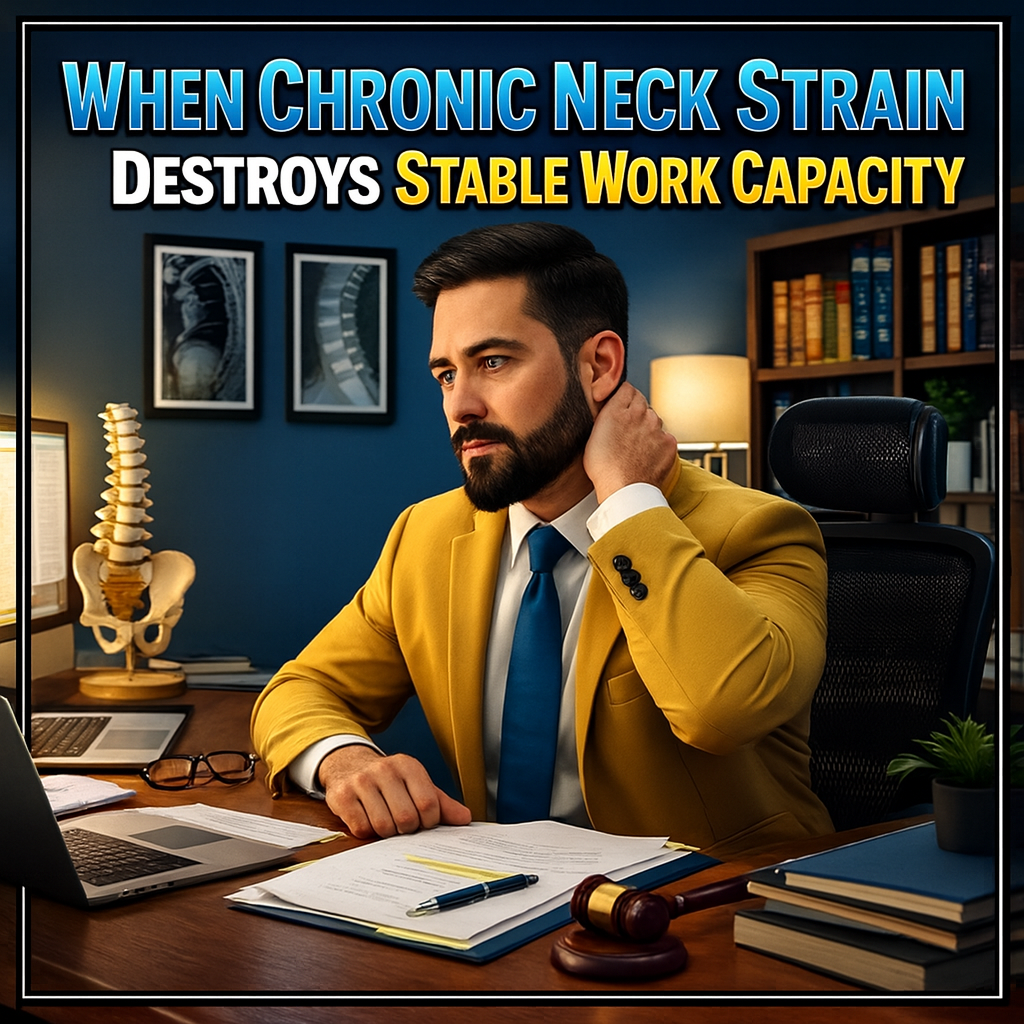
When Chronic Neck Strain Destroys Stable Work Capacity
Persistent neck and upper-back strain can silently erode work capacity, income stability and quality of life if symptoms, treatment and legal protections are not handled in a structured way.
Living with severe chronic neck and upper back strain is very different from having a simple episode of muscle pain after a long day. When the discomfort becomes constant, radiates to the shoulders or arms, limits head movement and makes it hard to sit, stand or concentrate, the condition starts to affect work, family life and financial security. Many workers try to “push through” for months, only seeking help when the pain is already disabling and documentation is incomplete for insurance or social security benefits.
Understanding chronic neck and upper back strain
Chronic neck and upper back strain usually involves a combination of muscle overload, ligament irritation and poor posture over time. It can be triggered by trauma (such as whiplash after a car accident) or by repetitive tasks, heavy lifting, computer work without ergonomic support, or prolonged use of mobile devices with the neck bent forward.
Typical features of severe chronic neck and upper back strain:
- Persistent pain for more than three months, often daily or almost daily.
- Stiffness and reduced range of motion when turning or tilting the head.
- Pain radiating to shoulders, shoulder blades or arms, sometimes with tingling.
- Headaches starting in the back of the head or upper neck.
- Worsening after desk work, driving, lifting or overhead activities.
- Sleep disturbance, fatigue and difficulty maintaining focus.
Over time, the body adapts with muscle guarding and altered posture, which can increase strain on the spine and surrounding structures. If the person continues working without adjustments, the condition may evolve into a long-term disability situation.
How chronic strain affects work and income
Functional limitations that matter for benefits
For social security and disability programs, the key question is not only the diagnosis, but how the condition limits the ability to perform work-related tasks. Decision makers look carefully at activities such as sitting, standing, lifting, reaching and concentrating.
Functional points that should be clearly described in medical records:
- Maximum time you can sit, stand or walk without needing to change position.
- Weight you can safely lift and carry at waist level and above shoulder level.
- Ability to keep the head in a fixed position (for computer work or driving).
- Frequency of severe pain flares requiring rest breaks or lying down.
- Impact of pain and medication on attention, memory and pace of work.
Two workers with the same MRI result may receive different decisions if one has well-documented limitations and the other has only generic notes such as “neck pain” or “muscle strain”. Detailed functional description is crucial.
Essential medical exams and documentation
Not every case of chronic neck and upper back strain will show dramatic imaging changes, but consistent clinical documentation supports both treatment and legal claims. Helpful elements include:
- Regular clinical notes describing pain intensity, location and evolution over time.
- Physical examination findings: range of motion, muscle spasm, trigger points, neurological signs.
- Imaging, when indicated: X-rays, MRI or CT to rule out fractures, herniated discs or spinal stenosis.
- Reports from physiotherapy, occupational therapy or pain specialists.
- Medication history and response, including side effects such as drowsiness.
Consistency between medical records, patient statements and workplace reports strongly increases the credibility of the case.
Legal and social security perspectives
When chronic strain may qualify for disability benefits
Severe chronic neck and upper back strain can support a claim for temporary or permanent disability benefits when symptoms prevent the person from performing their usual job and from adapting to other reasonable work. Relevant factors include:
- Duration of the condition, usually longer than three to six months despite adequate treatment.
- Objective evidence of limitation in daily activities and work tasks.
- Age, education and work history, especially when the person has only physically demanding experience.
- Need for frequent absences, unscheduled breaks or reduced hours.
In many systems, social security authorities evaluate whether the person can still perform “any suitable work” in the economy, not only their last occupation. Strong documentation showing why even lighter or alternative duties are not feasible is often decisive.
Further reading:
Employer obligations and workplace accommodations
In addition to social security, employment law in many jurisdictions requires employers to consider reasonable accommodations for workers with chronic musculoskeletal conditions. Depending on the country and specific legislation, this may involve:
- Ergonomic adjustments to the workstation, such as adjustable chairs, monitor height and document holders.
- Limiting heavy lifting, repetitive overhead work or prolonged static postures.
- Allowing micro-breaks, task rotation or partial remote work.
- Temporary reassignment to lighter duties while the worker continues treatment.
If the employer ignores medical recommendations, pushes the worker to unsafe tasks or terminates employment without proper assessment, there may be room for legal claims for damages or wrongful dismissal, in addition to disability benefits.
Practical steps to protect health and legal rights
Coordinating medical care and documentation
The first step is to choose a treating physician who takes the condition seriously, documents findings clearly and understands the impact on work. Bringing a short written description of daily limitations to appointments can help the doctor register details that matter later for benefits or legal analysis.
A combination of medication, physiotherapy, posture correction, exercise and sometimes psychological support (for chronic pain coping) is usually recommended. Keeping copies of referrals, test results and rehabilitation plans builds a complete file.
Communicating with employer and insurers
Workers should inform employers and, when applicable, occupational health services about the diagnosis and restrictions early, instead of waiting until the situation becomes critical. Written communication is safer than purely verbal conversation. When insurers or social security request forms, it is important to:
- Describe limitations in concrete terms (for example, “cannot sit more than 20 minutes without changing position”).
- Ensure that forms match the treating physician’s records.
- Attach medical reports that explicitly link the condition to work tasks when appropriate.
Practical examples and models
The following simplified examples show how medical and legal aspects can interact in real cases of severe chronic neck and upper back strain.
Example 1 – Office worker with progressive strain
An administrative assistant develops chronic neck and upper back pain after years of working at a non-ergonomic desk. She can no longer sit for more than 30 minutes, has frequent headaches and needs to lie down during pain peaks. Detailed ergonomic assessment confirms that neck flexion and monitor position contribute to the problem. Her physician documents limitations, recommends restricted hours and regular breaks. The employer provides an ergonomic chair, adjustable monitor and flexible schedule, allowing her to keep working part-time while applying for partial disability benefits.
Example 2 – Warehouse worker unable to continue heavy duties
A warehouse employee with a history of minor neck injuries suffers a new incident while lifting boxes above shoulder level. Pain becomes constant, with radiating symptoms to the arm and documented strength loss. Medical reports indicate that he should avoid lifting more than 5 kg and overhead work. The employer has no suitable light-duty positions. Based on consistent medical evidence, social security recognizes long-term disability, and the worker also negotiates an employment termination agreement with financial compensation.
Example 3 – Self-employed professional and income protection
A self-employed graphic designer experiences severe chronic neck strain related to long hours at the computer. She cannot meet deadlines due to pain and concentration problems. Because she previously purchased private disability insurance and kept good records of treatment and reduced work capacity, the insurer accepts a claim for temporary benefits while she reorganizes her schedule, adopts ergonomic equipment and gradually returns to a sustainable workload.
Common mistakes that weaken claims
- Continuing heavy work for months without medical follow-up, leaving a gap in records.
- Submitting disability forms with vague descriptions such as “pain sometimes limits tasks”.
- Ignoring physiotherapy or rehabilitation plans, suggesting poor treatment adherence.
- Stopping work suddenly without discussing accommodations or alternative duties.
- Relying only on imaging results and neglecting functional limitations in documentation.
- Failing to keep copies of medical reports, test results and employer communications.
Conclusion
Severe chronic neck and upper back strain is not just a physical complaint; it directly affects work capacity, income protection and long-term financial security. Combining consistent medical care, detailed functional documentation, clear communication with employers and careful use of legal and social security mechanisms offers the best chance to control symptoms, preserve employment when possible and secure benefits when continued work is no longer realistic.
Quick guide: severe chronic neck and upper back strain, work and benefits
- 1. Document symptoms early and consistently. Schedule regular medical visits, describe pain intensity, location, flares and how they affect work tasks.
- 2. Request clear work-related restrictions. Ask your doctor to record concrete limitations (sitting, standing, lifting, head position, need for breaks) in written form.
- 3. Adjust your workstation and duties when possible. Discuss ergonomic changes, lighter tasks or flexible schedules with your employer, in writing.
- 4. Follow the full treatment plan. Attend physiotherapy, rehabilitation and recommended exercises; keep all reports and discharge summaries.
- 5. Gather evidence for benefits or disability claims. Organize medical records, test results, treatment history, employer communications and income documents.
- 6. Apply for benefits as soon as work capacity is clearly reduced. Do not wait until financial collapse; seek guidance on social security or private disability procedures.
- 7. Consider legal advice when rights are denied. If benefits are refused or you lose your job despite medical restrictions, consult a lawyer experienced in disability, employment or social security law.
FAQ – severe chronic neck and upper back strain, work and benefits
Can severe chronic neck and upper back strain really qualify for disability benefits?
Yes, in many systems it can, especially when symptoms are persistent, treatment has been tried and documented, and functional limitations prevent you from performing your usual job or adapting to other realistic work. The decision is based on the overall impact on work capacity, not just on the diagnostic label.
Do I need an MRI or other imaging to support my claim?
Imaging can help rule out other conditions and may show degenerative changes, disc problems or structural issues, but decisions rarely depend on one exam alone. Consistent clinical notes, functional limitations, treatment history and specialist reports are often more important than a single MRI finding.
How detailed should my doctor be when describing work restrictions?
The more concrete, the better. Statements like “cannot sit more than 20–30 minutes without changing position”, “should not lift more than 5 kg” or “cannot keep the head flexed for prolonged periods” are more useful than general phrases such as “has neck pain” or “should avoid heavy work”.
What if my employer refuses to adjust my tasks or workstation?
In many jurisdictions, employers must consider reasonable accommodations for workers with health limitations, especially when supported by medical documentation. If they ignore restrictions or pressure you to perform unsafe tasks, you may need to involve occupational health services, unions or a lawyer to evaluate possible violations and remedies.
Can I apply for disability benefits while still working part-time?
In some systems, partial or temporary disability benefits are compatible with reduced work, as long as your reduced capacity and income are properly documented. In others, you may need to stop working or limit earnings to remain eligible. Because rules vary by country and program, specific legal or social security advice is important.
What kind of evidence is most persuasive for social security or insurance?
Decision makers usually value a consistent combination of documents: clinical records over time, specialist reports, test results when indicated, rehabilitation notes, detailed functional restrictions and objective information about your job demands, income and attempts to remain at work with accommodations.
When is it advisable to talk to a lawyer about my situation?
It is generally advisable to seek legal advice if benefits are denied, if you are facing dismissal or pressure to resign despite documented limitations, or if there are complex issues such as occupational disease recognition, workplace accidents or coordination of different benefit systems.
Reference framework – medical, occupational and legal aspects
Although specific rules differ between countries, severe chronic neck and upper back strain is usually evaluated within a structured framework that combines medical evidence, functional assessment and legal criteria. Key areas include:
- National social security and disability legislation. Laws and regulations define criteria for temporary and permanent disability, partial or total incapacity, waiting periods, contribution requirements and review procedures. These norms explain when chronic musculoskeletal conditions may justify benefits.
- Workers’ compensation and occupational disease rules. In cases where neck and upper back strain is linked to work activities, accident-at-work provisions, occupational disease lists and causation standards become relevant, including rules on employer liability and compensation for reduced earning capacity.
- Employment and non-discrimination law. Many systems require employers to consider reasonable accommodations for workers with health limitations and prohibit discrimination based on disability. These rules regulate job retention, task adjustments, termination procedures and protection against unfair dismissal.
- Occupational health and safety regulations. Standards on ergonomic design, manual handling of loads, workstation requirements and prevention of musculoskeletal disorders help define what is considered safe work and may support claims related to inadequate working conditions.
- Professional medical guidelines. Guidelines for the management of chronic neck pain, musculoskeletal disorders and chronic pain syndromes provide clinical criteria for diagnosis, recommended treatments and indications for referrals, rehabilitation and work restrictions.
- Insurance policy terms and conditions. For private disability or income-protection insurance, contractual definitions of “disability”, “own occupation” and “any occupation”, as well as waiting periods and proof-of-loss requirements, are crucial for understanding eligibility and appeals.
In practice, a solid case integrates these elements: clinical documentation aligned with recognized medical guidelines, functional assessment consistent with occupational demands, and legal interpretation based on the applicable social security, employment and insurance rules in the worker’s country.
Final considerations
Severe chronic neck and upper back strain is not limited to occasional discomfort; it can become a long-term condition with deep consequences for work, income and overall well-being. Recognizing the problem early, investing in proper diagnosis and treatment, and carefully documenting functional limitations are essential steps to protect both health and legal rights.
When medical care, workplace accommodations and social security mechanisms are coordinated, many people can stabilize symptoms, maintain some level of work activity or secure appropriate disability protection. On the other hand, ignoring pain, postponing medical visits or relying only on generic notes may weaken future claims and make recovery more difficult. Seeking information, support and professional guidance in time is a strategic decision for anyone facing this type of chronic condition.
Disclaimer – this information does not replace professional advice: This text is for general educational purposes only and does not create a doctor–patient, lawyer–client or any other professional relationship. Each case of neck and upper back strain has specific medical, occupational and legal characteristics that must be evaluated individually. For diagnosis, treatment, assessment of work capacity or analysis of benefits and legal rights, always consult qualified health professionals, social security offices and licensed attorneys in your jurisdiction.