
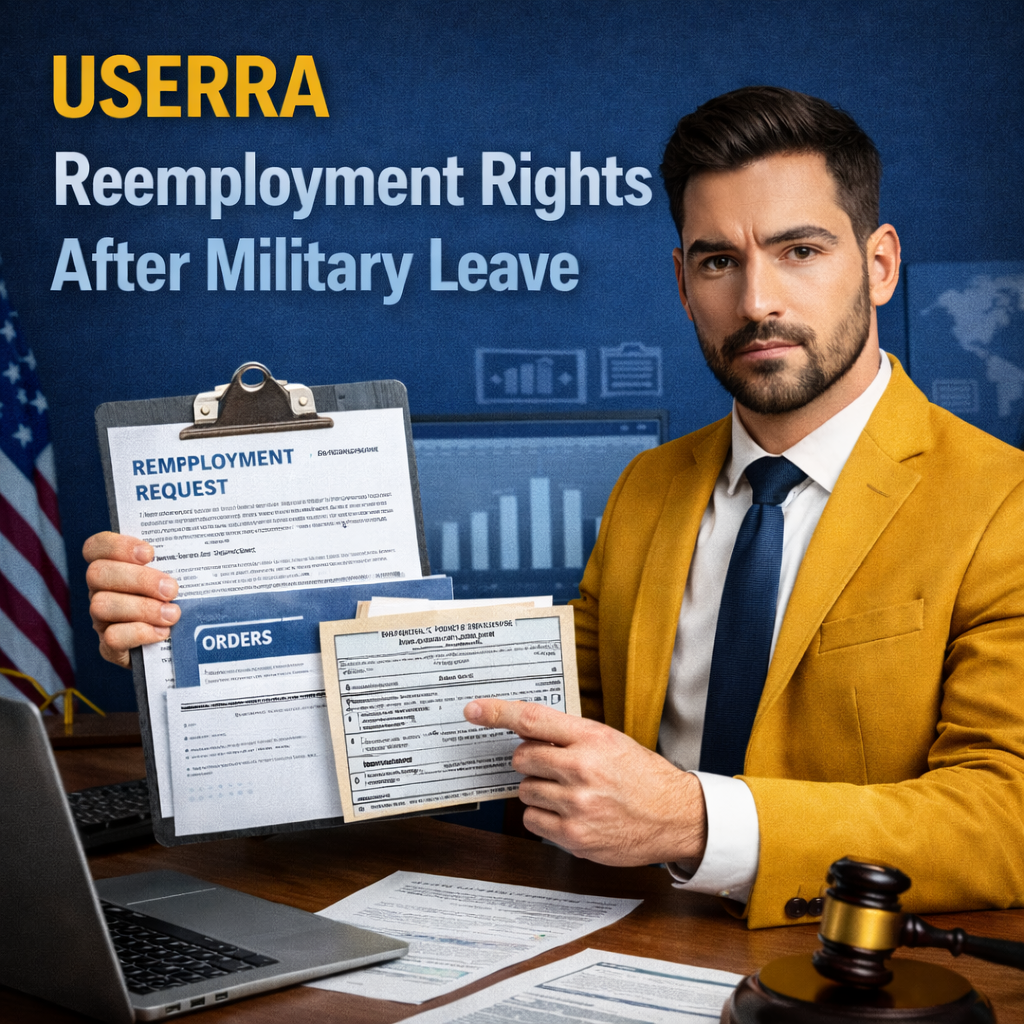
USERRA Reemployment Rights After Military Leave
USERRA rules reduce job-loss uncertainty during service by clarifying notice, deadlines, and reemployment protections.
Military leave can interrupt work plans without warning, and many disputes start with simple misunderstandings about notice, timelines, and what job must be offered upon return.
USERRA creates a federal baseline for reemployment rights, but outcomes often depend on details like the type and length of service, documentation, and how the return-to-work process is handled.
- Missteps on notice or deadlines can delay reemployment and benefits.
- Wrong job placement can trigger pay, seniority, and status disputes.
- Missing documentation may complicate reinstatement or pay adjustments.
- Poor communication can escalate into retaliation or discrimination claims.
Quick guide to USERRA military leave and reemployment rights
- USERRA is a federal law protecting employment and benefits during covered uniformed service.
- Issues usually arise around deployment orders, training, recall, or extended absences from work.
- The main legal area is employment law, including reemployment, benefits, and anti-discrimination protections.
- Ignoring USERRA can create wage exposure, benefit corrections, and reinstatement disputes.
- Basic path: document service, give notice when possible, request reemployment timely, and escalate to agency help or court if needed.
Understanding USERRA military leave and reemployment rights in practice
USERRA generally applies to employees who leave civilian jobs for qualifying uniformed service and then seek to return to work. It protects reemployment, certain benefits, and prohibits discrimination based on military obligations.
In practice, the strongest cases typically show clear service status, reasonable notice when feasible, timely return-to-work requests, and cooperation during the reinstatement process.
- Covered service (active duty, training, National Guard duty under qualifying authority).
- Advance notice when possible, recognizing emergencies can prevent notice.
- Cumulative service limits with key exceptions (for example, certain involuntary service).
- Timely application for reemployment after service ends.
- Character of service that does not disqualify reemployment rights.
- Documented orders and discharge status are frequently decisive.
- Return-to-work timing rules vary by length of service.
- The “escalator” concept drives job placement, seniority, and pay level.
- Benefits and pension credit often require coordinated HR corrections.
- Adverse actions tied to military duty can trigger discrimination exposure.
Legal and practical aspects of USERRA
Reemployment under USERRA generally means being placed as if employment had continued without interruption. This may affect seniority-based pay, promotions, and benefit accrual tied to time in service.
Employers may have obligations to reinstate health coverage options, treat service time as continuous for certain benefit purposes, and avoid penalizing employees for military absences.
Timelines and eligibility depend on the length of service and how the service ends. A return request that is late or unsupported may create disputes even when the underlying service is covered.
- Notice: usually required when feasible, with exceptions for necessity or impossibility.
- Reemployment deadlines: typically shorter for brief service and longer for extended service.
- Job placement rules: the appropriate role depends on the “would-have-attained” position.
- Accommodation: if service-related limitations exist, placement and adjustments may be required.
- Anti-discrimination: actions motivated by service obligations can be unlawful.
Important differences and possible paths in USERRA matters
USERRA problems often differ based on whether the service was short-term training or a longer deployment, and whether the return involves the same job, a higher role, or a comparable position with equivalent seniority and pay.
- Short service: return-to-work timelines can be very tight, so prompt contact matters.
- Long service: job placement may require evaluating promotions or restructuring that occurred.
- Service-related injury: may add accommodation and alternative placement obligations.
- Benefits disputes: health coverage and retirement credit can require retroactive adjustments.
Possible paths include informal resolution with HR, an internal complaint process, or seeking assistance from enforcement channels. Each route requires careful documentation and consistent communication.
When escalation is needed, a structured demand with timelines and supporting records can reduce delays. Litigation may be appropriate in persistent reinstatement, pay, or retaliation disputes.
Practical application of USERRA in real cases
Common scenarios include missed reinstatement deadlines after training, employers placing returning service members into lower-status roles, and confusion about how seniority and pay should be calculated after months away.
Further reading:
Employees most often affected include reservists, National Guard members, and workers in roles where promotions, bidding systems, or seniority ladders change quickly during an absence.
Helpful documents usually include service orders, dates of service, discharge or release paperwork, communications about notice, payroll history, job descriptions, and benefit plan materials.
- Collect orders, service dates, and any separation or release documents.
- Compile work records: pay stubs, role history, seniority lists, and benefits information.
- Submit a clear reemployment request in writing and keep proof of delivery.
- Track deadlines and respond promptly to reasonable employer requests for information.
- If placement or pay is disputed, request a written explanation and escalate through appropriate channels.
Technical details and relevant updates
USERRA is a federal statute with implementing regulations and guidance that shape how deadlines, job placement, and benefits must be handled. Employers often rely on HR policies, but internal policy cannot narrow federal protections.
Reemployment timing rules vary with service duration, and the “escalator” placement analysis can be fact-intensive when the workplace reorganized during service.
Higher courts regularly emphasize that USERRA should be interpreted broadly to protect service members, while still requiring the claimant to meet basic eligibility and timing requirements.
- Confirm the length of service period used for reemployment timing.
- Review whether service qualifies for exceptions to cumulative service limits.
- Check benefit plan rules for service-related pension credit and contributions.
- Document any adverse employment action occurring close to service events.
Practical examples of USERRA
Example 1 (more detailed): A reservist leaves for an eight-month activation and gives written notice and orders to HR. During the absence, the employer restructures the department and creates a higher-level role that most peers reached through seniority. On return, the employee is placed into a lower role with reduced premium pay. The employee requests reemployment in writing, provides service release paperwork, and asks for an explanation of placement. The employer reviews seniority progression, compares similarly situated employees, and adjusts placement and pay to match the position the employee likely would have attained, updating benefits and wage records accordingly.
Example 2 (shorter): An employee returns from a two-week training and is told the job is no longer available. The employee provides training orders and a prompt return request, then asks for reinstatement and confirmation of benefits continuity. The dispute centers on improper denial of reemployment and can be addressed through HR correction or enforcement support if not resolved.
Common mistakes in USERRA matters
- Failing to request reemployment within the applicable timeline after service ends.
- Relying on verbal notice only, without preserving written proof and dates.
- Accepting a lower role without documenting objections to placement or pay.
- Not collecting orders, release paperwork, and service dates early.
- Ignoring benefit plan details that require elections or retroactive corrections.
- Escalating without a clear record of communications and employer responses.
FAQ about USERRA
What does USERRA protect when someone leaves for military service?
USERRA generally protects reemployment, certain benefits continuity, and prohibits discrimination due to military obligations. The protections depend on covered service, timing, and discharge status. Documentation and a timely return request are often key to avoiding delays.
Who most often faces problems under USERRA rules?
Reservists and National Guard members commonly face issues when service overlaps with promotions, reorganizations, or seniority-based pay systems. Disputes also arise when employers misunderstand deadlines or treat military absences like ordinary leave. Consistent records help clarify the correct outcome.
What documents matter most if reemployment is denied or delayed?
Orders, dates of service, and release or discharge paperwork are usually central. Written notice and return-to-work requests, job descriptions, seniority records, and pay history also help establish the appropriate job placement and pay level. Keeping copies of emails and letters can reduce factual disputes.
Legal basis and case law
The primary legal foundation is the Uniformed Services Employment and Reemployment Rights Act (USERRA), which sets federal standards for reemployment, benefits, and anti-discrimination protections for covered service. Regulations and agency guidance further explain timing rules, job placement concepts, and benefit treatment.
In practice, courts often apply USERRA broadly to protect service members, focusing on whether eligibility requirements were met and whether the employer’s actions undermined reemployment or penalized military service. Courts commonly examine timing, documentation, job placement logic, and evidence of improper motivation.
When disputes involve reinstatement, pay, or retaliation, case outcomes frequently turn on factual records: notices given, dates, communications, and the employer’s stated reasons for decisions.
Final considerations
USERRA questions often arise from uncertainty about deadlines, documentation, and what job and pay level should apply after a service-related absence. Clear records and prompt communication tend to prevent avoidable disputes.
Practical precautions include preserving orders and service paperwork, requesting reemployment in writing, tracking timelines, and documenting job placement discussions and benefit corrections in a consistent file.
- Keep a single timeline with service dates and all employer communications.
- Confirm reemployment requests and responses in writing whenever possible.
- Seek qualified guidance if reinstatement, pay, or benefits remain unresolved.
This content is for informational purposes only and does not replace individualized analysis of the specific case by an attorney or qualified professional.