
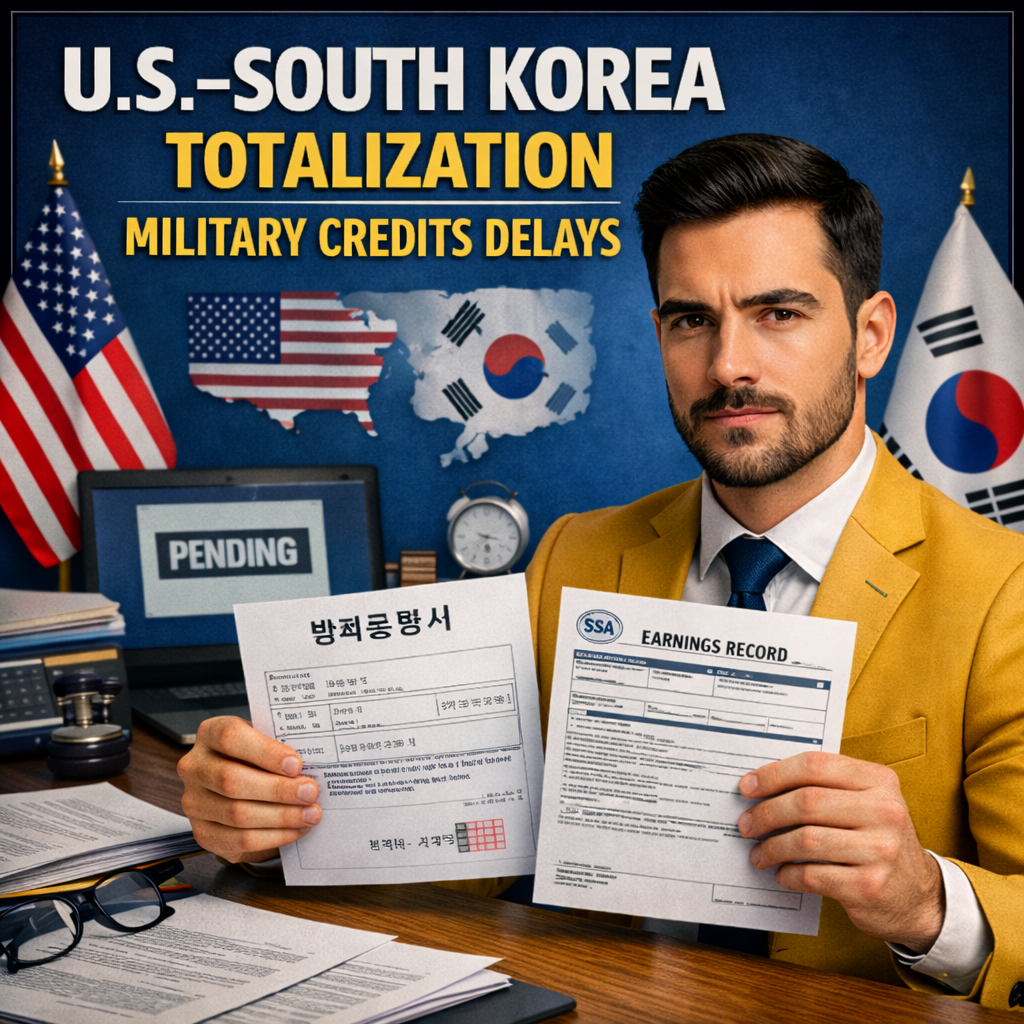
U.S.–South Korea totalization military credits delays
Military service credits can shift totalization eligibility, but only if records match across U.S. SSA and Korea’s pension system.
When work histories span the United States and South Korea, totalization can help bridge missing coverage months so a retirement or disability claim can move forward.
Military service credits add another layer: a credited period in one system may support eligibility, but it can also create confusion if the credited months are not reflected the same way in the other country’s recordkeeping.
- Coverage gaps that block minimum eligibility even with long careers
- Military credits shown in Korea but not accepted as “coverage” by SSA
- Delays caused by missing service documentation or name/ID mismatches
- Overlapping periods that require careful coordination to avoid errors
Quick guide to U.S.–South Korea totalization and military service credits
- Totalization coordinates U.S. Social Security and Korea’s pension coverage to help meet minimum eligibility thresholds.
- Issues usually appear when a claimant is short of U.S. quarters of coverage or short of Korea’s qualifying coverage period.
- The main legal area involves international social insurance coordination and administrative benefit claims.
- Ignoring coordination can lead to avoidable denials, payment delays, or incorrect calculations based on incomplete records.
- A practical path is to request records from both systems, file through the appropriate agency, and pursue administrative review if needed.
Understanding U.S.–South Korea totalization in practice
Totalization agreements do not merge two pensions into one. Instead, they help a person qualify by counting coverage periods from each country when local minimum requirements are not met.
Military service credits matter because they can appear as “credited coverage” in Korea, while the U.S. system generally relies on earnings-based quarters of coverage and specific military wage credit rules within SSA.
- Eligibility coordination: foreign coverage may be used to satisfy minimum eligibility thresholds.
- Separate benefit payments: each country pays its own benefit under its own calculation rules.
- Document-driven verification: agencies rely on official statements, certified records, and cross-checks.
- Timing differences: credited periods may post later, requiring follow-up before adjudication completes.
- Military credits can support Korea-side qualifying coverage, but SSA may treat them differently than earnings-based quarters.
- Mismatch in names, dates of birth, or national ID numbers is a frequent source of stalled verification.
- Overlapping timelines (work + credited service) may require clarification to prevent double-counting assumptions.
- Proof of service and pension statements usually carry more weight than informal employer letters.
- Filing through the “right door” (SSA or Korea’s liaison) often reduces back-and-forth requests.
Legal and practical aspects of military service credit interactions
South Korea may recognize certain military service periods as credited coverage for pension purposes, subject to local rules, eligibility criteria, and record confirmation. Those credits can be meaningful for meeting Korea-side minimum coverage.
In the U.S., SSA primarily uses earnings records to establish quarters of coverage, and military-related crediting follows SSA’s own statutory framework. A foreign military credit is not automatically a U.S. quarter of coverage, even if it helps on the Korea side.
In practice, totalization coordination often centers on whether the claimant is eligible to use Korea coverage to satisfy SSA’s minimum requirements for a totalized benefit, and whether Korea recognizes the claimant’s credited service in its own qualifying period.
- Confirm the coverage period record on each side (SSA earnings record; Korea pension coverage statement).
- Identify the credited military period shown in Korea’s record and the supporting service certificate.
- Check for record consistency (spelling, prior names, passport history, alien number, Korean ID).
- Track agency requests for additional evidence and respond within stated deadlines.
Important differences and possible paths in U.S.–South Korea coordination
One key difference is that totalization helps with minimum eligibility, while the amount paid is still calculated under each country’s separate rules. A person can qualify for a partial payment from one or both systems depending on the coverage history and local law.
Another difference is that Korea-side credited military service may be treated as qualifying coverage in Korea, while SSA’s eligibility determination relies on a specific definition of U.S. coverage and totalization rules. That difference is often the core reason a case needs careful documentation.
- Administrative coordination path: file through SSA (or the Korea liaison) and allow agencies to exchange records.
- Reconsideration/appeal path: request review if a decision appears based on incomplete foreign coverage or missing military credit proof.
- Settlement/clarification path: submit corrected identity records and official service documents to resolve discrepancies without litigation.
Practical application of totalization in real cases
These issues commonly arise when a worker has a U.S. career that is “almost enough” for SSA eligibility, plus a Korea history that includes insured work and a military service credit period. The claim may stall until the foreign record exchange is complete.
People most affected include immigrants who worked in both countries, U.S. citizens who spent early career years in Korea, and individuals who served in Korea’s military and later built earnings in the U.S. Self-employed individuals can also face record gaps if contributions were irregular.
Further reading:
Relevant documentation typically includes SSA earnings history, Korea pension coverage statements, military service certificates, identity documents, and any official correspondence showing credited periods or corrections.
- Gather identity documents and both systems’ coverage statements (SSA earnings record; Korea pension record).
- Obtain official proof of military service and any documentation showing credited coverage posted in Korea.
- File the claim through SSA or the designated liaison channel and clearly disclose both-country work history.
- Monitor deadlines, respond to evidence requests, and keep copies of all submissions and receipts.
- If denied or delayed based on missing periods, request administrative review and submit targeted corrections (IDs, dates, credited months).
Technical details and relevant updates
Totalization determinations depend on record exchange and verification. Even when eligibility is straightforward, processing can slow down if the agencies need to reconcile credited periods, verify identity, or confirm the timing of coverage.
Military service credit rules are especially sensitive to documentation quality. A case may hinge on whether the credited period is officially posted in Korea’s pension record and whether SSA can confirm the foreign coverage period for totalization purposes.
Agency guidance and forms can change over time, and some claimants may need updated statements (recent pension record printouts) if earlier documents do not show the final credited period posting.
- Verify that the pension record reflects the credited military period as posted, not just applied for.
- Check whether translations or certified copies are required for service documentation.
- Confirm that the claimed dates align with immigration history and employment timelines.
- Keep evidence of submissions and follow-up requests to reduce repeated document cycles.
Practical examples of military credit interactions
Example 1 (more detailed): A claimant worked 7 years in the U.S. and previously contributed to Korea’s pension system. The claimant’s Korea record shows a credited military service period that increases the total qualifying period under Korea rules. The U.S. claim is filed and initially stalled because the foreign coverage confirmation arrives without the updated credited months. The claimant submits a newer Korea pension statement plus an official service certificate and identity matching documents (prior passport, name spelling consistency). After record exchange updates, SSA completes the totalization eligibility analysis and the Korea-side agency proceeds with its own benefit review, with each side paying under its own rules.
Example 2 (shorter): A claimant’s Korea military credit is recognized locally, but SSA’s decision letter reflects only U.S. quarters. The claimant requests reconsideration, attaches the foreign coverage confirmation, and provides an updated Korea pension record showing the credited period posting date, allowing the agency to re-check the totalization eligibility threshold.
Common mistakes in military service credit coordination
- Submitting informal service proof instead of an official military service certificate or registry document
- Assuming a Korea military credit automatically creates U.S. quarters of coverage
- Filing without recent Korea pension statements that show the credited period as posted
- Ignoring name/ID inconsistencies (spacing, romanization changes, prior legal names)
- Missing agency deadlines for additional evidence requests
- Not keeping copies and submission confirmations, making follow-up harder
FAQ about U.S.–South Korea military credit interactions
Does Korean military service credit count as U.S. Social Security coverage?
Not automatically. Korea’s credited military period may support Korea-side qualifying coverage, while SSA relies on its own coverage rules. Under totalization, Korea coverage can help meet eligibility thresholds, but it does not usually convert into U.S. quarters as if it were U.S. earnings.
Who is most affected by military credit issues in totalization cases?
People with split careers who are short of minimum coverage in one system are most affected. This includes individuals who served in Korea’s military and later worked in the U.S., especially when records are incomplete, outdated, or inconsistent across identities and timelines.
What documents help when a claim is delayed or denied?
Strong documentation usually includes an updated Korea pension record showing the credited period posted, an official military service certificate, SSA earnings history, and consistent identity documents. If a decision appears based on missing periods, a reconsideration request with targeted corrections is typically the next step.
Legal basis and case law
The legal foundation typically includes the U.S.–South Korea totalization agreement and its implementing arrangements, which authorize the coordination of coverage periods to meet minimum eligibility requirements while keeping benefit calculations separate under each country’s law.
On the U.S. side, SSA administers totalization claims under federal statutes and regulations governing insured status and international agreements, using official earnings records and verified foreign coverage confirmations. On the Korea side, the National Pension framework and administrative rules govern how credited military service is recognized and posted to the pension record.
Disputes are commonly handled through administrative review channels rather than courtroom litigation. When cases reach courts, outcomes often turn on whether agencies followed their procedures, used substantial evidence, and correctly applied the agreement’s coordination rules to the documented coverage periods.
Final considerations
Military service credits can be decisive in a U.S.–South Korea totalization case, but only when the credited period is properly documented and reflected in official pension records. The main practical challenge is that each system recognizes coverage in its own way.
Strong outcomes depend on clean record matching, updated coverage statements, and timely responses to agency evidence requests. When eligibility is close, small documentation gaps can create long delays that are often preventable with organized filings.
This content is for informational purposes only and does not replace individualized analysis of the specific case by an attorney or qualified professional.