
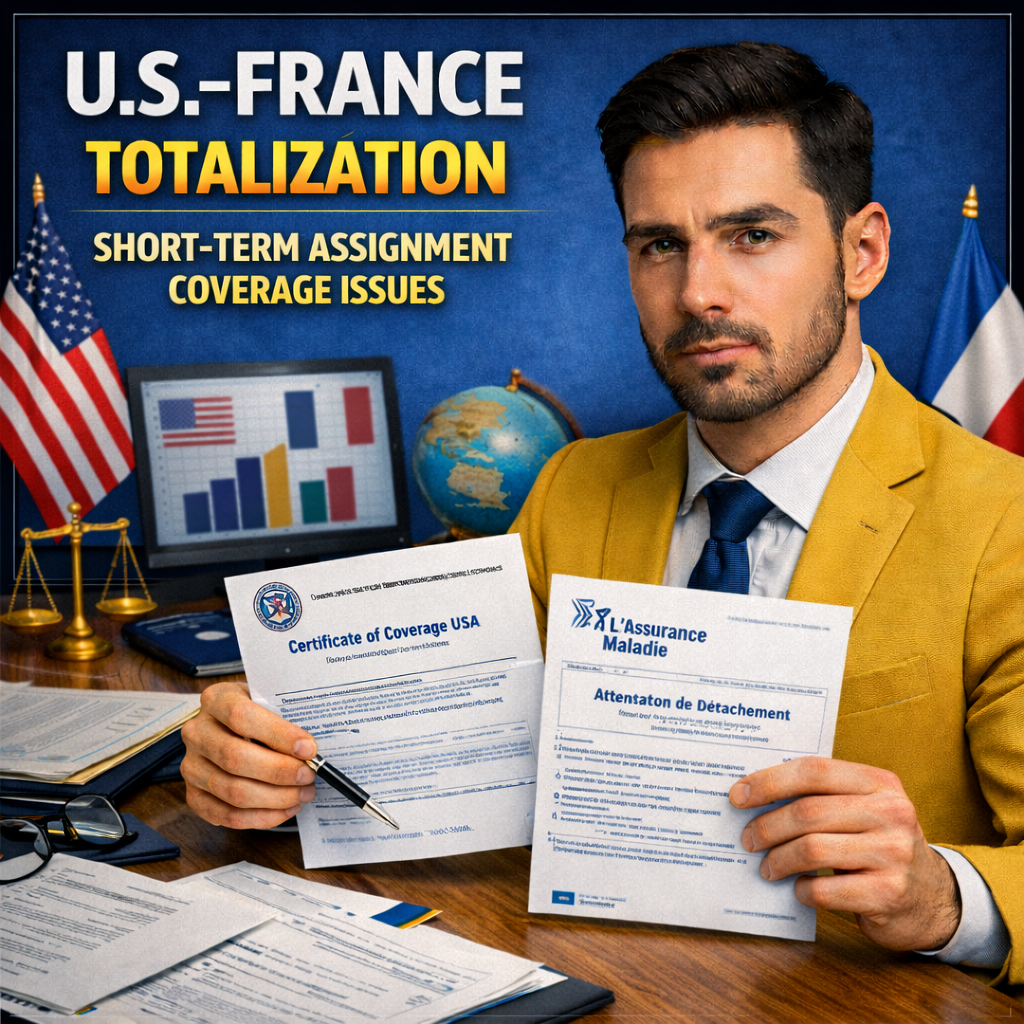
U.S.–France totalization short-term assignment coverage issues
Short-term U.S.–France assignments can trigger double payroll charges unless coverage is documented correctly.
Short-term cross-border assignments often look simple on paper, but payroll withholding can become messy when two systems claim coverage at the same time.
In U.S.–France scenarios, the key is understanding which country’s social security applies during the assignment, and how to document that status to prevent duplicate contributions.
- Payroll deductions in both countries for the same work period
- Missing or late coverage certificates delaying employer compliance
- Incorrect worker classification undermining assignment planning
- Benefit eligibility gaps when contributions are misallocated
Quick guide to U.S.–France totalization for short-term assignments
- Totalization coordinates social security coverage to limit duplicate contributions and preserve benefit eligibility.
- Problems usually arise when a worker is temporarily assigned across borders and payroll runs in both systems.
- The main legal area involves international social security coordination, payroll compliance, and certificate-based coverage rules.
- Ignoring coverage documentation can lead to double deductions, employer exposure, and later benefit delays.
- Typical path: confirm assignment facts, request a coverage certificate, align payroll withholding, and appeal/adjust if denied.
Understanding U.S.–France totalization for short-term assignments in practice
Totalization agreements aim to coordinate coverage when a worker’s career or assignment crosses borders, so the same period is not charged twice.
For short-term assignments, the central issue is determining which country’s system applies during the temporary posting and documenting it for payroll and compliance.
- Where the employee is physically working during the assignment
- Whether the employer remains the same and where it is established
- Expected assignment duration and whether it is truly temporary
- Whether the worker is employed or self-employed for the relevant period
- Whether any extension or successive assignments are planned
- Certificate timing is decisive for avoiding duplicate payroll charges
- Assignment duration and continuity are frequently scrutinized
- Worker classification affects which coverage pathway applies
- Payroll needs consistent documentation across HR, tax, and compliance teams
- Denials often stem from incomplete facts or mismatched employer details
Legal and practical aspects of U.S.–France short-term assignment coverage
In practice, agencies and payroll teams look for a coherent narrative supported by records: the assignment is temporary, the employment relationship is stable, and the request matches real working conditions.
Coverage documentation is typically used to support a request that one country’s system continues to apply for a limited period while the worker is physically abroad.
- Clear assignment letter or contract showing expected duration and location
- Proof of continued employment relationship and payroll structure
- Employer identifiers and establishment details consistent across filings
- Evidence that the work arrangement is temporary rather than an indefinite relocation
- Records showing start date, end date, and any extension request history
Important differences and possible paths in U.S.–France short-term assignment cases
Short-term arrangements can differ significantly depending on whether the worker is posted by an employer, hired locally, or operating as self-employed while crossing borders.
Common paths include: an administrative certificate request to align payroll coverage, a correction process for duplicate withholdings, and a formal review/appeal if a request is denied or misapplied.
- Administrative alignment: request coverage confirmation and adjust payroll withholding prospectively.
- Retroactive correction: seek refunds or adjustments if duplicate contributions were collected for the same period.
- Review/appeal: challenge denials by correcting factual gaps and submitting stronger supporting documentation.
Practical application of U.S.–France short-term assignment rules in real cases
These issues most often appear when an employee is sent abroad on a defined project, a training rotation, or a client engagement that lasts months rather than years.
They also arise when payroll teams in two countries are operating independently, or when the assignment changes midstream and the documentation is not updated to match the new timeline.
Useful documentation usually includes assignment letters, payroll records, HR confirmations, travel/entry records when relevant, and any prior coverage certificates or agency correspondence.
Further reading:
- Gather core facts: assignment dates, work location, employer details, worker status, and payroll flow.
- Collect documents: assignment letter, employment verification, payroll summaries, and prior coverage records.
- Submit the coverage certificate request through the appropriate administrative channel.
- Align payroll withholding based on the coverage decision and keep records consistent across teams.
- Monitor deadlines and respond quickly to requests for additional information; seek review if denied.
Technical details and relevant updates
Short-term assignment coverage often hinges on whether the posting is temporary in substance, not just in wording, and whether the worker remains attached to the home employer.
When assignments are extended, documentation typically needs to be updated promptly to avoid gaps where both systems treat the worker as covered.
Agencies may focus on consistency: employer identity across forms, accurate dates, and a clear explanation for any changes to the assignment plan.
- Verify that assignment dates match payroll periods and HR records
- Document extensions before the original period expires when possible
- Keep employer establishment details consistent across submissions
- Track certificate issuance and distribute it to payroll and compliance teams
Practical examples of U.S.–France short-term assignment coverage
Example 1 (more detailed): A U.S.-based employee is assigned to France for a 10-month client project. HR issues an assignment letter, payroll continues in the U.S., and a coverage certificate request is filed early with consistent employer details. The certificate is issued and shared with French payroll/compliance partners, preventing duplicate payroll deductions. When the project extends by 2 months, the employer submits an extension request with updated dates and supporting documentation, reducing the chance of a coverage interruption.
Example 2 (shorter): A worker arrives in France for a “short-term” role, but the local team treats it as an indefinite relocation and starts local payroll deductions. The employer later provides corrected assignment documentation and seeks administrative alignment to clarify which system applies for the defined period, then pursues correction for duplicate deductions already taken.
Common mistakes in U.S.–France short-term assignment coverage
- Requesting coverage documentation after payroll has already been withheld in both countries
- Inconsistent employer identifiers or establishment details across forms and letters
- Using vague assignment dates that do not match payroll periods
- Misclassifying the worker’s status (employee vs self-employed) for the relevant period
- Failing to update documentation when an assignment is extended or restructured
- Keeping certificates and agency communications siloed from payroll teams
FAQ about U.S.–France totalization for short-term assignments
What is a totalization agreement in short-term assignment situations?
It is a coordination framework used to determine which country’s social security system applies for a defined period when work crosses borders. For short-term assignments, it is often used to document continued coverage under one system and avoid duplicate contributions. The exact outcome depends on assignment facts and documentation.
Who is most affected by U.S.–France short-term assignment coverage issues?
Employees posted abroad on defined projects, employers running cross-border payroll, and workers whose assignments change midstream are frequently affected. Problems are common when coverage documents are delayed or inconsistent. Misalignment can also affect benefit timelines later.
Which documents are usually needed, and what if a coverage request is denied?
Typical documents include an assignment letter, employment verification, payroll summaries, and consistent employer identifiers, plus any prior certificates or agency messages. If denied, the next step is usually to identify what facts were missing or inconsistent, correct the record, and submit a review or updated request with clearer supporting evidence.
Legal basis and case law
The main legal foundation is the U.S.–France social security coordination framework, which allocates coverage for cross-border work and supports certificate-based documentation for temporary postings.
In practice, administrative guidance and agency determinations focus on assignment reality, continuity of the employment relationship, and consistency of documents across payroll and compliance records.
When disputes reach review processes, prevailing approaches tend to emphasize objective records: dates, employer status, worker classification, and whether the assignment was temporary rather than indefinite.
Final considerations
Short-term U.S.–France assignments can create serious payroll confusion when coverage is not determined and documented early, especially when multiple teams handle compliance independently.
Clear assignment documentation, timely certificate requests, and consistent records across HR and payroll are the most practical safeguards to prevent duplicate contributions and later benefit delays.
This content is for informational purposes only and does not replace individualized analysis of the specific case by an attorney or qualified professional.