
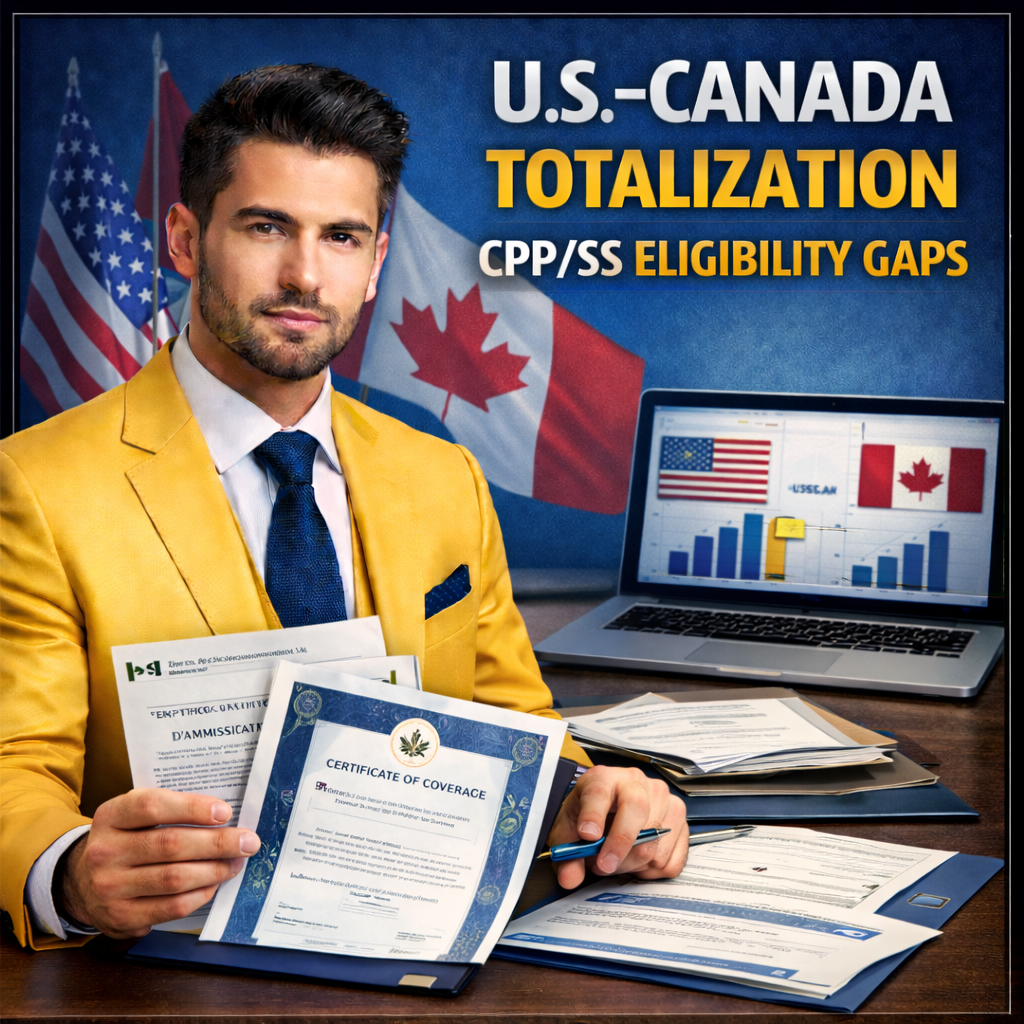
U.S.–Canada totalization CPP/SS eligibility gaps
U.S.–Canada totalization helps coordinate CPP and Social Security to avoid double contributions and close eligibility gaps.
Cross-border work between the United States and Canada can create two frustrating outcomes at once: contributions may be paid into the “wrong” system for an assignment, and a person may end up short of the minimum coverage needed to qualify for monthly retirement or disability benefits in either country.
U.S.–Canada totalization: CPP/SS coordination and coverage certificates is the practical framework used to reduce duplicate social security taxation in many temporary work setups and to help meet minimum eligibility by combining coverage periods, while each country still pays benefits under its own rules.
- Dual withholding can happen when payroll is set up without a coverage certificate.
- Eligibility shortfalls can occur after years split between two systems.
- Missing paperwork can delay benefit actions and lead to repeat requests.
- Unclear timelines make it harder to correct past contribution decisions.
Quick guide to U.S.–Canada totalization and coverage certificates
- What it is: a coordination agreement between the U.S. Social Security system and Canada’s pension system (CPP and, where applicable, Quebec’s plan).
- When it usually arises: temporary assignments, cross-border remote work, commuters, and careers split between both countries.
- Main legal area: payroll compliance, social insurance coordination, and benefit eligibility administration.
- What goes wrong if ignored: duplicate contributions, delayed corrections, and failure to meet minimum coverage rules.
- Basic path: confirm which system should cover the work, obtain the coverage certificate early, and preserve contribution evidence for future claims.
Understanding U.S.–Canada totalization in practice
Totalization agreements are usually built around two practical mechanisms. The first is coverage coordination, which aims to keep a worker covered by only one country’s social security system for a given period, when the agreement’s conditions are met. The second is benefit coordination, which may allow coverage periods to be combined to meet minimum eligibility thresholds.
This means a person can avoid paying into two systems for the same work in many temporary cross-border situations, and later—if eligible—use combined coverage to qualify for a benefit that would otherwise be denied due to insufficient credits in one country alone. Importantly, totalization does not merge the two systems into one benefit. Each country generally pays only the portion tied to coverage under its own system.
- Coverage coordination focuses on where contributions are owed for current work.
- Certificates are the practical proof used to support an exemption from the other country’s contributions.
- Benefit coordination focuses on meeting minimum eligibility using combined coverage.
- Payment calculations typically remain country-specific and proportional to credited coverage.
- Documentation is central: payroll records, assignment letters, and contribution histories.
- Request early: coverage certificates are most useful when obtained before payroll cycles compound errors.
- Stay consistent: names, dates of birth, and identifiers should match across records.
- Keep the timeline: start date, end date, employer, and work location details matter.
- Plan for claims: preserve contribution statements to support eligibility review later.
- Expect two decisions: one on coverage for the work period and another on benefit eligibility.
Legal and practical aspects of CPP/SS coordination
Coverage rules often turn on the worker’s status (employee vs. self-employed), the employer’s home country, the location where services are performed, and whether the assignment is temporary. In many cases, the agreement’s framework aims to keep the worker under the home system during a qualifying temporary posting.
When a certificate is obtained, it is typically used to show that contributions should remain in one system and that the other system’s contributions do not apply for the covered period. In practice, this can protect employers and workers during audits, payroll reviews, and benefit record clean-up efforts.
- Employee assignments usually rely on employer documentation and a defined posting period.
- Self-employment often requires extra care because coverage determinations can differ by system.
- Split duties across borders can complicate the “where the work is performed” analysis.
- Record correction is easier when certificates and payroll evidence are preserved.
Important differences and possible paths in CPP/SS totalization
It is common to mix up two different objectives: (1) preventing duplicate contributions during an active assignment and (2) combining coverage for a benefit claim years later. The first is primarily a payroll compliance matter; the second is primarily an eligibility matter.
- Compliance path: obtain the coverage certificate, align payroll settings, and keep the supporting file.
- Claim path: compile contribution histories from both countries and request combined coverage evaluation when eligible.
- Correction path: document the contribution overlap and request adjustments using official coverage evidence.
Practical application of CPP/SS coordination in real cases
Typical situations include U.S. companies sending employees to Canada for a multi-month or multi-year project, Canadian employers posting staff to the U.S., and individuals who changed residence and worked for multiple employers across both countries. People closest to retirement age and those facing disability applications often feel the impact of coverage gaps most strongly.
Useful documents tend to be predictable: assignment letters, payroll statements, work location records, proof of residence when relevant to administration, and contribution statements from each system. For claim preparation, having a unified timeline of employment and contributions reduces follow-up requests.
- Map the work pattern: dates, location(s), employer, and worker status.
- Confirm the intended coverage: determine which system should cover the assignment period.
- Request the certificate: obtain the coverage certificate using the official route for the responsible institution.
- Align payroll execution: ensure withholdings match the coverage position and preserve proof.
- Build the claim file: keep contribution histories and the certificate for future eligibility review.
Technical details and relevant updates
In practice, the administrative side matters as much as the legal concept. Certificates often require specific information such as employer details, the worker’s identity information, assignment dates, and where work will be performed. Errors in dates, names, or status can lead to delays or the need to re-file.
Many processing slowdowns come from incomplete packets or unreadable attachments. Clean scans, consistent identifiers, and a concise request message often produce faster routing and fewer repeat requests, especially when the case involves both payroll compliance and future benefits planning.
Further reading:
- Identity consistency: match spelling and names across passports, payroll, and system records.
- Readable documentation: keep PDFs legible and avoid cutting off pages or signatures.
- Defined posting period: clear start/end dates strengthen coverage determinations.
- Single source of truth: maintain one folder with certificate, payroll, and contribution history.
Practical examples of U.S.–Canada totalization
Example 1 (more detailed): A U.S. engineering firm assigns an employee to Ontario for 18 months. Payroll initially withholds in both systems because the assignment documentation was incomplete. The employer later obtains a coverage certificate supporting home-system coverage for the posting, then uses the certificate and payroll records to support corrections. The file also becomes useful later if the employee needs proof of coverage periods for eligibility review.
Example 2 (shorter): A dual-resident worker spent years in Canada contributing to CPP and later worked in the U.S. but did not reach the minimum credits for a U.S. benefit. When approaching retirement age, the worker gathers both contribution histories and requests combined coverage evaluation to meet minimum eligibility requirements, with each country paying under its own rules if approved.
Common mistakes in CPP/SS coordination
- Waiting until after the assignment begins to request a certificate, allowing duplicate withholdings to accumulate.
- Using inconsistent names or identifiers across payroll and contribution records.
- Assuming combined coverage means a single blended payment rather than separate country calculations.
- Failing to keep assignment letters and work-location evidence that supports coverage determinations.
- Submitting unreadable scans or incomplete documents, leading to repeated follow-ups.
- Delaying record gathering until retirement, when older contribution proof is harder to obtain.
FAQ about U.S.–Canada totalization
Does totalization create one combined CPP and Social Security payment?
No. Totalization generally helps meet minimum eligibility by combining coverage periods, but each country typically pays benefits based on coverage credited under its own system and calculation rules, often producing proportional results.
Who benefits most from coverage certificates?
Employees on temporary cross-border assignments and the employers running payroll are commonly the most impacted. Certificates can reduce duplicate withholdings and provide clear evidence for payroll compliance and later record corrections.
What documents should be prepared before contacting the competent institution?
Basic identity details, employer information, assignment start and end dates, work location, and proof of worker status (employee or self-employed). Keeping payroll statements and contribution histories in a single file supports both compliance and future eligibility review.
Legal basis and case law
The legal foundation is the bilateral social security agreement that coordinates coverage and benefits between the U.S. Social Security system and Canada’s pension system. In practice, the agreement is implemented through administrative procedures that define how coverage is determined, how certificates are issued, and how coverage periods can be used to meet minimum eligibility thresholds.
When disputes arise, decision-makers typically focus on the facts that prove coverage: where the work was performed, who the employer is, the assignment duration, and whether official coverage evidence supports single-system contributions during the period in question. For benefit eligibility, the recurring focus is whether certified coverage periods satisfy minimum thresholds without double-counting overlapping periods.
Because outcomes depend heavily on the specific work pattern and documentation quality, the most reliable strategy is building a clear record from the start: certificate requests, assignment letters, payroll proof, and contribution histories preserved in an organized timeline.
Final considerations
U.S.–Canada totalization CPP/SS coordination and coverage certificates is most effective when treated as a planning workflow rather than a last-minute rescue. Early decisions about coverage, plus a clean documentation file, can prevent duplicate contributions and reduce delays when benefit eligibility is evaluated later.
A simple approach tends to work best: confirm which system should cover the assignment, request the certificate early, align payroll, and keep contribution histories. This supports corrections if mistakes occur and helps close eligibility gaps when a claim depends on combined coverage.
This content is for informational purposes only and does not replace individualized analysis of the specific case by an attorney or qualified professional.