
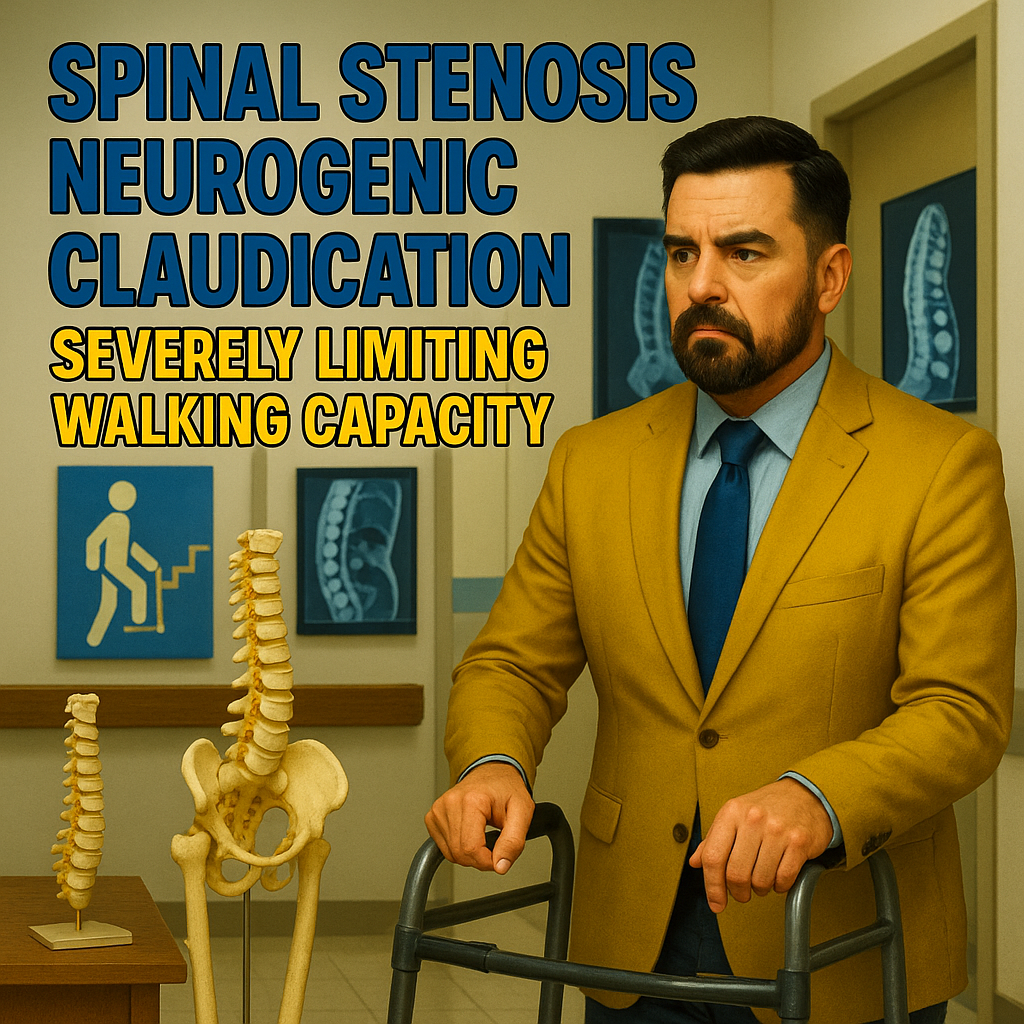
Spinal Stenosis Neurogenic Claudication Severely Limiting Walking Capacity
Spinal stenosis with neurogenic claudication can severely limit walking and standing, and clear documentation may support disability or income-support benefits.
Spinal stenosis with neurogenic claudication is a common reason why people who once walked for hours can now barely cross a parking lot. The combination of narrowed spinal canals and nerve crowding leads to leg pain, heaviness and weakness that are directly triggered by walking or standing and relieved by sitting or bending forward. Because these limitations affect mobility, independence and work capacity, the condition appears frequently in disability, workers’ compensation and long-term insurance claims.
Understanding spinal stenosis and neurogenic claudication
What spinal stenosis actually means
Spinal stenosis describes a structural narrowing of the spinal canal, lateral recesses or neural foramina. Most cases in older adults are degenerative: discs lose height, ligaments thicken and facet joints enlarge, gradually reducing the space available for nerve roots. The lumbar spine is most often affected, which explains the typical leg symptoms.
When this narrowing is significant, walking or standing increases pressure on nerves. The result is neurogenic claudication: pain, tingling, heaviness or weakness in the legs that appears with walking and improves when the person sits or bends forward, as when leaning over a shopping cart.
Typical symptom pattern of neurogenic claudication
- Leg pain, burning or tingling triggered by walking or standing.
- Relief within minutes of sitting or flexing the spine forward.
- Limited walking distance that may shrink over time.
- Sensation of leg “heaviness” or weakness, especially downhill.
How doctors diagnose and grade severity
Diagnosis begins with history and physical exam. Clinicians pay attention to how far a person can walk, whether symptoms improve when sitting and whether there are neurological deficits such as reduced sensation, weakness or abnormal reflexes. Imaging — especially MRI — shows the level and extent of canal narrowing and nerve crowding. CT scans and X-rays may complement MRI when bone structures or instability are in question.
Not every imaging abnormality is disabling. Many older adults show stenosis on MRI without major symptoms. For benefit and legal purposes, the key is the combination of documented stenosis and consistent functional limitations, especially in walking and standing.
When spinal stenosis with neurogenic claudication becomes a legal and benefits issue
Impact on work capacity and daily mobility
From a social-security or insurance perspective, spinal stenosis with neurogenic claudication is significant because it can severely reduce the ability to move around reliably. Jobs that require prolonged standing, walking, carrying or climbing become difficult or unsafe. Even sedentary jobs may be affected if the person cannot sit for long without needing frequent breaks or position changes.
Mobility
Walking distance shrinks; frequent stops or seating required.
Work tolerance
Standing jobs, assembly lines and retail positions become hard to sustain.
Safety
Leg weakness and unsteady gait increase fall risk, especially on stairs or uneven ground.
How disability and insurance systems usually analyze this condition
Although wording varies, many legal and administrative frameworks share similar elements when assessing spinal stenosis with neurogenic claudication:
- Objective spinal stenosis: imaging showing reduced canal or foraminal diameter consistent with symptoms.
- Neurogenic pattern: leg symptoms clearly related to standing and walking, relieved by sitting or flexion.
- Functional limitation: strictly limited walking distance, need for frequent rests, and difficulty maintaining a full workday.
- Duration and treatment: impairment that persists despite reasonable conservative care, often with a timeframe of at least 12 months in long-term disability settings.
Where appropriate, systems may also consider whether work exposure — repeated lifting, vibrations, long careers in physically demanding jobs — contributed to the development or worsening of stenosis, which is relevant in workers’ compensation cases.
Further reading:
Building a strong record for benefits and legal protection
Medical documentation: more than just an MRI report
For benefit claims, a simple note saying “lumbar spinal stenosis” is not enough. Helpful documentation usually includes:
- Detailed notes from spine specialists describing the pattern of neurogenic claudication.
- MRI reports explicitly mentioning central canal, lateral recess or foraminal stenosis and levels affected.
- Physical exam findings related to reflexes, strength, sensation and gait.
- Rehabilitation or pain-clinic records describing walking tolerance, use of assistive devices and response to therapy.
Functional documentation: translating pain into measurable limits
Decision-makers focus on what the person can do day after day. For spinal stenosis with neurogenic claudication, functional evidence should answer questions such as:
- How far can the person walk before needing to stop — 50 meters, one block, more?
- How long can they stand in one place before symptom onset — a few minutes or longer?
- Do they need a cane, walker, rail support or frequent seating opportunities?
- How often do they need to lie down or sit during a typical day?
- How do these limitations affect grocery shopping, housework, commuting and work tasks?
Practical steps for organizing a benefit claim
- Create a simple diary of walking distance, rest breaks and pain levels for several weeks.
- Ask your doctor to record these functional limits explicitly in clinic notes.
- Collect imaging and specialist reports in one folder or digital file.
- Ensure benefit application forms describe limitations in concrete distances and times, not just “severe pain.”
Technical and legal aspects that often influence decisions
Duration, consistency and treatment history
Most long-term disability and social-security systems require evidence that the impairment is long-standing and stable, not just a brief episode. Consistent reports over time, showing similar walking distances and the same pattern of neurogenic claudication, carry more weight than isolated notes. Records should also show that appropriate treatments — physiotherapy, medications, injections, sometimes surgery — were considered or attempted.
When surgery such as decompression or laminectomy is performed, post-operative records become critical. Some people improve enough to return to work; others continue to have limited walking capacity because of residual stenosis, nerve damage or other conditions. The outcome affects whether benefits are temporary, partial or long term.
How different systems frame spinal stenosis
In social-security–type disability schemes, spinal stenosis with neurogenic claudication may be evaluated under musculoskeletal or spinal disorder listings. If listing criteria are not fully met, decision-makers assess “residual functional capacity” — for example, whether the person can perform sedentary work if allowed frequent position changes and limited walking.
Workers’ compensation systems look for a link between work activities and the development or exacerbation of stenosis, then assign a degree of permanent impairment and assess wage-loss. Private disability insurance relies on policy definitions of “own occupation” or “any occupation,” but still depends on the same combination of medical and functional evidence.
Practical examples and models
Example 1 – Retail worker with limited standing tolerance
A store employee spends most of the day on their feet. Over time, they develop leg pain and heaviness after a few minutes of standing. MRI shows multilevel lumbar spinal stenosis. Despite therapy and modified duties, the person can stand only 10–15 minutes before needing to sit. Medical reports and employer records documenting repeated breaks and reduced productivity support a disability or workers’ compensation claim.
Example 2 – Construction worker with reduced walking distance
A construction worker, previously able to walk long distances on uneven ground, now must stop every 100–150 meters because of neurogenic claudication. He cannot safely climb scaffolding or stairs with tools. Imaging confirms severe lumbar stenosis, and the treating surgeon considers heavy work unsafe even after surgery. This combination of objective findings and functional restrictions supports long-term benefits or retraining into lighter work.
Example 3 – Sedentary employee with controlled symptoms
An office worker experiences leg discomfort after short walks, but symptoms are largely controlled with frequent breaks and a sit–stand workstation. They can complete an eight-hour day with accommodations and do not require a walking aid. In this scenario, the medical diagnosis alone may not justify full disability benefits, but formal workplace adjustments and, in some systems, partial support could be appropriate.
Common mistakes in spinal stenosis benefit claims
- Relying solely on MRI results without describing actual walking and standing limits.
- Using vague expressions like “cannot walk far” instead of specific distances and times.
- Failing to mention that relief only occurs when sitting or bending forward.
- Stopping recommended treatment or follow-up without medical explanation.
- Sending incomplete documentation that omits specialist or rehabilitation reports.
- Missing filing or appeal deadlines and assuming a first denial is final.
Conclusion: aligning spinal stenosis reality with benefit protection
Spinal stenosis with neurogenic claudication can quietly transform daily life, turning routine walks into exhausting and painful tasks. For legal and benefit systems, the crucial issue is how the documented stenosis and neurogenic pattern translate into reliable limits on walking, standing and sustaining a normal workday. When medical imaging, specialist records and concrete functional descriptions are organized and consistent, they form a solid basis for disability, workers’ compensation or income-support claims—helping to protect mobility, dignity and financial stability without exaggeration or aggressive language.
Condition: Spinal stenosis with neurogenic claudication (leg symptoms triggered by walking/standing and relieved by sitting or bending forward).
- Key symptoms: Leg pain, burning, tingling, heaviness or weakness when walking or standing upright.
- Typical pattern: Symptoms improve after a short rest in a seated or flexed position, such as leaning on a shopping cart.
- Common location: Lumbar spine (lower back), where canal narrowing compresses nerve roots.
- Warning signs: Rapid loss of walking distance, frequent near-falls, new bladder or bowel problems.
Essential medical evaluation:
- Clinical history focused on walking distance, standing tolerance and relief when sitting.
- Physical and neurological exam (strength, reflexes, sensation, gait and balance).
- MRI of the lumbar spine to measure spinal canal and foraminal narrowing.
- Complementary tests (X-ray, CT, EMG) when structural detail or differential diagnosis is needed.
Main treatment options:
- Activity modification, supervised exercise and physical therapy.
- Pain management with medication and, in selected cases, epidural injections.
- Use of walking aids or frequent seated breaks for safety.
- Decompressive surgery if severe, progressive or refractory to conservative care.
Impact on work and daily life: Reduced walking and standing tolerance, difficulty with stairs and uneven ground, increased fall risk and, in many jobs, inability to complete a full shift without significant rest periods.
Key elements for benefit claims: MRI proving stenosis, specialist reports describing neurogenic claudication, objective limits on walking/standing, documentation of treatment history and evidence of how the condition affects work tasks and daily activities.
1. Can spinal stenosis with neurogenic claudication qualify for disability benefits?
Yes. When spinal stenosis produces neurogenic claudication that severely limits walking and standing, and these limitations are expected to last for a long period despite treatment, many disability and income-support systems may recognize it as a disabling condition.
2. What clinical features distinguish neurogenic claudication from simple leg fatigue?
Neurogenic claudication typically worsens with walking or prolonged standing and improves quickly when sitting or bending forward. It may involve burning, tingling, heaviness or weakness in both legs, often with a limited and reproducible walking distance, rather than general tiredness.
3. Which imaging tests are most important for confirming spinal stenosis?
MRI of the lumbar spine is the main exam, because it shows the diameter of the spinal canal, lateral recess and foramina, as well as the degree of nerve root crowding. CT or X-rays can complement MRI when bone detail, alignment or instability need to be evaluated.
4. Is surgery required before someone can receive disability or compensation benefits?
No. Benefits do not automatically depend on surgery. Decision-makers usually look at the overall treatment history, reasons why surgery is or is not recommended, and the person’s functional limitations. The central question is whether stenosis still causes significant walking and standing restrictions.
5. How should walking limitations be described in forms and reports?
Use specific numbers rather than vague terms. Indicate how many meters or minutes you can walk before pain or heaviness forces you to stop, how long you must rest, and whether you need a cane, walker, railing or frequent seating opportunities to move safely.
6. Can someone still working part-time with accommodations be considered disabled?
In some systems, yes. If neurogenic claudication requires reduced hours, frequent breaks or a lower-intensity role with significant loss of income, partial disability or wage-loss benefits may apply, depending on the rules of the social-security, workers’ compensation or insurance scheme.
7. Do MRI findings alone guarantee approval of a claim for spinal stenosis?
No. Many people have stenosis on MRI without serious symptoms. Successful claims combine imaging with clinical evidence and clear descriptions of how neurogenic claudication limits walking, standing, work performance and daily life over time.
Legal and technical framework for spinal stenosis with neurogenic claudication
Across different jurisdictions, spinal stenosis with neurogenic claudication is generally analyzed under the broader category of spinal and musculoskeletal disorders with neurological compromise. While the specific statutes, regulations and guidelines vary, several recurring elements appear in disability, social-security and compensation systems.
1. Objective structural impairment. Most systems expect clear medical proof of spinal canal or foraminal narrowing in the lumbar region, documented by MRI or equivalent imaging. Reports usually describe levels involved, degree of stenosis and the presence of nerve root crowding or compression consistent with neurogenic claudication.
2. Neurogenic claudication pattern. Legal and administrative decision-makers differentiate neurogenic claudication from vascular or non-specific leg pain by requiring a characteristic pattern: symptoms triggered by walking or prolonged standing, clearly relieved by sitting or lumbar flexion. Consistent clinical descriptions across multiple visits help to establish this pattern.
3. Functional limitation of ambulation and posture. Beyond the anatomical diagnosis, rules typically focus on the ability to ambulate effectively. This often includes maximum walking distance, need for rest breaks, use of assistive devices, ability to climb stairs, stand at a workstation and move safely on uneven surfaces. Some systems explicitly refer to “effective ambulation” or “sustained work capacity” in their criteria.
4. Duration and stability. To qualify for long-term disability or retirement-type benefits, many schemes require that the impairment and related functional limits are expected to last at least a year or to be permanent. Documentation showing stable or progressive walking restrictions over time, despite appropriate treatment, is therefore important.
5. Treatment history and medical reasonableness. Administrators often review whether the person received appropriate conservative care (physical therapy, exercise programs, medication, injections) and whether surgical options were reasonably considered. The goal is not to force specific treatments, but to confirm that the current functional status reflects a well-documented and realistic management plan.
6. Causation in occupational and workers’ compensation cases. Where work causation matters, such as in workers’ compensation, guidelines examine whether long-term heavy labor, repetitive lifting, vibration exposure or specific incidents contributed to the development or aggravation of lumbar stenosis. Medical experts may be asked to comment on the probability and extent of this causal relationship.
7. Integration with legal definitions of disability. Social-security systems typically compare the claimant’s residual functional capacity with the physical and mental demands of past work and other potential occupations. Private insurance contracts rely on definitions such as “unable to perform own occupation” or “unable to perform any occupation.” In all cases, spinal stenosis with neurogenic claudication is translated into practical limits on walking, standing, lifting and maintaining a full workday.
Because regulations and case law differ widely, lawyers and advocates usually consult the specific national or regional social-security legislation, workers’ compensation codes and insurance policy terms that govern spinal and musculoskeletal impairments with restricted ambulation.
Final considerations
Spinal stenosis with neurogenic claudication is not defined only by an MRI report; it is defined by how far and how safely a person can walk, stand and carry out daily activities. For benefit and legal purposes, the strongest cases combine clear imaging, consistent specialist documentation and precise descriptions of walking distance, rest needs and workplace limitations. When these elements are organized and aligned with the applicable legal criteria, they help ensure that mobility restrictions are properly recognized, without exaggeration or underestimation.
This information is intended for general educational purposes only and does not replace individualized assessment, diagnosis or advice from qualified health professionals or legal practitioners, who must review the specific medical records, work demands and laws that apply in each case.