
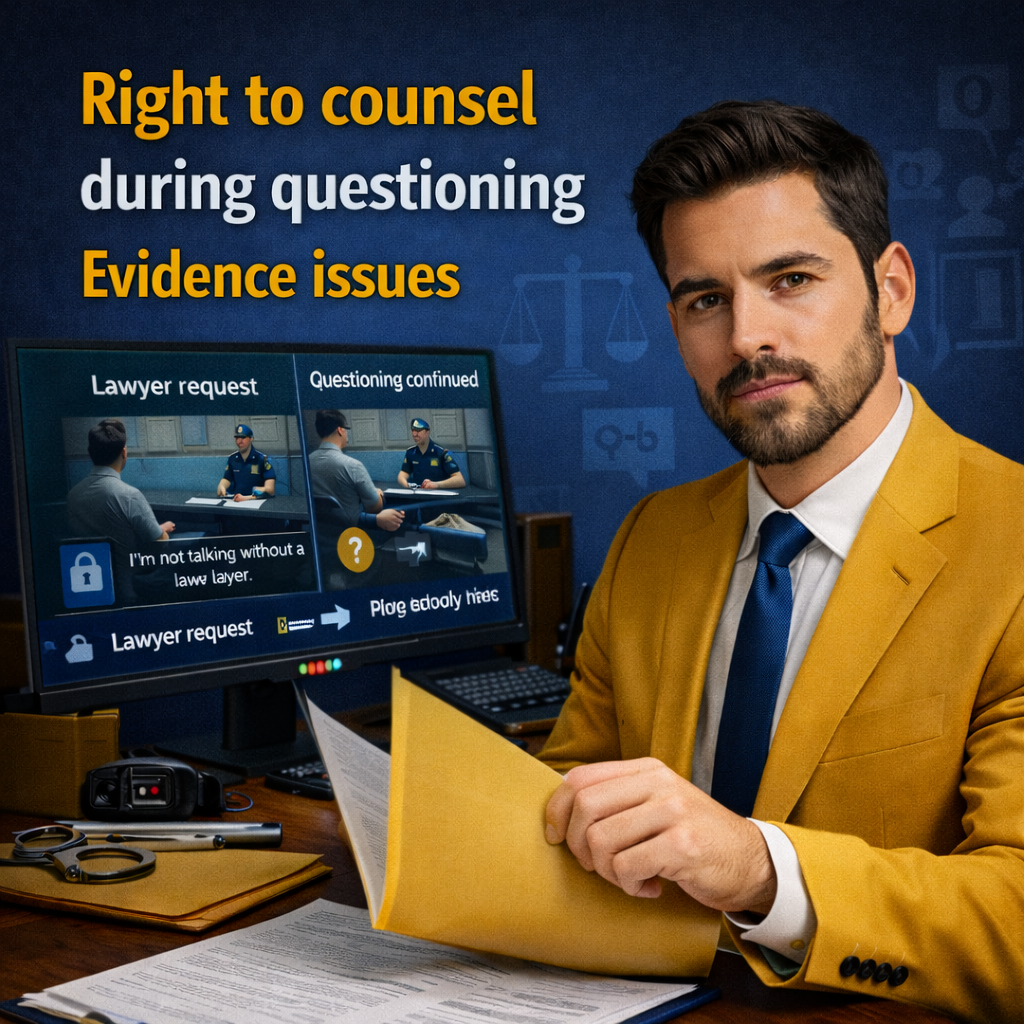
Right to counsel during questioning evidence issues
Police questioning can move fast, and small decisions made in minutes can shape what evidence exists for months. The right to counsel is often discussed in broad terms, but its actual scope depends on timing, custody status, and whether formal charges have started.
Understanding when counsel must be provided, when questioning must stop, and how a request for a lawyer should be communicated helps avoid statements that later become difficult to challenge. It also clarifies what law enforcement is allowed to do during interviews, stops, and post-charge interrogations.
- Misunderstanding “custody” can lead to unprotected statements.
- Ambiguous requests for a lawyer often do not pause questioning.
- Waivers may be treated as valid even under pressure and confusion.
- Post-charge interviews raise a different counsel framework than Miranda.
Quick guide to right to counsel during questioning
- The topic covers when a person can have counsel present and when questioning must pause until counsel is available.
- Problems usually arise in stationhouse interviews, roadside encounters that turn into interviews, and follow-up “voluntary” meetings.
- The main legal areas involved are constitutional criminal procedure, especially the Fifth and Sixth Amendments.
- Ignoring the framework can create statements that are difficult to exclude and can shape charging and plea decisions.
- A basic path is to preserve what happened (timelines, recordings, witnesses), raise the issue early through counsel, and seek suppression when appropriate.
Understanding right to counsel during questioning in practice
The phrase “right to counsel” during questioning can mean two different protections that operate at different times. One is tied to custodial interrogation (the Miranda framework), and the other is tied to the start of adversarial criminal proceedings (the Sixth Amendment framework).
In practice, the key questions are not only “Did the person ask for a lawyer?” but also “Was the person in custody?” and “Had formal charges begun?” Those details often determine whether police had to stop questioning, re-advise rights, or avoid certain forms of contact.
- Custody focuses on whether a reasonable person would feel free to end the interview and leave.
- Interrogation includes direct questioning and actions likely to elicit an incriminating response.
- Invocation is the act of clearly requesting counsel or stating a desire not to answer without counsel.
- Waiver is an agreement to speak without counsel after advisements, which must be knowing, intelligent, and voluntary.
- Attachment of the Sixth Amendment generally occurs after formal charges such as indictment, information, or arraignment.
- Clear words matter: an uncertain “maybe I need a lawyer” may not pause questioning.
- “Custody” can exist without handcuffs if the setting and control feel restraining.
- Waivers are often judged from the totality of circumstances, not later regret.
- After charges, counsel rules can become offense-specific and more restrictive for police contact.
- Documentation of timing is often as important as the exact words used.
Legal and practical aspects of right to counsel
Under the Miranda framework, the right to counsel is triggered by custodial interrogation. If custody is missing (for example, a genuinely voluntary interview), Miranda warnings may not be required, even if the questions are pointed and the person is a suspect.
If custody and interrogation are present, police must give Miranda warnings before questioning. A person can waive those rights, but a clear request for counsel generally requires officers to stop interrogation until counsel is present or until the person reinitiates discussion under the governing standards.
Under the Sixth Amendment, the right to counsel generally becomes active once formal proceedings begin. After that point, deliberate efforts to elicit statements about the charged offense without counsel can raise separate admissibility problems, even if Miranda warnings are given.
- Timing: warnings, invocation, and any break in questioning should be tracked to the minute.
- Clarity: courts often distinguish a direct request for counsel from an equivocal remark.
- Voluntariness: intoxication, fatigue, language barriers, and coercive tactics may affect validity.
- Reinitiation: who restarted conversation after an invocation can be outcome-determinative.
- Recording: video and audio can resolve disputes about tone, pauses, and exact wording.
Important differences and possible paths in right to counsel issues
A core distinction is Fifth Amendment counsel during custodial interrogation versus Sixth Amendment counsel after charges. They can overlap, but they are not identical. A person may have a Sixth Amendment right for a charged offense while being questioned about an uncharged offense under a different analysis.
Common paths include raising the issue informally with the prosecutor, filing a motion to suppress statements, and litigating custody/waiver through evidentiary hearings. In some cases, negotiated resolutions can address the dispute without a full hearing, but preserving the record early is still essential.
- Negotiated resolution: may reduce reliance on disputed statements but should not assume statements disappear automatically.
- Suppression motion: focuses on custody, interrogation, advisements, clarity of invocation, and voluntariness.
- Appeal: often depends on a clean factual record and timely objections in the trial court.
Practical application of right to counsel in real cases
Disputes about counsel during questioning frequently appear in stationhouse interviews, “come talk to us” invitations, and situations where a temporary detention turns into a sustained interview. They also arise when a person is questioned in a hospital, at home with multiple officers present, or in a patrol car after a traffic stop escalates.
People most affected include first-time suspects unfamiliar with procedure, juveniles and vulnerable adults, and anyone facing language or comprehension barriers. The key evidence often relates to what the environment communicated about freedom to leave and whether questioning was designed to prompt incriminating responses.
Further reading:
Relevant materials commonly include recordings, dispatch logs, interview room logs, Miranda forms, body-worn camera footage, written notes, and any texts or calls inviting the interview. Medical records and interpreter documentation can also matter when comprehension is disputed.
- Gather all available records: bodycam, interview video, Miranda forms, and the precise timeline of contact.
- Identify the custody indicators: location, duration, number of officers, physical control, and statements about leaving.
- Analyze the advisement and waiver: wording used, comprehension, language support, and signs of coercion or confusion.
- Preserve the invocation details: exact words, follow-up questions by officers, and whether questioning continued.
- Have counsel evaluate options: suppression motion, negotiated resolution, or targeted hearing on custody and voluntariness.
Technical details and relevant updates
Courts typically evaluate custody using an objective “reasonable person” lens, rather than the officer’s internal intent. Small factual differences can shift the outcome, such as whether the person was told they could leave, whether doors were locked, and whether personal items (phone, keys) were held by officers.
Invocation disputes often turn on clarity. Many jurisdictions apply rules that require a clear request for counsel to halt interrogation, and courts examine recordings closely when available. The concept of a “break” in custody and re-contact can also affect whether questioning may resume after an earlier request.
For Sixth Amendment issues, the major focus is whether formal proceedings had started and whether officers (or agents) deliberately elicited statements about the charged offense without counsel. This analysis can be highly fact-specific and can vary by jurisdictional nuance.
- Short interruptions versus meaningful breaks in custody can change the governing rule.
- “Functional equivalent” interrogation can include conduct beyond direct questions.
- Offense-specific limits may apply after formal charges for the charged conduct.
- Recording policies and local practice can affect how disputes are proven.
Practical examples of right to counsel during questioning
Example 1 (more detailed): A suspect is invited to “clear things up” at the station. They arrive voluntarily, but are taken to an interview room, the door is closed, and two officers question them for two hours. Midway through, the suspect says, “I think I should talk to a lawyer,” and an officer responds, “We can do that later, just help us understand this.” Questioning continues and the suspect makes incriminating admissions. In a later challenge, the key issues include whether the setting became custodial, whether the statement was a clear request for counsel, whether the officer’s response continued interrogation, and what the recording shows about tone and pressure.
Example 2 (shorter): A person is questioned during a traffic stop that extends into a roadside interview. They are not handcuffed, but their car is blocked and an officer keeps their identification while asking detailed accusatory questions. The person answers and later claims they should have had counsel. The analysis focuses on whether a reasonable person would have felt free to end the encounter, and whether the questioning crossed into custodial interrogation requiring Miranda warnings.
Common mistakes in right to counsel during questioning
- Assuming Miranda applies to every police conversation, including clearly voluntary interviews.
- Making an unclear request for counsel that can be treated as equivocal.
- Continuing to talk after requesting counsel, creating “reinitiation” disputes.
- Failing to track the timeline, especially breaks, transport, and changes of location.
- Relying on memory instead of preserving recordings, logs, and written advisement forms.
- Waiting too long to raise the issue, losing opportunities to secure evidence or witnesses.
FAQ about right to counsel during questioning
Does the right to counsel apply before an arrest?
It can, but it depends on custody and the type of questioning. Under Miranda, the key trigger is custodial interrogation, which can occur without a formal arrest. Separate counsel protections tied to formal charges usually begin later, after proceedings start.
What counts as a clear request for a lawyer?
Courts often look for a direct, unambiguous statement indicating counsel is wanted before continued questioning. The exact standard can vary, but clarity is critical because vague remarks may not pause interrogation. Recordings are frequently decisive in showing what was actually said.
What documents help challenge statements made during questioning?
Video and audio recordings, body-worn camera footage, Miranda forms, interview logs, dispatch records, and witness accounts are commonly important. Materials showing comprehension issues, such as interpreter use or medical status, can also matter. A detailed timeline often helps connect the facts to the legal standards.
Legal basis and case law
The right to counsel during custodial interrogation is primarily tied to the Fifth Amendment privilege against compelled self-incrimination and the Miranda doctrine. The practical effect is that when custody and interrogation are present, warnings are required and a clear request for counsel generally requires interrogation to stop under controlling standards.
The separate right to counsel under the Sixth Amendment generally attaches after the government initiates formal criminal proceedings, such as indictment, information, or arraignment. Once attached, deliberate efforts to elicit statements about the charged offense without counsel can raise admissibility issues even if the interaction looks “consensual” on the surface.
Courts commonly apply a totality-of-circumstances approach to waiver and voluntariness and focus closely on custody indicators, clarity of invocation, and who initiated further discussion after a request for counsel. Appellate decisions frequently emphasize that small factual differences in setting, officer conduct, and recorded wording can lead to different outcomes.
Final considerations
The right to counsel during questioning is not a single rule; it is a set of protections that depend on custody, interrogation methods, and whether formal proceedings have begun. The most common disputes turn on clarity of a request, the reality of the setting, and whether a waiver was genuinely informed and voluntary.
Practical precautions focus on preserving evidence, building a reliable timeline, and evaluating the custody and waiver framework early. In many cases, the strength of a challenge depends less on broad legal slogans and more on details that can be proven through recordings and objective records.
This content is for informational purposes only and does not replace individualized analysis of the specific case by an attorney or qualified professional.