
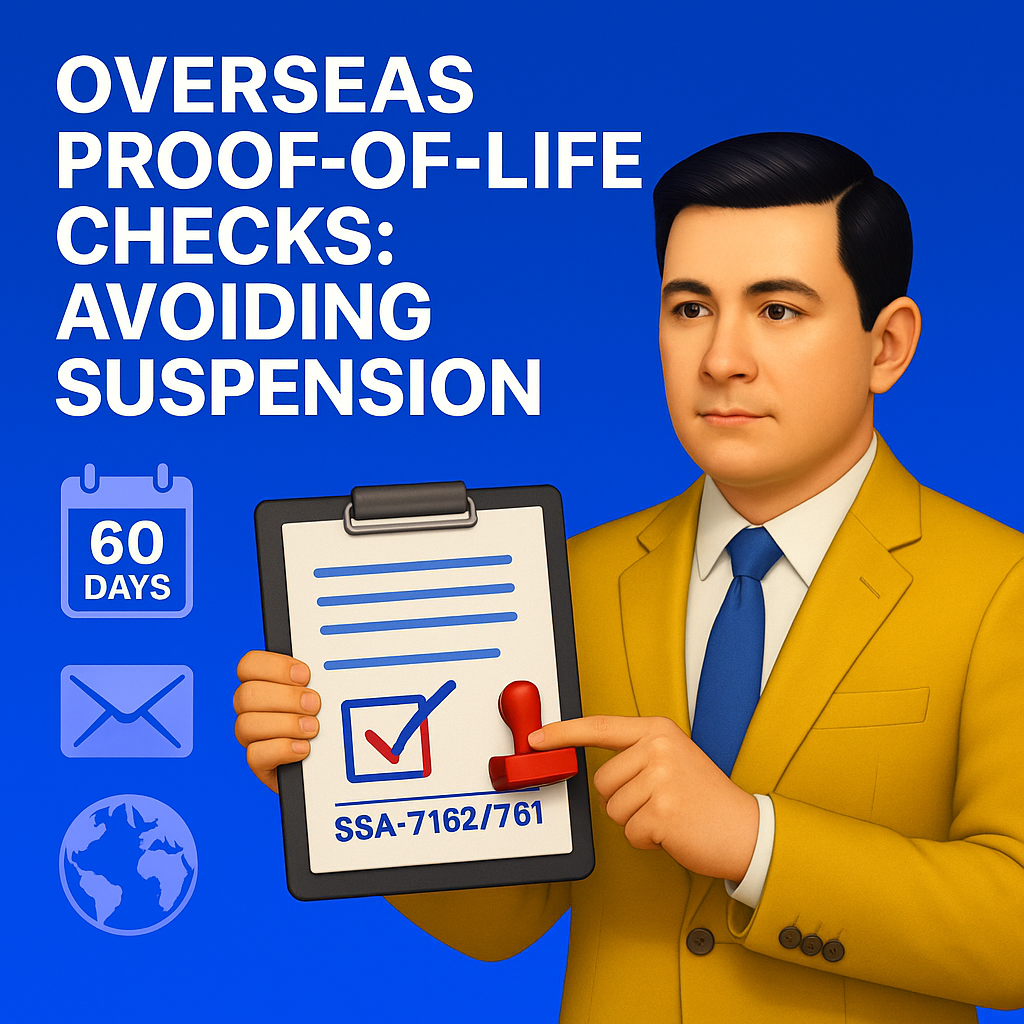
Overseas Proof-of-Life Checks: Deadlines, Embassy Options & How to Avoid Suspension
Proof-of-life checks overseas are routine verifications used by the U.S. Social Security Administration (SSA) and other benefit programs to confirm that beneficiaries living outside the United States are alive and still eligible for payments. For SSA, this process happens through the Foreign Enforcement Questionnaires—form SSA-7162 (for beneficiaries managing their own payments) and SSA-7161 (for representative payees). Failing to respond on time typically triggers a temporary suspension until a signed form is received and scanned.
Why proof-of-life checks exist (and why they matter)
Millions of U.S. Social Security payments flow to addresses outside the country. When mail is slow, people move, or records are incomplete, agencies cannot rely only on returned mail to detect problems. The FEQ process is a targeted, periodic audit that reduces improper payments, confirms continued entitlement, and ensures the right person is still receiving the money. Returning your form quickly protects your cash-flow and prevents lengthy reinstatement steps later.
Who is selected for a proof-of-life questionnaire
- Beneficiaries with no payee abroad are usually sent the SSA-7162. In many countries, selection is biennial (every two years) using a terminal-digit rotation so only half the group receives a form each year.
- Representative payees abroad (individuals or organizations managing funds for someone else) are generally sent the SSA-7161 on an annual basis because of the fiduciary risk.
- Special categories—such as beneficiaries aged 90+ or residents in locations with mail interruptions—may receive the form more frequently or through a Federal Benefits Unit (FBU) at a U.S. embassy/consulate.
Typical timeline and deadlines
Dates vary slightly by country and operational conditions, but the cycle below is a reliable reference for planning:
~60 days to reply
September: Follow-up (~45 days)
January: Suspension notices → February payment stops
Practical rule: aim to mail your form within two weeks of receiving it. That cushion covers international post, holidays, and scanning time in Wilkes-Barre before the suspension run.
What the questionnaires ask
SSA-7162 (you manage your own payments)
- Identity & address confirmation.
- Marital status changes affecting spouse/auxiliary benefits.
- Work/earnings if under Full Retirement Age.
- Child-in-care status for certain auxiliaries.
- Signature and date—the most common cause of rejection is a missing signature.
SSA-7161 (representative payee files)
- Proof of life and beneficiary’s living arrangement.
- Whether the payee still serves and how the funds are used/saved.
- Banking details including International Direct Deposit (IDD).
- Work, marriage, residence changes affecting entitlement.
Where to return your form
| Option | How it works | When to prefer |
|---|---|---|
| Mail to SSA scanning center WBDOC – Wilkes-Barre, PA |
Use the pre-addressed envelope. Write in dark ink, complete both sides, sign and date. Keep a copy + postal receipt. | Most countries with reliable post. This is the standard and often fastest path to be scanned into SSA’s system. |
| Drop off at a U.S. Embassy/Consulate Federal Benefits Unit (FBU) |
FBUs accept your completed form, verify identity, and forward to WBDOC. Some posts require an appointment and a government ID. | Locations with postal suspensions, repeated losses, or after a suspension when you need proof the form was received. |
Step-by-step to avoid suspension
- Open and read everything the day it arrives. Note the mailing date on the envelope for your records.
- Use black ink. Print clearly. Keep “X” marks inside the YES/NO boxes.
- Update contact details if the pre-printed address/phone is outdated. Legibility matters for scanning.
- Answer all questions. If you mark YES, use the reverse side to add details and dates.
- Sign and date in the correct spot. If you sign with a mark, arrange a witness signature as required.
- Make copies of both sides plus your receipt or FBU drop-off confirmation.
- Return within two weeks by tracked mail or drop at an FBU. Keep the tracking number.
- Set a reminder for the same period next year (or every other year, depending on your category).
Common pitfalls and how to fix them
| Pitfall | Impact | Prevention/Fix |
|---|---|---|
| Form never received due to an old address | Missed both waves → automatic suspension | Keep SSA and your FBU updated. Ask the FBU for a replacement form if you suspect selection. |
| Unsigned/undated return | Rejected by scanning → treated as non-response | Double-check the signature block. If you use a mark, add a witness signature. |
| Slow international mail | Form arrives after the processing cutoff | Mail early with tracking, or hand it to an FBU. |
| Using the wrong form (7162 vs 7161) | Unprocessed; no “hit” in the system | Beneficiaries complete 7162; payees complete 7161. |
| Unreported marriage, work, or residence change | Overpayment or incorrect entitlement | Report on the reverse side and separately notify SSA/FBU as required. |
Simple risk bars (visual cue)
Relative risk of experiencing a payment stop (illustrative):
Return within 30 days
Return after follow-up letter
No response until January suspension run
If you are already suspended
Suspension for non-receipt is temporary. Once SSA scans an accurate, signed questionnaire, monthly payments are resumed and any missed month(s) are typically paid retroactively. The fastest path is to submit the completed form immediately—by mail with tracking or via a nearby FBU with a government ID.
How representative payees can stay audit-ready
- Separate accounts: Where permitted, keep funds in an account titled for the beneficiary with the payee designation.
- Document use of funds: Keep receipts for housing, food, medical care, and personal needs; record savings and purpose.
- Annual memo: Keep a short summary for each beneficiary—address, living arrangement, IDD bank, use of funds, and any changes since last year.
- Compliance calendar: Create May/June tasks with auto-reminders; include a “resend” step in September if a follow-up arrives.
- Escalation path: If the beneficiary cannot be located, document your attempts and notify SSA/FBU promptly.
Quick Guide
- What is it? A periodic proof-of-life check for beneficiaries abroad via forms SSA-7162 or SSA-7161.
- When? May–June initial mailing; September follow-up for non-responders.
- Deadline? Return within about 60 days of receipt.
- Where to send? Mail to the SSA scanning center (WBDOC) or submit through an FBU.
- What if I miss it? Expect a January suspension notice; February payment stops until your form is scanned.
- Pro move: Keep a copy + tracking; set a recurring reminder for early May.
FAQ
1) I didn’t receive any form this year—am I exempt?
Not necessarily. Many beneficiaries are on a biennial cycle, and addresses change. Confirm that SSA has your current address and ask your nearest FBU if a replacement is needed.
2) Can I email or upload my questionnaire?
SSA’s standard process is a paper return by mail or via an FBU. The form must be scanned at the Wilkes-Barre center to be recorded as received.
Further reading:
3) Will direct deposit (IDD) prevent suspension?
No. IDD is a payment method. If you are selected for foreign enforcement and fail to return the form, benefits can still be suspended until the form is scanned.
4) What if I returned the form but payments still stopped?
Mail delays happen. Contact your FBU with proof of mailing. You may be asked to submit another signed copy so it can be scanned promptly.
5) I’m under Full Retirement Age and working abroad. Do I report that?
Yes. Report work and earnings on the questionnaire. Earnings may affect benefits before FRA under the earnings test.
6) Do representative payees have to report how funds are used?
Yes. The SSA-7161 asks whether funds are used for current needs and where savings are held. Keep receipts and bank statements.
7) My country’s mail is unreliable. What should I do?
Use a postal option with tracking or submit via the local FBU. Many FBUs accept forms and forward them to the scanning center.
8) What happens after a long suspension?
If SSA and the FBU cannot locate you, records may reflect “whereabouts unknown.” This is preventable—send the form or contact an FBU to re-establish contact.
9) My spouse is my payee. Do they report their own income?
No. The focus is on the beneficiary’s status and any earnings that affect entitlement. The payee’s income is not required unless relevant to stewardship.
10) How do I keep from ever missing this again?
Set a calendar reminder for early May, keep your address updated, store a scanned copy of last year’s form, and have a stamped envelope ready for this year’s return.
Legal / Policy basis (plain-English summary)
- Foreign Enforcement Program: SSA conducts periodic proof-of-life checks for beneficiaries residing outside the U.S., using SSA-7162 and SSA-7161.
- Mailing windows & deadlines: Initial mailings typically occur in May–June with about a 60-day response window and a September follow-up to non-responders.
- Suspension process: If no valid form is recorded, SSA issues January suspension notices and stops the February payment for January benefits. Payments resume when a signed form is scanned and accepted.
- Return options: Forms are routed to the SSA scanning center in Wilkes-Barre, PA or accepted via Federal Benefits Units at U.S. embassies/consulates which forward them to the scanner.
- Payee duties: Representative payees must use funds for the beneficiary’s needs, maintain records, and report changes affecting entitlement (residence, marriage, work, child-in-care, institutionalization).
Checklist before you mail
- ☐ Correct name, SSN, and foreign address
- ☐ All YES/NO boxes completed clearly
- ☐ Reverse side completed for any “YES” answers
- ☐ Signature and date (with witness if signing by mark)
- ☐ Copies made of both sides + mailing receipt
- ☐ Return sent within two weeks of receipt
This material is an educational overview to help beneficiaries and payees avoid suspension. It does not replace official instructions or individualized guidance from the Social Security Administration or a qualified representative.