
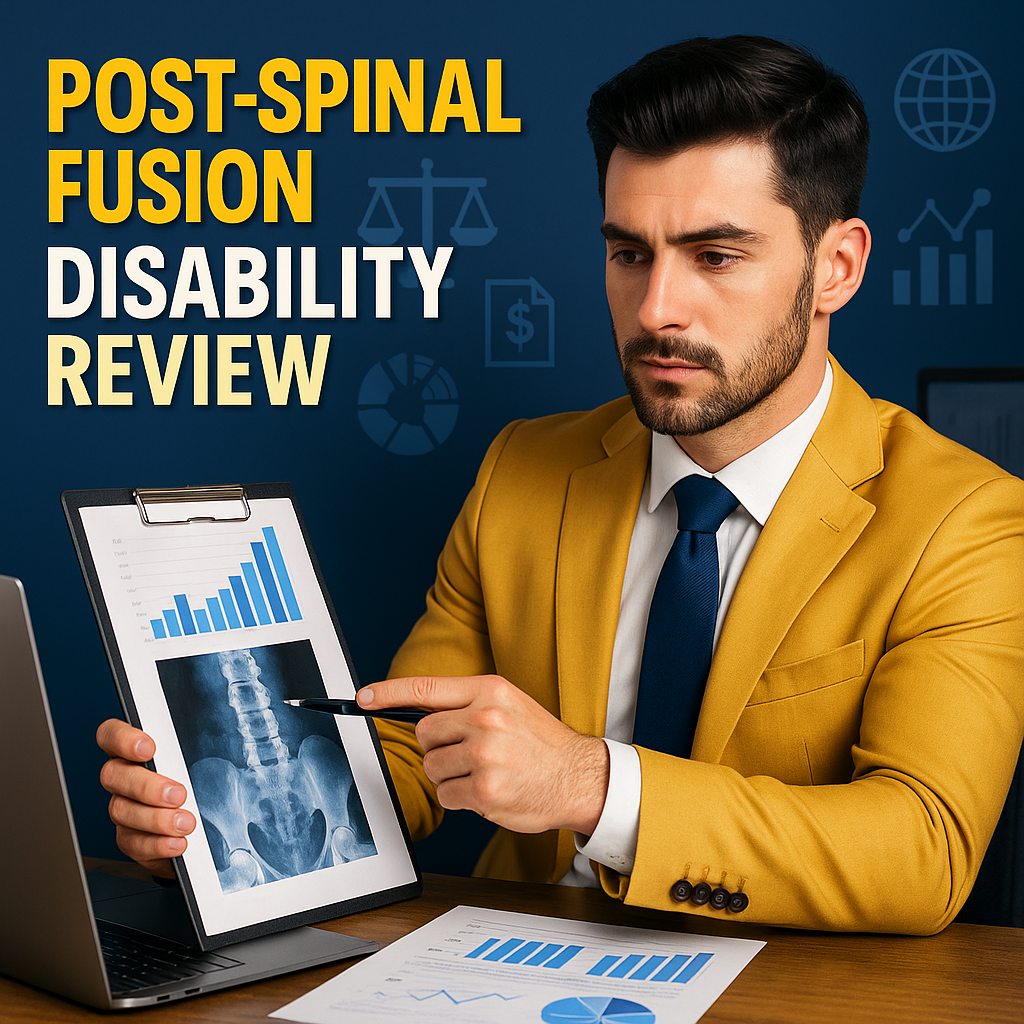
Post-spinal fusion limited motion disability assessment
Explains how post-spinal fusion with limited range of motion is evaluated in medical and social security law, and why structured documentation is essential.
Post-spinal fusion can stabilize the spine and reduce severe pain, but it almost always reduces flexibility. When the fused segment is extensive or complications occur, limited range of motion may become a permanent condition, affecting driving, bending, lifting and daily activities.
From a medical-legal and social security perspective, the main issue is not only the surgery itself, but how residual stiffness, pain and functional restriction impact work capacity. Disputes often arise when official evaluations underestimate limitations or disregard specific job demands.
- Persistent stiffness after fusion can severely limit bending and rotation.
- Long-term pain and fatigue may prevent sustained standing or sitting.
- Under-documented functional loss often leads to denial of benefits.
- Clear medical and occupational evidence is crucial in disputes.
Key points about post-spinal fusion limitation
- The topic involves residual stiffness and pain after spinal fusion surgery, with limited range of motion in the fused region.
- Problems usually appear when returning to work that requires bending, lifting, driving or prolonged static postures.
- The main legal fields are social security law, medical law and occupational health.
- Ignoring persistent limitation can result in unsafe work conditions and unfair denial of disability or accommodation rights.
- Solutions typically involve structured medical reports, administrative appeals and, if necessary, judicial review.
Understanding post-spinal fusion with limited range of motion in practice
Spinal fusion permanently joins vertebrae with bone grafts and hardware to stabilize unstable or degenerative segments. Once fusion occurs, movement at that level is lost, and adjacent segments may need to compensate, sometimes leading to overload and pain above or below the fused area.
In some individuals, stiffness, weakness and neuropathic symptoms persist despite rehabilitation. When these limitations interfere with reaching, twisting, lifting, driving or prolonged sitting and standing, the question becomes whether residual capacity still meets the requirements of the previous job or any suitable alternative work.
- Documented reduction in flexion, extension and rotation of the spine.
- Chronic pain, muscle spasm or radicular symptoms after surgery.
- Functional fatigue with repetitive movements or static postures.
- Need for assistive devices, braces or frequent position changes.
- Limitations confirmed by physical examination and functional tests.
- Functional capacity often weighs more than imaging findings alone.
- Reports should quantify safe lifting limits and tolerated positions.
- Driving ability and reaction time are critical in many occupations.
- Consistency between symptoms, exams and work history is fundamental.
Legal and practical aspects of disability assessment
Social security systems generally require proof of substantial and lasting reduction in work capacity. In post-spinal fusion cases, the analysis focuses on whether limited range of motion and pain prevent previous duties and whether realistic accommodations can maintain employment.
Decision-makers evaluate how long the condition has been stable, whether further surgery or rehabilitation is expected, and how age, education and skills interact with physical limitations. They also verify if the claimant has tried lighter or adapted tasks before requesting full disability.
- Defined criteria for temporary, partial and total incapacity.
- Statutory deadlines for filing claims, submitting exams and appeals.
- Use of official guidelines for spinal disorders and functional assessment.
Different scenarios and possible procedural paths
Outcomes vary significantly between heavy manual workers and people in predominantly sedentary roles. A warehouse worker who must lift and twist regularly will be evaluated differently from an office employee whose tasks could, in theory, be adapted with ergonomic adjustments.
- Administrative claim: initial request supported by surgical reports, imaging and functional capacity assessments.
- Internal appeal: submission of updated exams and detailed descriptions of limitations after a denial.
- Judicial action: court review with independent expert opinion on residual capacity and legal criteria.
Practical application in real post-spinal fusion cases
Typical cases involve individuals who underwent lumbar or cervical fusion after trauma, degenerative disc disease or deformity. Months after surgery, they may still struggle to bend, lift objects from the floor or keep a seated position for more than a short period without significant pain.
Those who worked in construction, transportation, cleaning, nursing or warehouse logistics often face serious difficulties returning to their previous duties. Even office workers may find prolonged sitting and neck rotation for computer work or driving to be problematic.
Relevant evidence includes operative reports, imaging, neurology and orthopedics notes, functional capacity evaluations, rehabilitation records and occupational descriptions.
- Gather surgical reports, imaging studies and follow-up notes describing residual limitation.
- Obtain functional assessments quantifying range of motion, lifting capacity and tolerated postures.
- File the claim with organized evidence and a clear description of previous job tasks.
- Monitor deadlines, attend medical evaluations and provide any requested clarifications.
- Appeal or seek judicial review if the decision disregards consistent clinical and occupational data.
Technical details and recent trends
Modern fusion techniques and instrumentation have improved outcomes, but they have not eliminated long-term limitations. Some patients develop adjacent segment disease, ongoing neuropathic pain or hardware-related issues that keep function below what many jobs require.
Current practice encourages combining imaging findings with standardized functional tests rather than relying only on radiology or self-reported pain. Legal disputes increasingly focus on whether evaluations considered the concrete demands of the insured person’s occupation.
- Use of standardized spine mobility and endurance tests in reports.
- Attention to medication side effects, such as sedation or cognitive impact.
- Documentation of unsuccessful attempts at graded return to work.
Practical examples of post-spinal fusion limitation
A 52-year-old construction worker undergoes lumbar fusion after a work-related injury. One year later, flexion and extension are significantly reduced, and he cannot safely lift more than light loads or climb scaffolding. Functional testing shows limited walking distance and intolerance to prolonged standing. An initial administrative denial relies on age and theoretical capacity for lighter duties, but a judicial expert confirms that his skills are tied to heavy manual labor, leading to recognition of permanent disability benefits.
In another case, a 45-year-old bus driver has cervical fusion following disc herniation. Neck rotation remains restricted, and long driving periods worsen pain and numbness. Occupational evaluation concludes that limited range of motion compromises safe driving and emergency maneuvers. After submitting updated reports and route descriptions during an appeal, the agency grants partial disability and access to vocational rehabilitation.
Common mistakes in post-spinal fusion claims
- Submitting only imaging exams without functional descriptions of limitation.
- Using generic medical certificates that ignore specific job demands.
- Failing to document unsuccessful attempts at returning to adapted duties.
- Assuming the surgery itself automatically guarantees disability recognition.
- Missing procedural deadlines for completing documentation or appeals.
FAQ about post-spinal fusion with limited range of motion
When can post-spinal fusion justify disability benefits?
Benefits may be considered when limited range of motion and pain are stable, long-lasting and significantly reduce capacity to perform previous work or any realistic alternative occupation.
Which documents are most important for these evaluations?
Key documents include operative and follow-up reports, imaging, functional capacity assessments, rehabilitation records and detailed descriptions of occupational tasks and failed adaptations.
What can be done after a denial of benefits?
The claimant can file an internal appeal with updated medical and functional evidence, or initiate judicial proceedings to obtain an independent assessment of disability and legal compliance.
Legal basis and case law
The legal basis for post-spinal fusion disability claims usually lies in social security statutes regulating incapacity benefits and in constitutional or human rights provisions protecting dignity and health. These norms require objective proof of reduced earning capacity and individualized analysis.
Specific regulations and medical guidelines define how spinal disorders, surgical outcomes and chronic pain should be evaluated. They often emphasize functional criteria, such as tolerable positions, lifting limits and the need for frequent breaks or position changes.
Case law in many jurisdictions highlights the importance of considering real job demands and not just generic descriptions. Courts frequently correct decisions that ignore intensive physical requirements, commuting difficulties or the safety implications of limited range of motion.
Final considerations
Post-spinal fusion with limited range of motion can compromise mobility, comfort and long-term employability, especially in physically demanding occupations. Proper evaluation depends on connecting medical findings with accurate descriptions of functional capacity and workplace requirements.
Organized documentation, attention to deadlines and early legal or technical guidance help transform complex medical information into clear evidence for administrative and judicial decisions, reducing uncertainty and disputes.
This content is for informational purposes only and does not replace individualized analysis of the specific case by an attorney or qualified professional.