
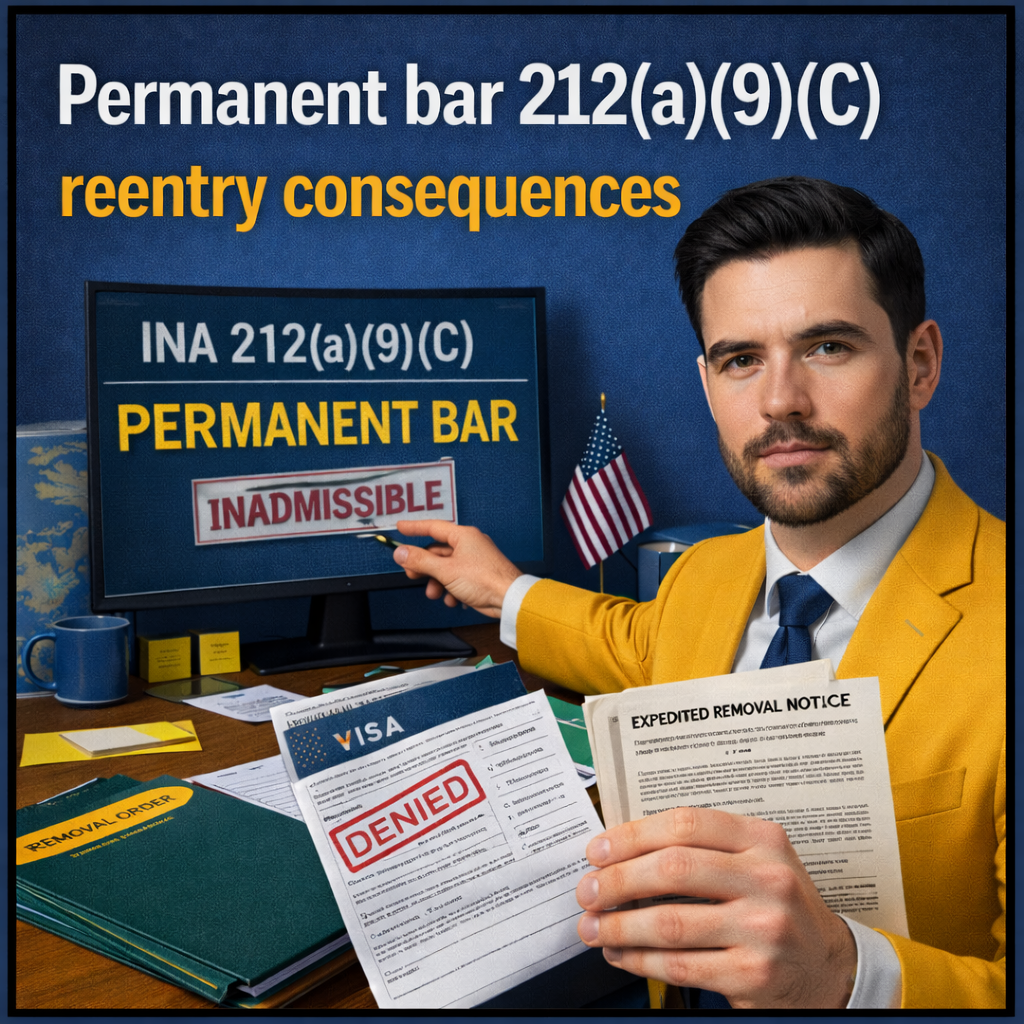
Permanent bar 212(a)(9)(C) reentry consequences
Unlawful reentry can trigger a permanent inadmissibility bar, making future visas and green cards far harder to pursue.
Immigration cases sometimes turn on a single event: leaving the United States and later coming back (or trying to come back) without being admitted. When that happens after certain prior violations, the law can impose what is commonly called a “permanent bar,” which can block many future immigration options.
The hardest part is that the permanent bar under INA 212(a)(9)(C) is often confused with the better-known 3-year and 10-year bars for unlawful presence. The triggers, timelines, and possible remedies are different, and small factual details (dates, entries, removals, attempts) can change the legal outcome.
- Permanent bar can apply after removal or extended unlawful presence plus a later unlawful entry/attempt.
- Timing errors (counting days, departures, entries) frequently lead to wrong strategy choices.
- New petitions often do not cure inadmissibility created by 212(a)(9)(C).
- Evidence gaps about travel history can derail consular or USCIS processing.
Fast orientation to permanent bar for unlawful reentry
- What it is: an inadmissibility ground that can block admission after a later unlawful reentry or attempted reentry.
- When it usually arises: after a prior removal order or substantial unlawful presence, followed by returning without being admitted.
- Main legal area: U.S. immigration inadmissibility rules under INA 212(a)(9)(C), with related overlap (removal orders and unlawful presence).
- Downside of ignoring: pursuing visas or adjustment without addressing 212(a)(9)(C) can lead to denials, delays, and wasted filings.
- Basic path: confirm travel/entry facts, identify the specific trigger, evaluate long-term options (often consular processing and permission to reapply), and manage deadlines strategically.
Understanding permanent bar triggers in practice
The “permanent bar” label is shorthand. The statute focuses on a specific pattern: a person who is removed (or who accumulates certain unlawful presence) and then later enters or attempts to enter the United States without being admitted.
Because the law is fact-driven, a reliable timeline is essential. The following elements are typically examined together:
- Prior removal (including certain expedited removals) or prior immigration violation history.
- Unlawful presence totals (often whether it exceeded 1 year in the aggregate in some scenarios).
- Later entry or attempt without inspection/admission, or otherwise not lawfully admitted.
- Departure and reentry dates supported by records (passports, I-94, CBP history, court documents).
- How the government coded events (removal order, voluntary departure, withdrawal, parole, etc.).
- 212(a)(9)(C) is triggered by a later unlawful entry/attempt, not only by overstaying.
- Removal vs. voluntary departure can matter, but the later entry/attempt still drives the analysis.
- “Attempted entry” can include being stopped at the border and turned back under certain circumstances.
- Different bars can overlap: 3/10-year bars and the permanent bar may both be relevant.
- Case posture (inside the U.S. vs. consular processing) heavily influences available steps.
Legal and practical aspects of unlawful reentry bars
Under INA 212(a)(9)(C), the inadmissibility is commonly analyzed in two main branches: (1) a prior removal followed by a later unlawful entry/attempt, or (2) certain unlawful presence patterns followed by a later unlawful entry/attempt. Either branch can make a person inadmissible for future admission.
A key practical reality is that the government often verifies the record across multiple systems: immigration court files, CBP border events, USCIS filings, and consular notes. Inconsistencies (for example, missing departure evidence or unclear dates) frequently lead to lengthy “administrative processing” or requests for more evidence.
- Core requirement: prove what happened (removal/unlawful presence) and what happened later (entry/attempt without admission).
- Critical dates: last departure, any later entries/attempts, and any orders or removals tied to those events.
- Decision criteria: whether the statute’s trigger elements are met and whether any narrow exceptions apply.
Important differences and possible paths under 212(a)(9)(C)
The permanent bar is not the same as the 3/10-year unlawful presence bars under INA 212(a)(9)(B). The 3/10-year bars are typically triggered by unlawful presence plus departure; the permanent bar focuses on the later unlawful entry/attempt after prior violations.
Common paths are usually long-term and procedural, not quick fixes. Typical options include:
- Consular strategy after time abroad: in many cases, the statute contemplates seeking consent to reapply after a lengthy period outside the U.S. (often discussed as “10 years outside” before requesting permission).
- Reopening/clarifying prior proceedings: where records are wrong or incomplete, immigration court or agency motions may be considered to correct the procedural history.
- Exception-focused review: limited statutory or humanitarian pathways may apply in narrow scenarios, depending on the person’s facts.
Practical application of unlawful reentry bars in real cases
The issue commonly surfaces when a visa application is refused, a green card case stalls, or a filing triggers a deeper review of travel history. The permanent bar often appears in cases involving prior removals, long overstays followed by departure, and later border events (including turn-backs or reentries without inspection).
People most affected include those with a complicated travel history, prior immigration enforcement encounters, or multiple attempts to return after departure. The documents that typically matter are objective records that establish dates and classifications of events.
Examples of relevant evidence include passport stamps, I-94 history, CBP travel records, removal orders, expedited removal paperwork, USCIS receipt notices, immigration court dockets, and consular refusal worksheets where available.
Further reading:
- Build a verified timeline of entries, departures, and enforcement events with supporting documents.
- Identify the exact statutory trigger (removal-based or unlawful-presence-based branch) and the later entry/attempt facts.
- Request missing records where needed (agency records, court files, CBP history) to reduce factual uncertainty.
- Choose the procedural posture realistically (consular vs. inside-U.S. options) and avoid filings that assume admissibility.
- Monitor deadlines and next steps (requests for evidence, consular follow-ups, motion windows) and document every submission.
Technical details and relevant updates
Although 212(a)(9)(C) is a statutory provision, real outcomes can depend on how agencies classify events and how courts interpret key terms such as “entered,” “attempted to enter,” and “without being admitted.” That is why official records and the exact wording of prior orders often matter as much as the general story.
Another recurring technical issue is overlap: one case can involve multiple inadmissibility grounds at the same time (for example, prior removal, unlawful presence bars, and separate grounds tied to documentation or misrepresentation). A strategy that addresses only one ground may still fail if another remains unaddressed.
- Border event coding (withdrawal, expedited removal, parole) can materially affect analysis.
- Multiple grounds may require layered solutions rather than a single waiver approach.
- “Attempt” facts can be debated and may require careful documentation of what occurred at inspection.
- Time outside the U.S. is often central when evaluating permission-to-reapply pathways.
Practical examples of permanent bar scenarios
Example 1 (more detailed): A noncitizen departs the United States after an extended period of unlawful presence. Years earlier, there was also a prior enforcement encounter at the border. Later, the person attempts to reenter without being admitted and is stopped at inspection. When a family-based visa is pursued through a consulate, the case is refused due to a permanent bar finding. The records review focuses on (1) the unlawful presence and departure history, (2) the later attempt to enter without admission, and (3) whether the statutory path that contemplates permission to reapply after substantial time abroad is the appropriate procedural route. The outcome depends on verified dates, the nature of the enforcement paperwork, and consistent documentation across filings.
Example 2 (shorter): After a prior removal order, a person later returns to the U.S. without being admitted and remains for years. A later employer-sponsored process is started, but the prior removal and later reentry history triggers a permanent bar analysis. The case requires a record-based strategy and realistic planning for long timelines and procedural constraints.
Common mistakes in permanent bar cases
- Relying on memory instead of building a documented timeline of departures, entries, and border events.
- Assuming a new petition approval means admissibility is resolved.
- Mixing up 212(a)(9)(B) (3/10-year bars) with 212(a)(9)(C) (permanent bar triggers).
- Submitting inconsistent dates across forms, affidavits, and interviews.
- Ignoring old orders or border paperwork that the government can still retrieve and use.
- Filing in the wrong posture (for example, pursuing a path that presumes admission when the record suggests otherwise).
FAQ about the permanent bar for unlawful reentry
What triggers the permanent bar under INA 212(a)(9)(C)?
The permanent bar is generally linked to a later unlawful entry or attempted entry without being admitted, after certain prior violations such as removal or significant unlawful presence patterns. The analysis is highly dependent on dates and the exact classification of prior events. A verified timeline is typically the starting point for any strategy discussion.
Who is most commonly affected by 212(a)(9)(C)?
Individuals with prior removal-related events, long periods of unlawful presence followed by departure, and later border encounters are frequently impacted. Cases with multiple entries or attempts are also common. The more complex the travel history, the more important complete records become.
What documents usually matter most when 212(a)(9)(C) is suspected?
Key documents include passport pages, I-94 history, CBP travel records, removal or expedited removal paperwork, immigration court records, USCIS receipts, and consular refusal notes where available. These documents support the dates and legal categories that drive the inadmissibility analysis and the choice of procedural path.
Legal basis and case law
The primary legal basis is INA 212(a)(9)(C), which establishes inadmissibility for certain individuals who reenter or attempt to reenter the United States without being admitted after specified prior immigration violations. In practice, this provision is applied by comparing the person’s record to the statute’s trigger elements.
Related provisions often appear in the same case file, including INA 212(a)(9)(B) (3/10-year unlawful presence bars) and rules tied to prior removal orders and admissibility at entry. Depending on the facts, multiple grounds can overlap, and each ground may require its own procedural response.
Courts and agencies commonly focus on definitions and proof: what counts as an “entry” or “attempt,” how prior removals are documented, and whether the record supports the required sequence of events. Outcomes often turn on the reliability of records and consistency across proceedings, rather than on general explanations of the law.
Final considerations
The permanent bar for unlawful reentry is one of the most restrictive inadmissibility grounds because it is triggered by a later unlawful entry or attempted entry after prior violations. Confusing it with the 3/10-year bars can lead to strategies that do not match the case’s actual legal posture.
A practical approach usually begins with a documented timeline, retrieval of missing records, and a realistic evaluation of the procedural path and time horizon. Clear documentation, consistent filings, and careful handling of prior orders and border events are often decisive in keeping a case coherent.
This content is for informational purposes only and does not replace individualized analysis of the specific case by an attorney or qualified professional.