
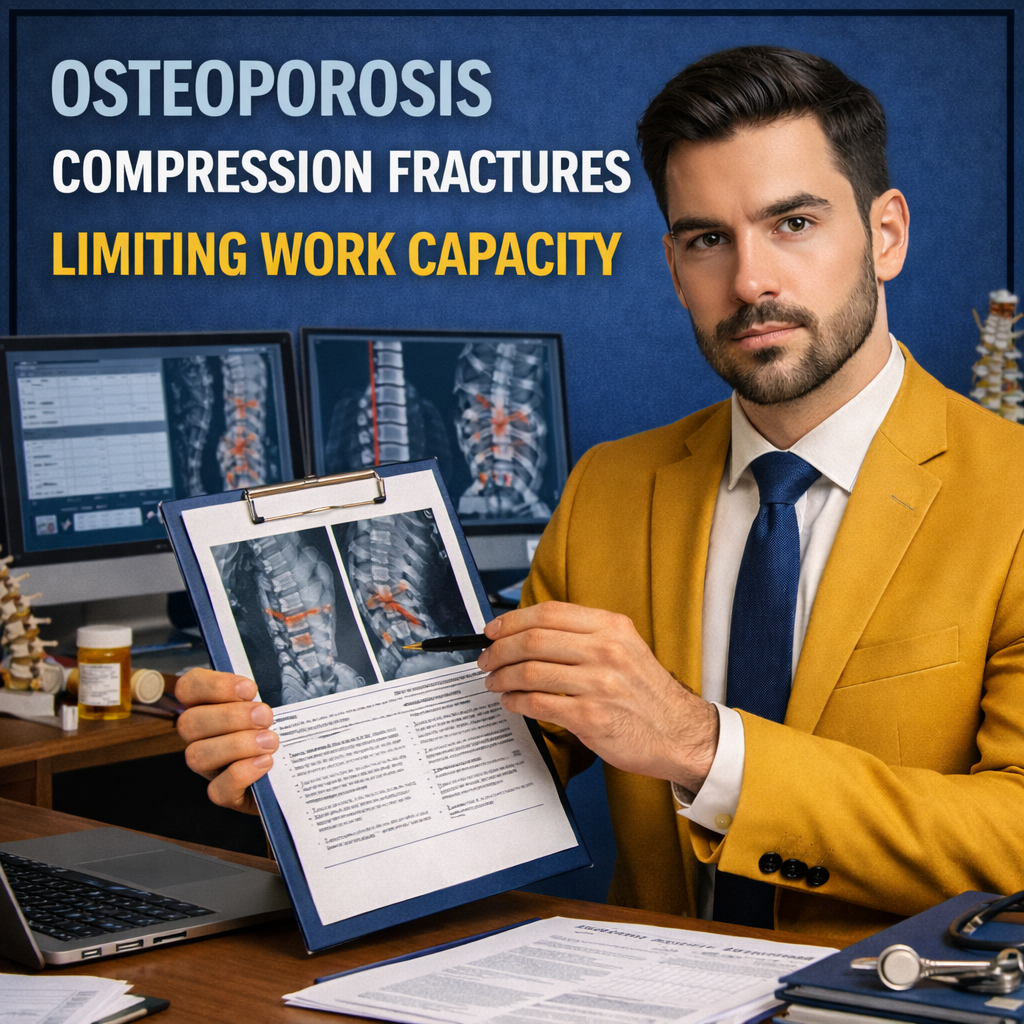
Osteoporosis Compression Fractures Limiting Work Capacity
Osteoporosis with multiple compression fractures often creates a difficult proof problem: imaging may be clear, but daily limitations can still be questioned when pain and fatigue fluctuate.
In medical-legal and disability contexts, outcomes commonly depend on whether treatment history, functional restrictions, and consistency across records show a sustained inability to meet work demands.
- Delayed documentation can weaken the timeline of impairment.
- Gaps in treatment or imaging follow-up may trigger credibility challenges.
- Work-capacity assumptions can undervalue spine-related restrictions.
- Inconsistent symptom reporting can lead to denial or reduced benefits.
Quick guide to osteoporosis compression fractures and disability evaluation
- What it is: Osteoporosis-related vertebral compression fractures affecting posture, pain, and mobility.
- When it arises: After falls, minor trauma, or spontaneous fractures with progressive height loss.
- Main legal area: Medical evidence and disability/benefits (work capacity and functional limits).
- What goes wrong: Records focus on diagnosis, but omit functional restrictions and endurance limits.
- Basic path: Build a consistent record, submit a supported claim, and appeal with targeted evidence if denied.
Understanding osteoporosis with multiple compression fractures in practice
Multiple vertebral compression fractures can create a combined impairment: pain, reduced spinal tolerance, and movement limits, often worsened by kyphosis and deconditioning.
In claims, the central question is usually not whether fractures exist, but whether the documented limitations prevent sustained work activities over a normal schedule.
- Objective support: imaging reports (X-ray, MRI, CT), documented height loss, kyphosis findings.
- Clinical course: persistent pain despite treatment, repeated fractures, medication history for osteoporosis.
- Functional impact: limits in standing, sitting, lifting, bending, and walking tolerance.
- Safety concerns: fall risk, need for assistive devices, activity restrictions to prevent re-injury.
- Consistency: similar limitations across primary care, orthopedics, pain management, and PT notes.
- Imaging + functional notes matter more than diagnosis alone.
- Repeated fractures and progressive kyphosis often increase work restrictions.
- Treatment adherence and follow-up strengthen the credibility of limitations.
- Clear limits on lifting, bending, and tolerance help reduce guesswork.
- Fall-prevention restrictions can affect job options even in light-duty roles.
Legal and practical aspects of osteoporosis fracture claims
In disability and benefits evaluations, reviewers typically weigh whether symptoms and restrictions are supported by objective findings and longitudinal treatment history.
They also look for whether conservative measures were tried, whether specialists were involved when appropriate, and whether functional restrictions are described in concrete, work-relevant terms.
- Evidence of severity: multi-level fractures, persistent pain notes, documented posture changes.
- Treatment record: osteoporosis medication, pain management, PT, brace use, injections or procedures.
- Functional documentation: restrictions stated as tolerances (minutes/hours) and weight limits.
- Duration: persistent impairment over time, not only during an acute flare period.
- Consistency checks: alignment between reports, imaging, and daily-activity statements.
Important differences and possible paths in osteoporosis fracture cases
Some cases focus on the fractures themselves, while others hinge on secondary effects such as kyphosis, nerve irritation, deconditioning, or medication side effects that reduce endurance.
- Short-term incapacity: acute fractures with a clear recovery plan and time-limited restrictions.
- Long-term limitation: multiple fractures with persistent pain and reduced tolerance despite treatment.
- Worsening course: additional fractures or progressive deformity affecting function over time.
Common paths include an administrative claim supported by medical records, a reconsideration/appeal with additional functional evidence, or a contested hearing where consistency and longitudinal documentation are decisive.
Practical application of osteoporosis fracture evidence in real cases
These claims often appear after repeated falls, minor trauma events, or gradual worsening where daily tasks become difficult due to back pain, posture changes, and fatigue.
People in physically demanding jobs are frequently affected, but sustained sitting and concentration can also be limited in sedentary work when pain flares and tolerance is low.
Helpful evidence usually includes imaging reports, provider notes that state restrictions, PT evaluations, medication lists, and any documented fall-risk or activity precautions.
Further reading:
- Collect a timeline: imaging dates, fracture levels, height loss, and treatment milestones.
- Gather functional proof: PT findings, gait/brace notes, tolerances, and work-relevant restrictions.
- Request targeted medical statements: limitations framed as lifting/bending limits and sit/stand/walk tolerances.
- Submit the claim with organized exhibits: imaging + longitudinal notes + function-focused summaries.
- Escalate if denied: appeal with updated imaging, specialist input, and stronger functional documentation.
Technical details and relevant updates
Compression fractures are often documented by radiology reports describing vertebral height loss, wedge deformity, or acute/subacute changes on MRI, which can support a medically determinable impairment.
In practice, benefits decisions frequently turn on the translation of spine findings into specific work limitations, especially around bending, lifting, postural tolerance, and safety restrictions.
Additional attention points can include medication side effects, coexisting arthritis or degenerative disc disease, and how fall risk changes feasible job options.
- Multi-level fractures: often correlate with reduced tolerance and stronger restriction needs.
- Kyphosis/posture changes: can support limits on standing and prolonged sitting.
- Fall-risk precautions: can affect climbing, uneven surfaces, and certain workplace environments.
- PT objective measures: can help anchor functional limits in clinical findings.
Practical examples of osteoporosis compression fracture cases
A warehouse worker develops repeated vertebral compression fractures after minor falls. Imaging confirms multi-level wedge deformities, and PT documents reduced trunk strength, limited bending, and poor standing tolerance. The claim is supported by orthopedics and primary care notes stating lifting limits, avoidance of repetitive bending, and a sit/stand option. An appeal adds updated imaging and a detailed functional statement, leading to a reassessment of work capacity based on sustained tolerance limits rather than job title alone.
A retail cashier with osteoporosis reports worsening back pain and posture changes after multiple fractures. Records include X-rays, medication history, and a brace note, but early documentation lacks clear tolerances. The follow-up submission adds PT findings and provider restrictions on standing duration and lifting, aligning the record and strengthening the evaluation.
Common mistakes in osteoporosis compression fracture claims
- Submitting imaging without functional restrictions tied to work tasks.
- Leaving gaps in treatment history or missing follow-up after new symptoms.
- Using vague statements like “severe pain” without tolerances or limits.
- Inconsistent reports across providers about activity level and daily limitations.
- Failing to document fall risk, brace use, or safety-related restrictions.
- Waiting until appeal to obtain PT evaluations or specialist input.
FAQ about osteoporosis with multiple compression fractures
Do imaging findings alone prove inability to work?
Imaging can establish fractures and severity, but decisions often rely on documented functional limits. Records that specify tolerances, lifting limits, and postural restrictions tend to be more persuasive than diagnosis alone. A consistent timeline of symptoms and treatment also matters.
Who is most affected in work-capacity and benefits disputes?
People with multi-level fractures, progressive posture changes, recurrent falls, or persistent pain despite treatment are commonly affected. Workers in physically demanding roles face obvious limits, but sedentary work can also be impacted by low sitting tolerance and frequent symptom flares.
What documents help if a claim is denied?
Updated imaging, PT functional evaluations, and a targeted provider statement describing concrete restrictions are often helpful. A clear timeline, medication history, and consistent notes across providers can address concerns about severity and duration. Appeals are stronger when they focus on functional impact and sustained tolerance.
Legal basis and case law
In disability and benefits frameworks, claims generally depend on showing a medically determinable impairment supported by medical evidence and a functional impact that limits the ability to perform sustained work activities. Osteoporosis with documented compression fractures often satisfies the medical-evidence component when imaging is clear.
Legal analysis commonly turns on functional capacity: whether restrictions are consistent, supported, and durable over time. Decision-makers frequently weigh credibility factors, treatment history, and whether the documented limitations match objective findings and clinical observations.
Courts and adjudicators often uphold denials where records lack functional specificity, but may reverse or remand when decision-makers ignore longitudinal evidence, mischaracterize the record, or fail to address objective findings and documented restrictions in a reasoned way.
Final considerations
Osteoporosis with multiple compression fractures can be medically clear yet legally challenging when the record does not translate the condition into concrete, sustained functional limits.
Strong cases usually present a consistent timeline, ongoing treatment, and specific restrictions that connect imaging findings to real-world work demands, including safety and fall-prevention limits.
This content is for informational purposes only and does not replace individualized analysis of the specific case by an attorney or qualified professional.