
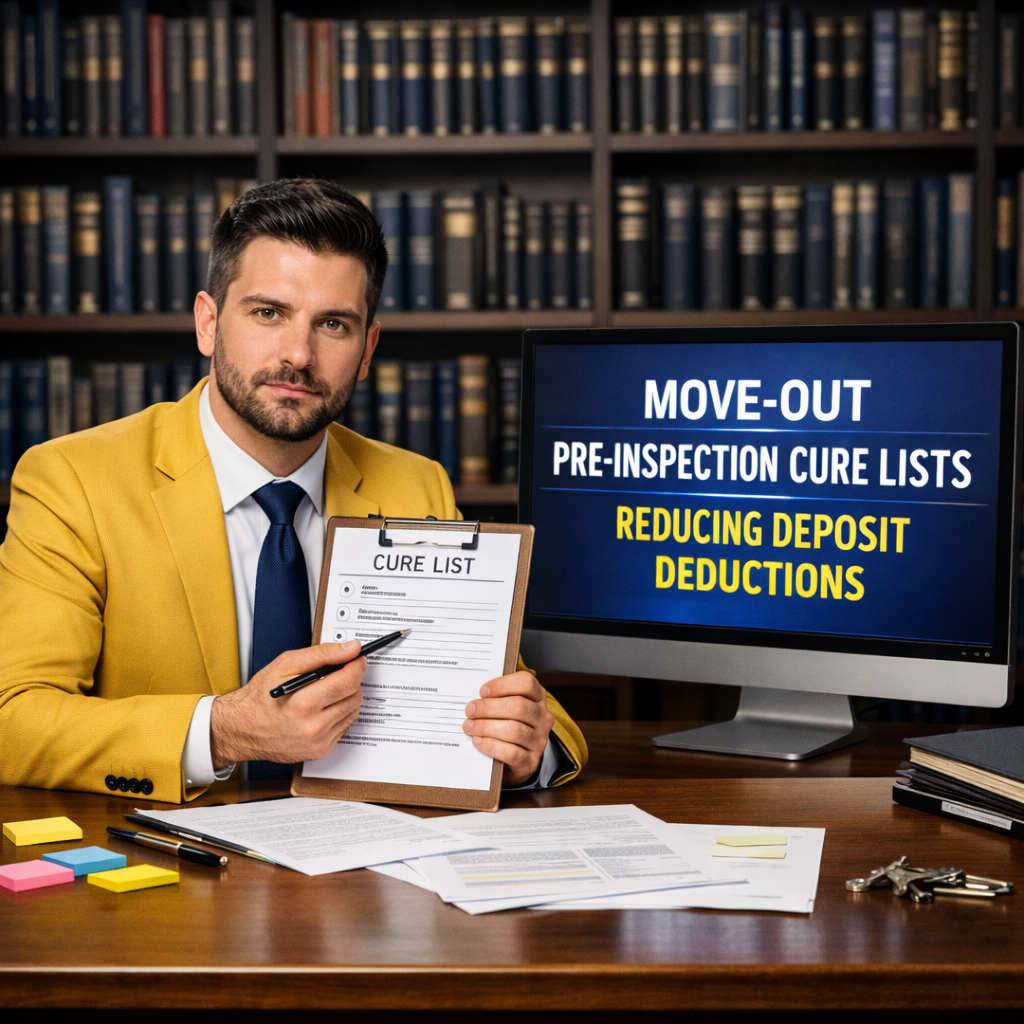
Move-out pre-inspection cure lists reducing deposit deductions
Move-out pre-inspections and cure lists shape deposit deductions, timelines, and evidence in disputes.
Move-out is when small misunderstandings become expensive: a landlord claims “damage,” a tenant says “normal wear,” and the security deposit turns into a fight.
Pre-move-out inspections (often called “pre-inspections” or “walk-throughs”) can change the whole outcome by creating a dated snapshot of conditions and a written list of fixes the tenant can still complete.
This article explains how pre-inspection rights work in practice, what a proper cure list should include, and how both sides document compliance so deposit disputes are easier to resolve.
- Ask early: request the pre-inspection window before move-out week so scheduling delays do not remove the opportunity.
- Demand a written cure list: itemized issues + expected standard + deadline for re-check (or move-out proof).
- Proof sequence matters: before photos → cure work → after photos → receipts → final walk-through notes.
- Deposits often turn on classification: damage vs normal wear, and whether the tenant had a real chance to cure.
See more in this category: CATEGORY NAME
In this article:
Last updated: January 5, 2026.
Quick definition: A move-out pre-inspection is a walkthrough before the tenant leaves that produces a written list of issues the tenant may fix (“cure”) to avoid deposit deductions.
Who it applies to: Tenants planning a move-out and landlords/property managers who expect to charge for cleaning, repairs, or replacements after turnover.
Time, cost, and documents:
- Time: schedule request + inspection date + cure window + final move-out check.
- Cost: often reduces deductions by shifting fixes to the tenant at lower cost.
- Documents: request email/text, dated checklist, photos, receipts, final statement of deductions.
- Evidence: “before/cure/after” chain is usually stronger than opinions.
Key takeaways that usually decide disputes:
- Was a cure opportunity provided where required or promised in the lease/policies?
- Was the list itemized with standards that are measurable (not vague)?
- Do photos show damage or only normal wear and aging?
- Is the charge reasonable compared to the condition and market pricing?
- Were timelines followed for the final deposit accounting and return?
Quick guide to move-out pre-inspection rights
- Request in writing: ask for a pre-inspection date and written cure list; keep a timestamped record.
- Bring your own checklist: photograph walls, floors, appliances, bathrooms, and any disputed areas.
- Push for specificity: each item should name the location, issue, and what “fixed” looks like.
- Confirm the cure method: can you self-repair, hire a vendor, or must the landlord do it?
- Lock the proof chain: “before” photos → cure completion evidence → “after” photos → move-out condition.
- Know the deposit rules: deductions typically must be itemized, supported, and issued within a defined timeline.
Understanding move-out pre-inspections in practice
Pre-inspection rights are not identical everywhere. In some places, they are a statutory right; in others, they exist through lease language, property policy, or fair dealing expectations during turnover.
Further reading:
Even when not strictly required, a pre-inspection can reduce conflict because it changes the argument from “surprise deductions” to “shared checklist + documented outcomes.” That shift matters when money is on the line.
- Cure list must be actionable: “clean bathroom grout” beats “bathroom not acceptable.”
- Separate wear from damage: faded paint, minor scuffs, and aged fixtures are commonly argued as wear.
- Repairs need a reasonableness check: labor rates, parts, and scope should match the condition shown in photos.
- Turnover timing affects fairness: last-day inspections without cure time often lead to higher disputes.
- Itemization wins: a clear line-by-line list is easier to defend than a single large charge.
What a strong cure list looks like
A cure list is best treated as a workflow document, not a complaint. It should identify the issue, the standard, and the evidence expected.
Well-built cure lists usually include location details (room, wall, fixture), and they avoid broad labels like “damage” without explaining what is wrong and why it is chargeable.
- Item ID: “Kitchen – sink cabinet door.”
- Observed issue: “hinge loose; door misaligned.”
- Standard for completion: “door closes flush; hinge secure; no missing hardware.”
- Tenant options: “tighten hinge or replace hinge; keep receipt if purchased.”
- Proof method: “after photo showing alignment; optional short video close test.”
Legal and practical angles that change the outcome
Normal wear vs damage is the central classification dispute. If the item is wear, the charge may be improper or limited; if it is damage, the question becomes proportionality and proof.
Opportunity to cure is another dispute driver. Where law, lease, or policy creates a cure right, denying it can weaken the landlord’s deduction defense and strengthen the tenant’s challenge.
- Proof logic: photos dated near move-out + cure list timing + invoices tied to specific items often decide outcomes.
- Scope logic: replacing an entire item for a small defect raises “betterment” concerns (charging the tenant for an upgrade).
- Process logic: inconsistent standards between tenants can create credibility issues in repeated disputes.
Workable paths landlords actually use to reduce disputes
Operationally, landlords who want fewer deposit fights typically standardize the process: a scheduled pre-inspection, a written cure list with photos, and a consistent final accounting template.
Another approach is offering clear “tenant-proof” instructions: acceptable cleaning standards, common wear examples, and a checklist that mirrors the move-out statement so nobody is surprised.
- Path 1: Pre-inspection + cure list + quick re-check (or tenant photo proof) before move-out day.
- Path 2: Standard turnover pricing with caps or predefined items, reducing subjective charges.
- Path 3: Deposit statement with direct linkage: each charge maps to a cure list item and matching photo.
Practical application of move-out pre-inspections in real cases
In real life, the dispute is usually not about the concept of an inspection. It is about timing, documentation, and whether the tenant had a meaningful chance to fix what is fixable.
A clean workflow reduces emotion and increases clarity. Treat the process like a short project with deliverables rather than a last-minute scramble.
- Send the request: ask for a pre-inspection date, cure list in writing, and the expected completion standard for each item.
- Prepare your baseline proof: take dated photos/video of each room before the pre-inspection (especially disputed areas).
- Attend and document: during the pre-inspection, write down what is said and request the written list the same day.
- Cure intelligently: focus on high-impact items (cleaning standard, minor repairs, trash removal, small holes) and keep receipts.
- Create “after” evidence: re-photo every cured item from the same angle as “before” and save files in a labeled folder.
- Finalize with a move-out packet: send a short summary with cure proof and a forwarding address for deposit return.
Technical details and relevant updates
Pre-inspection rights and deposit rules are state- and locality-dependent. Some jurisdictions require a walkthrough opportunity; others do not, but still regulate deposit accounting, itemization, and timelines.
Even where pre-inspections are optional, the deposit statement commonly must be itemized and issued within a set period after move-out. Documentation quality often determines whether a charge appears credible.
- Timeline sensitivity: late accounting can create leverage in disputes even when some charges were justified.
- Itemization quality: lump-sum “cleaning fee” disputes more easily than a line-by-line breakdown.
- Betterment concern: charging a tenant for full replacement when only partial repair was needed can be challenged.
- Vendor invoices: strongest when they map directly to a specific cure item and location.
Statistics and scenario reads
Deposit disputes tend to cluster around a few repeat categories. The cure list process shifts a portion of those disputes from “opinion” to “documentable compliance.”
These scenario reads are practical heuristics, useful for anticipating what tends to be contested and what tends to settle quickly.
- Distribution (typical dispute buckets): Cleaning standard disputes 28%, Paint/wall marks 22%, Flooring wear vs damage 18%, Missing items/hardware 12%, Trash removal/haul 10%, Misc. repairs 10%.
- Before/after (process impact): Itemized cure list reduces “surprise deduction” claims by 35%, photo pairing improves resolution speed by 25%, standardized charges reduce negotiation time by 18%, re-check option reduces final deductions by 15%.
- Monitorable metrics: % of move-outs with pre-inspection completed, average number of cure items per unit, % of cure items closed by tenant, average deposit withheld amount, dispute rate per 100 move-outs, average days to deposit accounting.
Practical examples of move-out pre-inspection cure lists
Example A: Cleaning + minor wall fixes
- Cure item: “Bathroom – soap scum and mineral buildup.”
- Standard: fixtures and tile free of visible residue under normal lighting.
- Tenant cure: descaling + photos of tub corners and faucet base.
- Outcome: cleaning charge avoided; deposit statement includes “cured” note.
- Cure item: “Living room – small nail holes.”
- Standard: filled, sanded, touch-up consistent with existing paint tone.
- Tenant cure: patch kit receipt + before/after photos from same angle.
- Outcome: repair charge reduced to materials only or removed.
Example B: Flooring and “damage” classification
- Cure item: “Bedroom – stain on carpet edge.”
- Standard: stain treated; if not removable, document attempted professional clean.
- Tenant cure: professional cleaning invoice + post-clean photos.
- Outcome: dispute shifts to reasonableness (cleaning vs replacement), not denial.
- Cure item: “Hallway – deep scratch on laminate.”
- Standard: assess repairability; avoid full replacement unless necessary.
- Tenant cure: repair kit attempt documented; landlord provides repair estimate.
- Outcome: charges more defensible when scope matches the scratch footprint.
Common mistakes in move-out pre-inspections
Late request makes scheduling impossible, then the process becomes “final only” with no cure window.
Vague cure items (“clean better”) create subjective disputes and weaken deposit deductions later.
No photo pairing (before vs after) forces everyone to rely on memory instead of evidence.
Mixing wear and damage in one line item invites challenges about improper charging for aging.
Over-scope repairs (full replacement for a small defect) raises reasonableness and betterment concerns.
Unclear deadlines for cure work and deposit accounting turns a fixable issue into a timeline dispute.
FAQ about move-out pre-inspection rights
Is a pre-move-out inspection always required?
No. Requirements vary by jurisdiction and lease terms. Even when optional, it can still be strategically valuable for proof and dispute reduction.
What is a “cure list” in a move-out context?
A written, itemized list of issues identified before move-out that the tenant can fix to avoid or reduce deposit deductions, with clear completion standards.
How far in advance should the tenant request a pre-inspection?
As early as possible once a move-out date is planned. Waiting until the last week often results in scheduling conflicts and no meaningful cure window.
Can a landlord refuse to provide the cure list in writing?
They may try, but a written list is the most reliable way to avoid disputes. A tenant can send a confirmation message summarizing what was said to create a record.
Do tenants have to fix every item on the cure list?
Not necessarily. Tenants usually prioritize items that are cheap to fix and commonly lead to deductions, while documenting any items they dispute as wear.
What evidence is most persuasive after a cure is completed?
Before-and-after photos from the same angles, receipts, and a brief written summary linking each cure item to the proof file.
Can the landlord still charge after the tenant cures an item?
They may, but the dispute becomes whether the cure met the stated standard and whether additional work was actually necessary and reasonable.
How does “normal wear” usually factor into deposit disputes?
Normal wear generally refers to ordinary aging from reasonable use. Many disputes arise when wear is labeled as damage without clear evidence of misuse.
Are cleaning charges always allowed?
Not always. Charges often must be tied to condition beyond ordinary use and supported by itemization and reasonableness. A pre-inspection can make expectations clear.
What if the pre-inspection happens but there is no time to cure?
That weakens the “cure opportunity” concept. Tenants should document the timing and propose proof-based alternatives (photos, receipts) before the final walk-through.
Can a tenant ask for a re-check after curing items?
Often yes as a practical request, though not always a formal right. Where a re-check is not possible, the next best option is a well-organized proof packet.
What should a deposit deduction statement include?
Typically an itemized list of charges with enough detail to understand what was charged, why, and how amounts were calculated, plus any required timelines for delivery.
What if the landlord’s deductions feel inflated?
Disputes usually focus on reasonableness: scope of work, pricing, and whether replacement is justified. Documentation (photos and invoices) becomes the center of the argument.
References and next steps
Because rules vary by state and locality, the most reliable next step is verifying the specific deposit and inspection framework that governs the property location.
- Next step: Review the lease clauses on move-out, cleaning standards, pre-inspection, and deposit deductions.
- Next step: Check state/local landlord-tenant rules for deposit timelines, itemization, and any required walkthrough opportunity.
- Next step: Build a move-out proof folder: request messages, cure list, before/after photos, receipts, and the final accounting.
- Next step: If a dispute arises, compare each deduction line to the cure list item and matching evidence.
Related reading:
- Security deposit itemization and documentation standards
- Normal wear versus damage: practical classification examples
- Cleaning charge disputes and proof-based resolution
- Move-out timelines, notice requirements, and deposit return windows
- Repair scope disputes and betterment arguments
- Dispute escalation steps: written demand, mediation, small claims preparation
Category path: CATEGORY NAME
Legal basis
Move-out pre-inspection rights and cure opportunities may come from state statutes, local ordinances, and lease terms. Even where pre-inspections are not mandatory, deposit rules typically still regulate itemization, reasonableness, and timelines.
In disputes, decision-makers commonly evaluate whether the process was fair, whether the evidence supports each deduction, and whether the charges reflect necessary work rather than upgrades or generalized turnover costs.
Final considerations
Pre-inspections and cure lists are most effective when treated as a structured proof process: a clear list, a real chance to cure, and a documented before/after chain.
When the process is vague or rushed, disputes become emotional and expensive. When it is specific and documented, disputes become easier to resolve and often smaller.
Key points to carry into move-out week:
- Timing: request early enough to preserve a real cure window.
- Specificity: cure items must be measurable, not subjective.
- Evidence: pair each deduction claim to photos and a matching line item.
- Tenant focus: cure the highest-cost items first and keep clean proof files.
- Landlord focus: standardize cure lists and link deductions to evidence.
- Dispute focus: argue classification and reasonableness using photos, not assumptions.
This content is for informational purposes only and does not replace individualized legal analysis by a licensed attorney or qualified professional.