
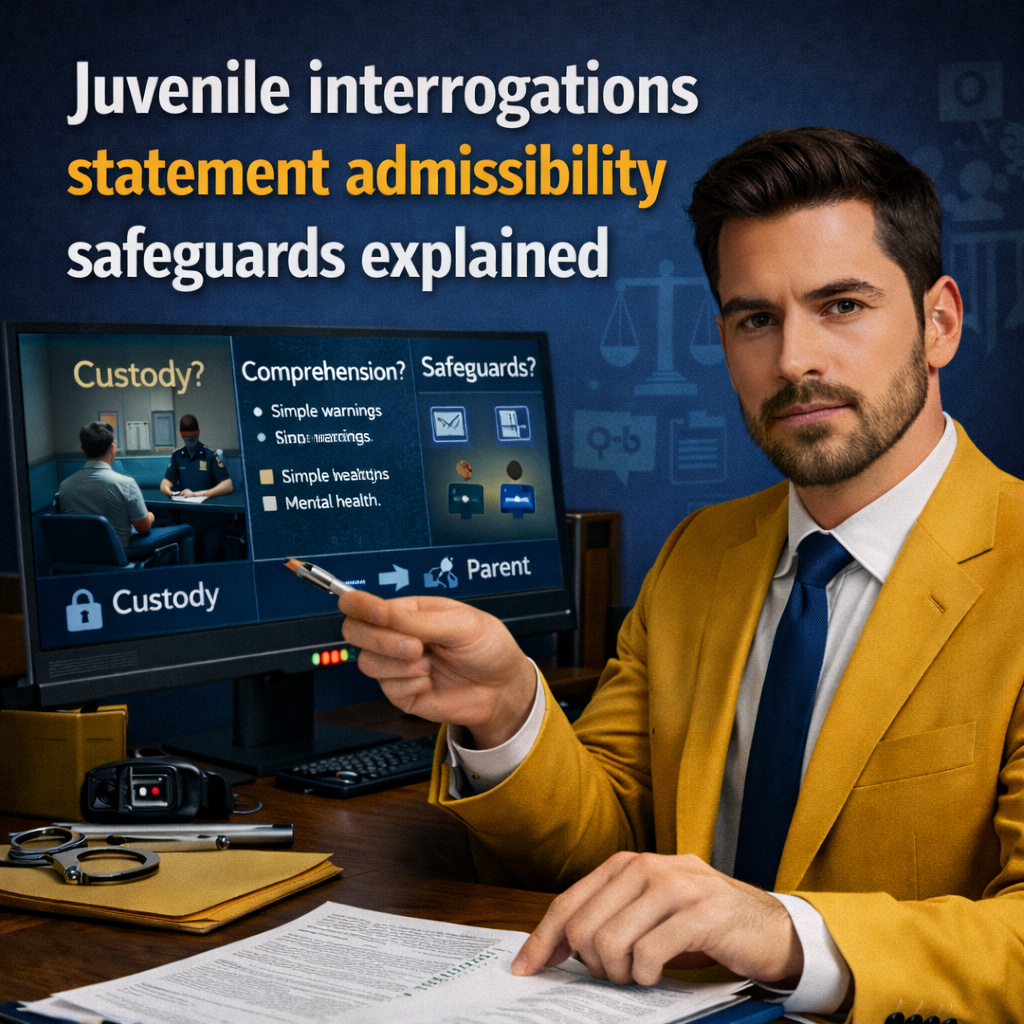
Juvenile interrogations statement admissibility safeguards explained
Juvenile interrogations raise special concerns because children often misunderstand authority, consequences, and the right to remain silent.
Even when officers follow standard procedures, statements from minors can be challenged if safeguards were missing or the waiver was not truly knowing and voluntary.
Juvenile questioning often turns on custody, comprehension, and safeguards that shape whether statements can be used later.
- Age and maturity can change the custody analysis and waiver validity.
- School settings and “informal chats” may still trigger Miranda.
- Parent or attorney access issues often drive suppression motions.
- Recording gaps and unclear timelines can undermine the prosecution narrative.
Quick guide to juvenile interrogations and added protections
- What it is: questioning of a minor by police or agents to obtain statements about suspected conduct.
- When it arises: arrests, school incidents, welfare checks, group interviews, or stationhouse questioning.
- Main legal area: constitutional criminal procedure (Miranda, due process), plus state juvenile statutes and court rules.
- What can go wrong: a waiver may be invalid if the child did not understand rights or felt unable to leave.
- Basic path: preserve evidence, seek counsel early, and litigate admissibility before trial or adjudication.
Understanding juvenile interrogations in practice
Juvenile interrogations are evaluated through a “totality of the circumstances” lens, with special attention to age, comprehension, and pressure.
The key questions are whether the minor was in custody, whether Miranda warnings were required and properly given, and whether any waiver was valid.
- Custody: whether a reasonable person in the child’s position would feel free to end the questioning.
- Interrogation: questioning or tactics likely to elicit an incriminating response.
- Waiver: whether the child knowingly, intelligently, and voluntarily gave up rights.
- Voluntariness: whether coercion, threats, promises, or extreme pressure tainted the statement.
- Added protections: state rules on parental notice, counsel consultation, or recording requirements.
- Short, simple warnings matter; jargon-heavy scripts can backfire with minors.
- School interviews with administrators and SROs can blur “free to leave” signals.
- Time of day, fatigue, and isolation often weigh heavily in voluntariness analysis.
- Parent presence can help or harm, depending on pressure, alignment, and coaching.
- Unrecorded breaks and off-camera conversations create credibility problems later.
Legal and practical aspects of juvenile questioning
Federal constitutional standards set the floor: Miranda is required for custodial interrogation, and due process requires statements to be voluntary.
For juveniles, courts commonly weigh age and vulnerability more heavily when deciding custody and whether a waiver was truly informed.
State law may provide additional protections, such as requiring parental notification, mandating recording in certain settings, or limiting waivers without counsel for younger children.
- Factors often analyzed: age, education, language, mental health, prior justice exposure, and comprehension testing.
- Setting factors: stationhouse vs. school, number of officers, display of weapons, physical positioning, door control.
- Time factors: duration, late-night questioning, long waits, and repeated rounds after a denial.
- Behavior factors: promises of leniency, minimizing the seriousness, threats, or suggesting silence will “look bad.”
Important differences and possible paths in juvenile cases
Juvenile proceedings differ from adult cases in goals and terminology, but statements can still decide outcomes such as detention, diversion eligibility, or adjudication.
Common paths include early diversion discussions, a motion to suppress statements, or a negotiated resolution that accounts for evidentiary strength and long-term consequences.
- Informal resolution: may be available when evidence is weak or rehabilitation plans are strong; caution against admissions.
- Suppression litigation: challenges custody, interrogation tactics, waiver comprehension, and voluntariness.
- Appeal or review: may follow an adverse ruling, especially where recording or statutory safeguards were ignored.
Practical application of juvenile protections in real cases
Problems often appear when a student is questioned at school after an incident, when a child is picked up and “asked to explain,” or when multiple minors are interviewed together.
Minors are commonly affected because they are more likely to speak to end discomfort, to please authority figures, or to misunderstand that “leaving” is an option.
Further reading:
Evidence and documentation typically include video/audio recordings, dispatch logs, school discipline records, interview notes, consent forms, and timelines showing when warnings were given.
- Preserve timelines: identify when contact began, where it occurred, and who controlled movement and exits.
- Secure recordings: request body-worn camera, station video, school security footage, and interview room audio.
- Assess Miranda triggers: analyze custody signals and whether questions were designed to elicit admissions.
- Evaluate waiver validity: examine the script used, the child’s comprehension, language needs, and any pressure.
- Litigate or negotiate: file a suppression motion when warranted and use evidentiary weaknesses in resolution talks.
Technical details and relevant updates
Modern juvenile cases frequently turn on how courts interpret “custody” for minors, including whether age is part of the reasonable-person analysis.
Many jurisdictions also focus on the reliability of juvenile statements, recognizing that developmental factors can increase false or inaccurate admissions.
Recording expectations have grown over time, and missing recordings may affect credibility, compliance findings, or remedial instructions even when not strictly required.
- School interviews: administrative questioning can become custodial if police direct it or control the encounter.
- Consultation rules: some states require access to a parent, guardian, or counsel before waiver in certain cases.
- Language and disability: interpreters and accommodations can be essential for any valid waiver analysis.
- Re-interrogation: repeated questioning after an invocation can trigger suppression depending on facts and timing.
Practical examples of juvenile interrogation issues
Example 1 (more detailed): A 14-year-old is taken from class to a conference room with a school resource officer and an administrator. The door is closed, the student is told to “be honest,” and the officer asks leading questions about a phone theft. The student is not told they can leave, and a parent is not contacted until after the interview. Later, the defense requests the video and discovers no recording exists for the first 20 minutes. A suppression motion argues the student was effectively in custody due to isolation, authority pressure, and age-based perceptions, and that any waiver was not knowing because the warnings were delayed and delivered in adult language. The outcome may depend on the custody finding, the credibility of the timeline, and whether state rules required notice or recording.
Example 2 (shorter): A 16-year-old is questioned at the station after a traffic stop. Miranda is read, but the officer paraphrases key lines and quickly asks “you good?” The teen nods and talks for an hour while exhausted. A challenge may focus on comprehension, fatigue, and whether the waiver was truly informed under juvenile standards.
Common mistakes in juvenile interrogation cases
- Assuming a school interview is “not police” even when officers control the encounter.
- Failing to request all recordings, including hallway, transport, and pre-interview audio.
- Overlooking language needs, learning disabilities, or mental health factors affecting comprehension.
- Ignoring breaks, off-camera conversations, and shifting locations that change custody analysis.
- Relying on a parent’s presence without assessing whether it increased pressure or confusion.
- Waiting too long to consult counsel, allowing narratives to harden before evidence is preserved.
FAQ about juvenile interrogations and added protections
Does Miranda always apply when a minor is questioned?
Miranda generally applies only to custodial interrogation. For juveniles, “custody” can be influenced by age and setting, especially when the child would not feel free to leave. Non-custodial conversations may still be scrutinized for voluntariness and pressure.
Is a parent required to be present during juvenile questioning?
Federal law does not universally require a parent’s presence, but many states provide added protections such as notification or consultation rules in certain cases. Even without a strict requirement, parent access issues can matter in the totality-of-circumstances analysis for waiver and voluntariness.
What documents and evidence matter most if a statement is challenged?
Recordings, dispatch and transport logs, interview notes, and a clear timeline are central. School records, witness statements about the setting, and information about the child’s comprehension (language, disabilities, prior exposure) can also be critical. These materials help assess custody, Miranda triggers, and whether any waiver was valid.
Legal basis and case law
Juvenile interrogations are anchored in the Fifth Amendment privilege against self-incrimination and the Miranda framework governing custodial interrogation. The Fourteenth Amendment due process voluntariness standard also applies, requiring that statements be the product of a free and rational choice rather than coercion.
Juvenile-specific doctrine emphasizes a totality-of-the-circumstances approach for waiver validity, commonly weighing age, intelligence, experience, and pressure. Courts also address how age affects the custody analysis and whether the minor reasonably felt free to end the encounter.
Key decisions often cited in this area include Miranda v. Arizona (warnings and custody/interrogation framework), In re Gault (due process protections in juvenile proceedings), Fare v. Michael C. (juvenile waiver evaluated under totality), and J.D.B. v. North Carolina (age can be relevant to custody). Outcomes frequently turn on facts rather than broad labels, especially in school settings and informal interviews.
Final considerations
Juvenile interrogations require careful attention to custody signals, warning timing, and whether the child truly understood the choice to remain silent and request counsel.
Strong practice centers on preserving recordings, building a precise timeline, and documenting factors that affect comprehension and voluntariness, especially in school-based encounters.
This content is for informational purposes only and does not replace individualized analysis of the specific case by an attorney or qualified professional.