
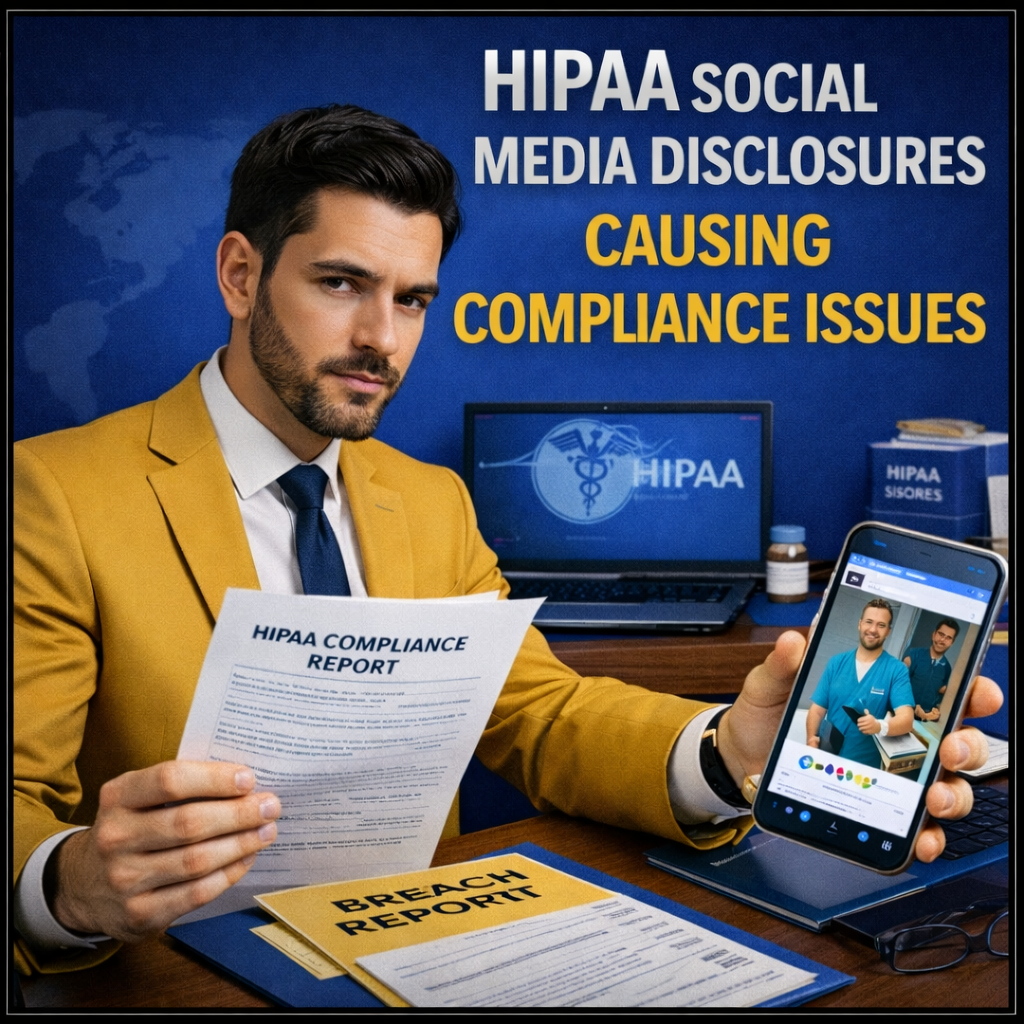
HIPAA social media disclosures causing compliance issues
Social media makes it easy for healthcare staff to share workplace moments, patient “success stories,” or behind-the-scenes images. The same speed and visibility can also create privacy exposure when posts reveal protected health information (PHI), even indirectly through photos, captions, timestamps, locations, or distinctive details.
HIPAA questions often arise because the line between personal speech and workplace information is not always obvious. A post that seems harmless can become a “disclosure” if it identifies a patient or allows identification when combined with other information, triggering internal investigations, takedown requests, and possible reporting duties.
- Patient photos or stories may reveal PHI through context or metadata.
- Posts can trigger internal discipline, audits, and corrective action plans.
- Delayed removal and review can complicate breach assessments and timelines.
- Inconsistent policies increase exposure across teams and locations.
Quick guide to HIPAA and social media disclosures by staff
- What it is: workplace social posts that may disclose patient-related information governed by the HIPAA Privacy Rule.
- When it arises: photos in clinical areas, patient “shout-outs,” screenshots, messages, or comments about cases.
- Main legal area: HIPAA Privacy Rule, Breach Notification Rule, and related workforce policies.
- What can go wrong: unauthorized disclosure findings, reportable breach determinations, sanctions, and reputational damage.
- Basic path to address it: preserve evidence, remove/limit the post, perform a breach risk assessment, and document corrective steps.
Understanding HIPAA and social media disclosures by staff in practice
HIPAA generally regulates covered entities (providers, health plans, clearinghouses) and their business associates. Staff members acting within the “workforce” of a covered entity can create a HIPAA issue when a post discloses PHI without a permitted basis or a valid patient authorization.
Not every mention of work creates a HIPAA event. The central question is whether the content includes PHI or enables identification. This can happen through names, faces, medical details, room numbers, dates, unique circumstances, or even a recognizable background.
- Direct identifiers: names, faces, addresses, dates of service, medical record numbers.
- Indirect identifiers: distinctive tattoos, rare diagnoses, unique incidents, location tags, timing clues.
- Format does not matter: text, images, video, audio, comments, reposts, or private groups.
- “De-identified” claims: weak anonymization can still allow re-identification in small communities.
- Scope expansion: a post can spread and be copied before removal.
- Faces, voice, wristbands, and charts commonly create identification.
- Context clues (dates, units, locations) can be enough to identify.
- “Patient consent” must usually be a compliant written authorization.
- Documentation of the incident response often matters as much as removal.
- Repeated issues typically signal training and policy gaps.
Legal and practical aspects of staff social media disclosures
HIPAA permits uses and disclosures of PHI for treatment, payment, and healthcare operations, and for certain public interest purposes. Social media posts about patient care typically do not fit these categories. When a post is tied to marketing, storytelling, or general visibility, a patient authorization is commonly required.
Operationally, organizations often handle a social media incident through an internal privacy process: immediate containment, preservation of evidence, review of who saw the content, and evaluation of what was exposed. A covered entity may also need to coordinate with human resources, compliance, and security teams.
- Authorization review: verify whether a written HIPAA authorization exists and whether it covers the exact use.
- Minimum necessary: if any disclosure is permitted, limit content to the least information required.
- Breach assessment: assess probability that PHI was compromised based on content, audience, and mitigation.
- Timing control: document when the post was created, discovered, removed, and confirmed removed.
- Corrective action: training refreshers, policy updates, and technical safeguards where feasible.
Important differences and possible paths in staff social media cases
Cases differ by content and visibility. A public post with identifiable patient imagery is typically treated more seriously than a generic post about work stress. Posts in “private” groups can still qualify as disclosures, especially when membership is large or not controlled by the covered entity.
- Patient-identifying content: photos/videos in clinical areas, charts, wristbands, or patient stories with unique details.
- Workplace-only content: non-patient images that still raise policy issues (badges, internal systems, schedules).
- Third-party content: reposts, tags, or comments that amplify an original disclosure.
- Device and account differences: employer-issued devices and official pages add governance obligations.
Common paths include an internal resolution (takedown, discipline, training), a formal breach response with notifications if required, and in high-impact situations, engagement with counsel to preserve privilege and coordinate reporting. Appeals or disputes typically relate to whether the content was identifiable PHI and whether mitigation reduced the likelihood of compromise.
Practical application of staff social media disclosures in real cases
Incidents often start with a screenshot from a coworker, a patient complaint, or a compliance audit. Posts may involve “celebration” photos, emergency department stories, before-and-after images, or casual comments about unusual cases that are easy to recognize locally.
Relevant evidence usually includes the original post, timestamps, captions, hashtags, comments, reposts, platform analytics (views/shares), device logs when available, and internal communications documenting the response. A structured record helps explain what happened and what steps were taken to mitigate exposure.
- Preserve evidence: capture screenshots, URLs, timestamps, and copies of comments and shares.
- Contain quickly: request removal, restrict visibility, and prevent reposting from official channels.
- Assess identifiability: evaluate whether PHI was disclosed directly or through context and metadata.
- Run breach analysis: document the probability of compromise and the mitigation steps performed.
- Implement corrections: retraining, policy updates, and reinforcement of approval workflows.
Technical details and relevant updates
Social media events often intersect with security and compliance beyond the visible post. Screenshots may persist, and some platforms cache content. A “deleted” post can remain accessible through reposts, downloads, or third-party archives, affecting mitigation analysis.
Further reading:
Organizations increasingly use written social media standards that address photographs in clinical areas, consent documentation, marketing approvals, and “no filming” zones. Technical safeguards may include disabling cameras in certain applications, limiting access to clinical systems from personal devices, and monitoring for PHI keywords on official channels.
For multi-state operations, state medical privacy rules and professional licensing standards may add obligations beyond HIPAA, particularly around psychotherapy notes, minors, and sensitive services. Coordination across privacy, HR, and communications teams reduces inconsistent handling.
- Metadata controls: location tagging, timestamps, and background details can create identifiability.
- Platform retention: reposts, caches, and archives can outlast deletion.
- Role-based rules: marketing, clinicians, and contractors may have different approval workflows.
- Documentation discipline: consistent incident logs support defensible decision-making.
Practical examples of staff social media disclosures
A hospital staff member posts a short video celebrating a successful procedure, recorded at a nurse’s station. A patient name appears briefly on a whiteboard in the background, and a wristband is visible on a bed in the corner. The post is shared publicly, and a family member recognizes the patient’s room setup. The organization preserves evidence, requests immediate removal, documents the time window of exposure, and performs a breach assessment focused on identifiability, audience scope, and mitigation, while implementing a camera-free zone policy for clinical areas.
A clinic employee posts a photo of a “busy day” with paperwork on a desk. The image includes a partially visible referral form and a schedule with initials and appointment times. The content is removed quickly after internal reporting, and the response emphasizes staff training on photographing workspaces and handling printed materials.
Common mistakes in staff social media disclosures
- Assuming “no name shown” means the content is not identifiable.
- Relying on verbal consent instead of a compliant written authorization.
- Delaying takedown while debating policy or intent.
- Failing to preserve screenshots, timestamps, and share metrics.
- Inconsistent enforcement between departments or shifts.
- Ignoring background details such as charts, wristbands, or location tags.
FAQ about staff social media disclosures under HIPAA
Do staff social media posts count as HIPAA disclosures?
They can, if the post includes PHI or enables identification of an individual and relates to healthcare services. The platform type does not determine HIPAA status; content and identifiability are the key factors. Even indirect clues can create identification in small communities.
Who is most affected when a post is made?
Patients may experience privacy harm, while covered entities face compliance duties and reputational exposure. Staff may face discipline under workplace policies. Contractors and business associates can also be involved if they handle PHI or publish content on behalf of the organization.
What documents and steps matter after discovery?
Important items include preserved screenshots, timestamps, platform analytics, and internal incident records showing removal and mitigation. A documented breach assessment is commonly central to decision-making. Policies, training records, and any relevant authorizations should be collected and reviewed.
Legal basis and case law
HIPAA’s Privacy Rule (45 C.F.R. Parts 160 and 164) governs when PHI may be used or disclosed by covered entities and business associates. In practice, disclosures for publicity, marketing, or storytelling commonly require a valid written authorization that clearly describes the information, purpose, and recipient.
The Breach Notification Rule (45 C.F.R. Part 164, Subpart D) addresses when an impermissible use or disclosure may require notification. The analysis typically considers the nature of the information, who received it, whether it was actually viewed, and the extent of mitigation. The Security Rule (45 C.F.R. Part 164, Subpart C) can also be implicated if device access, account security, or safeguards contributed to exposure.
Enforcement trends often emphasize organizational responsibility for workforce training, policies, and consistent response documentation. When corrective action is prompt, well-documented, and paired with meaningful prevention steps, outcomes often improve. When patterns repeat without systemic change, enforcement attention can increase.
Final considerations
Staff social media disclosures can create privacy exposure not only through obvious identifiers, but through context and background details that enable recognition. Fast containment, careful documentation, and a structured breach assessment help reduce uncertainty and support defensible decisions.
Clear policies, routine training, and practical guardrails around photographing clinical areas and paperwork are central to prevention. Consistent handling across teams, locations, and shifts reduces mixed messages and helps sustain compliance over time.
This content is for informational purposes only and does not replace individualized analysis of the specific case by an attorney or qualified professional.