
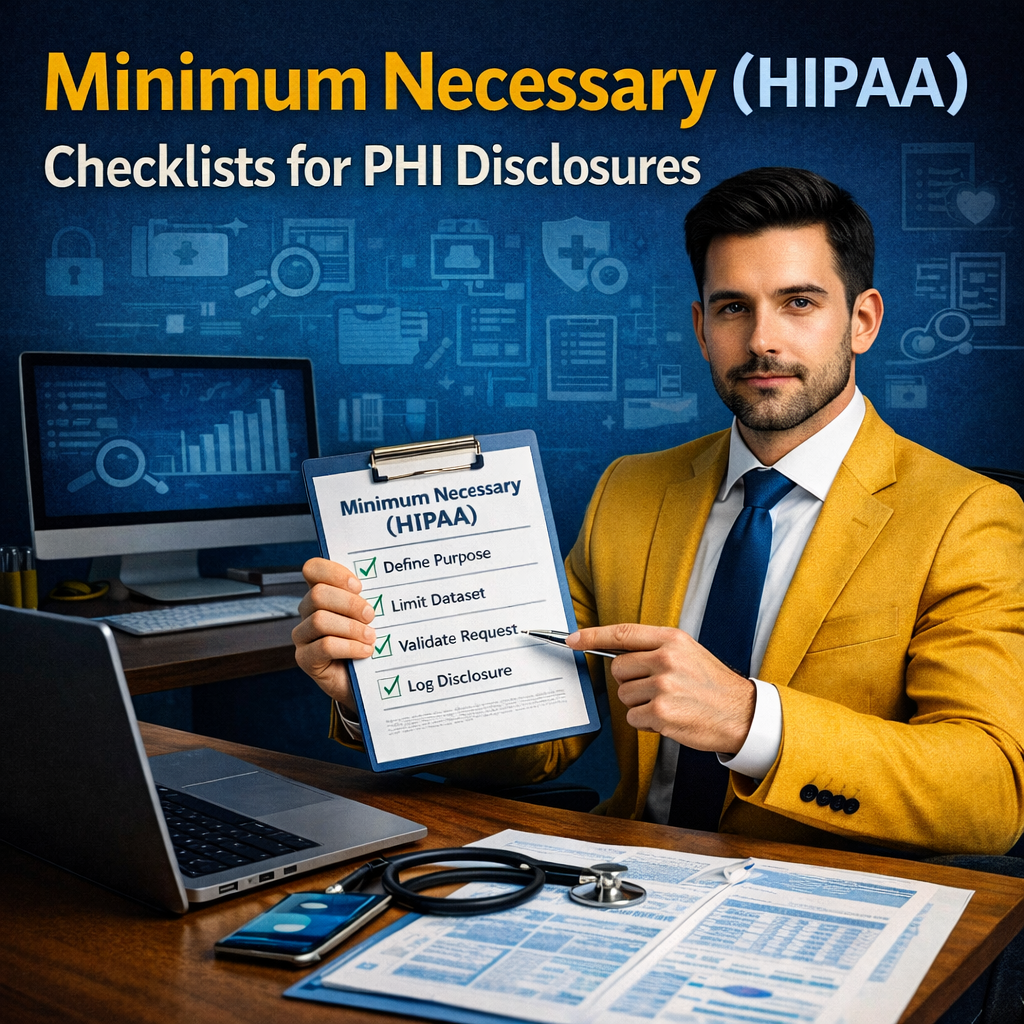
Minimum Necessary (HIPAA) Checklists for PHI Disclosures
Minimum Necessary is easy to misapply, and strong checklists reduce over-disclosure and audit exposure.
“Minimum Necessary” sounds simple, but in day-to-day operations it often breaks down at the moment someone needs data fast: a scheduler asks for extra details, a vendor requests a full export, or a team shares a report “just in case.”
The practical challenge is separating what is helpful from what is permitted, and documenting that decision in a way that holds up when a request is questioned later.
- Over-sharing PHI beyond a defined purpose
- Vendors and tools receiving broader data than needed
- Workforce access not aligned to role-based duties
- Weak logging and approvals for disclosures
Quick guide to Minimum Necessary (HIPAA)
- What it is: limiting PHI use, access, and disclosure to what is reasonably needed for a specific purpose.
- When it arises: routine operations (billing, QA, analytics, customer support, vendor tickets), and most non-treatment disclosures.
- Main legal area: HIPAA Privacy Rule operational compliance, tied to Security Rule controls.
- What happens if ignored: unnecessary PHI exposure, compliance findings, corrective actions, and reputational damage.
- Basic path to fix: define purposes, build role-based access, standardize requests, and document approvals and exceptions.
Understanding Minimum Necessary (HIPAA) in practice
Minimum Necessary is not a single rule; it is an operating discipline. The core idea is to match the purpose of a use or disclosure to a bounded dataset, using policies, access controls, and repeatable checklists.
In practice, teams struggle when “purpose” is vague. The most defensible approach is to define permitted purposes and tie each one to a pre-approved data scope and an escalation path for exceptions.
- Purpose definition: why the PHI is needed, in plain operational terms.
- Data scope: which identifiers and clinical fields are in-scope and out-of-scope.
- Audience: who can receive it (internal role, vendor function, external requester category).
- Method: how it is shared (portal, secure file transfer, encrypted email, API, view-only access).
- Retention: how long it is kept, and how it is disposed of.
- Start with “purpose then data”: never approve a dataset before the purpose is written down.
- Prefer segmented access: views, filters, and scoped exports beat “full record” pulls.
- Make it routine: standard request forms reduce ad-hoc decisions under pressure.
- Track exceptions: approvals, rationale, and expiration dates for expanded access.
- Verify vendors: align minimum dataset, safeguards, and return/destruction terms.
Legal and practical aspects of Minimum Necessary
Minimum Necessary generally applies to uses, disclosures, and requests for PHI. Covered entities should identify “reasonably necessary” information for typical scenarios and build policies that guide the workforce to consistent outcomes.
A common operational pitfall is treating Minimum Necessary as a purely technical limitation. It is also a process requirement: training, documented procedures, and a clear way to handle exceptions are part of what regulators and auditors look for.
- Role-based access: access must map to job functions, not convenience.
- Standard protocols: routine disclosures should have predefined scopes.
- Request validation: confirm requester identity and authority where applicable.
- Secure transmission: use methods appropriate to the sensitivity and channel.
- Documentation: record what was shared, why, and under what authority.
Important differences and possible paths in Minimum Necessary
Not every HIPAA disclosure is treated the same. The Minimum Necessary analysis depends on the type of disclosure, the recipient, and the purpose. Operational teams often benefit from a simple “lane” model for requests.
- Routine operations lane: billing, payment integrity, QA, and support with standardized scopes and templates.
- External request lane: third parties, insurers, and vendors with identity checks and written terms.
- Exception lane: expanded access requiring documented approval, time limits, and monitoring.
- Special authority lane: authorizations, subpoenas, and other formal processes routed to legal/compliance review.
Typical paths include a policy-and-training refresh for quick stabilization, a controls project (RBAC, logging, segmentation) for durable change, and a contract remediation initiative for vendors and data flows. Each path works best when paired with sampling reviews and metrics that show reduced over-disclosure.
Practical application of Minimum Necessary in real cases
Minimum Necessary issues most often surface in everyday scenarios: a staff member prints a full chart for a limited task, a developer requests production data for debugging, or a vendor asks for a complete export to “improve service quality.”
Those most commonly affected include billing teams, call centers, IT and security staff, analytics groups, and vendors providing hosting, customer support, transcription, or claims services. The key is to make “what data is needed” a documented question, not a guess.
Useful evidence and records include request tickets, disclosure logs, role definitions, access reviews, training attestations, vendor data-flow maps, and written protocols for common disclosures.
Further reading:
- Define the purpose: capture a short statement describing why the PHI is needed and by whom.
- Select the minimum dataset: use a standard template (fields + identifiers) tied to that purpose.
- Validate authority: confirm recipient identity, relationship, and required documentation if external.
- Use controlled sharing: prefer scoped access, secure transfer methods, and time-limited availability.
- Document and review: log the disclosure, set retention limits, and sample-check for over-disclosure patterns.
Technical details and relevant updates
Minimum Necessary becomes easier to enforce when systems support segmentation and monitoring. Practical controls include field-level permissions, export restrictions, masking, and workflow approvals that prevent “one-click full record” sharing.
From a governance perspective, align Minimum Necessary with Security Rule practices: access management, audit controls, and integrity protections help demonstrate that policies are backed by real safeguards.
Organizations also benefit from periodic “protocol refresh” cycles, where common disclosures are re-evaluated against current workflows, vendor relationships, and tools. This reduces drift over time.
- Scoped exports: pre-built reports with limited fields for routine tasks.
- Just-in-time access: time-bound elevation for exceptions with approval trails.
- Monitoring: alerts for unusually large exports or atypical access patterns.
- Vendor controls: minimize shared fields and enforce deletion/return obligations.
Practical examples of Minimum Necessary
Example 1 (more detailed): A revenue cycle team outsources claim appeals to a vendor. The vendor requests full medical records for every appeal. Compliance narrows the dataset to what is typically needed (relevant dates of service, limited clinical notes tied to the appeal reason, billing codes, and supporting documentation), adds a protocol for exceptions, and updates the vendor agreement to require role-based access, logging, and return/destruction of PHI at the end of each appeal. The organization keeps request tickets and sampling results as evidence of consistent application.
Example 2 (shorter): A support agent needs to verify a patient portal login issue. Instead of pulling the entire chart, the agent uses a limited support view showing account status, last login timestamps, and contact verification details, then escalates to a supervisor only if additional information is required.
Common mistakes in Minimum Necessary
- Approving “full record access” for convenience instead of purpose-limited scopes
- Allowing vendor tools to ingest broader PHI than their function requires
- Skipping identity and authority checks for external requests
- Failing to define routine disclosure protocols and exception approvals
- Weak logging, making it hard to prove what was shared and why
- Keeping exports indefinitely without clear retention and disposal steps
FAQ about Minimum Necessary
Does Minimum Necessary apply to all HIPAA disclosures?
No. It generally applies to many uses and disclosures, but certain situations are treated differently, such as disclosures for treatment and disclosures to the individual. The operational key is to classify the request correctly before deciding the dataset scope.
Which teams usually struggle most with Minimum Necessary?
Billing, customer support, analytics, IT, and vendor management frequently face pressure to move fast and may over-share by default. Clear protocols and scoped system views reduce the need for ad-hoc judgment calls.
What documents help defend Minimum Necessary decisions?
Standard disclosure protocols, role definitions, access reviews, request tickets, vendor data-flow documentation, training records, and disclosure logs are commonly relied on. Sampling reports showing reduced over-disclosure are also useful when demonstrating consistent practice.
Legal basis and case law
The Minimum Necessary standard is rooted in the HIPAA Privacy Rule’s requirement to limit uses, disclosures, and requests for PHI to what is reasonably necessary for the intended purpose. In practical terms, this supports data minimization and reduces unnecessary exposure during routine operations.
Related Privacy Rule provisions also emphasize building policies for typical disclosures and applying safeguards for workforce access. When Minimum Necessary is treated as a documented protocol rather than a vague principle, organizations can show consistent implementation across teams and vendors.
In enforcement actions and compliance reviews, agencies commonly focus on patterns: broad access without role limits, repeated large disclosures to vendors, weak documentation, and inadequate monitoring. Courts and regulators tend to view written protocols and demonstrated controls as indicators of good-faith compliance.
Final considerations
Minimum Necessary compliance is most effective when it is operationalized: defined purposes, scoped datasets, and consistent procedures that work under real pressure. Checklists help teams make fast decisions without defaulting to “send everything.”
Durable improvement usually comes from combining process and technology: role-based access, segmented views, controlled exports, vendor data limits, and meaningful documentation that explains why a disclosure was appropriate.
This content is for informational purposes only and does not replace individualized analysis of the specific case by an attorney or qualified professional.