
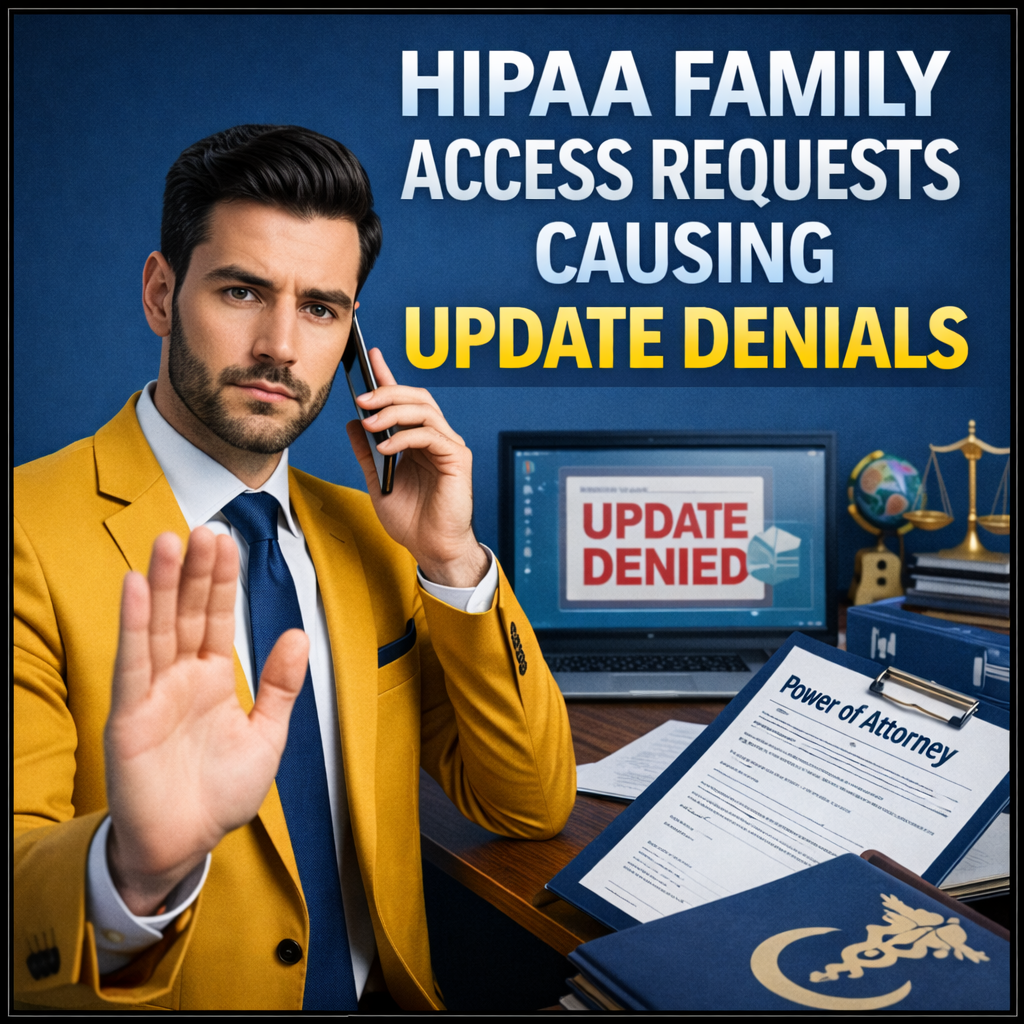
HIPAA family access requests causing update denials
Family access under HIPAA depends on authority and context, avoiding improper disclosures and stressful care delays.
Family members often assume they automatically have access to a loved one’s health information, especially during emergencies or complicated care. HIPAA can feel like a wall when staff say “we can’t share anything,” even when the family is trying to help.
Confusion grows because the answer changes depending on the situation: adult vs minor, in-person vs phone updates, emergency care vs routine visits, and whether someone has formal authority to act as a personal representative.
- Over-sharing to family can trigger reportable privacy incidents and discipline.
- Under-sharing can delay care coordination, discharge planning, and safety decisions.
- Missing authority documents often causes “no updates” responses and rework.
- Phone and portal communications create extra identity and verification hurdles.
Quick guide to HIPAA and family access to information
- What it is: rules on when providers and plans may share PHI with relatives and caregivers, and when authority is required.
- When issues arise: hospital updates, discharge coordination, picking up prescriptions, billing questions, and emergency situations.
- Main legal area involved: HIPAA Privacy Rule, personal representative authority, and permitted disclosures in care contexts.
- What happens when ignored: improper disclosures, denial of helpful updates, and avoidable delays in decisions.
- Basic path to fix it: clarify relationship and purpose, document authority when needed, and request a limited, appropriate disclosure.
Understanding HIPAA and family access in practice
HIPAA generally allows health professionals to share certain information with family or friends involved in a person’s care, but it does not create a blanket “family access” rule. The disclosure usually must be appropriate to the situation and limited to what is relevant.
One of the biggest differences is between a family member who is simply helping and a person who is a personal representative. A personal representative is someone legally authorized to act for the patient, and that status often changes what can be requested.
- Patient agreement or opportunity to object: when the patient is present and can agree, object, or limit what is shared.
- Professional judgment: when staff reasonably believe sharing limited information is in the patient’s best interest.
- Personal representative authority: when a legal document makes someone the patient’s decision-maker for health matters.
- Emergency context: when limited information may be shared to help locate or notify family.
- Minimum necessary mindset: sharing what is needed for the purpose, not a full record by default.
- Authority documents often matter more than relationship labels.
- Updates vs full records are different requests with different handling.
- Patient preferences can limit what staff may share with family.
- Identity verification drives many “no information by phone” outcomes.
- Scope limitations help staff share appropriately without over-disclosing.
Legal and practical aspects of family access
HIPAA permits certain disclosures to family or friends involved in care when the patient agrees or does not object after being given an opportunity. If the patient is not present or cannot meaningfully decide, providers may use professional judgment to share limited information that is relevant to the person’s involvement.
Personal representative rules are different. When someone has legal authority to make health care decisions, that person is often treated as the patient for access and decision purposes, subject to important exceptions. This is why facilities frequently ask for documentation such as health care power of attorney paperwork or guardianship orders.
Special situations can change the analysis. For minors, parents often have access, but state law and specific circumstances can limit parental access. For adult patients, spouses and adult children do not automatically have full access unless the patient permits it or they have recognized authority.
- Identity checks: facilities may require codes, ID presentation, or portal verification.
- Purpose-limited updates: information may be limited to the care involvement context.
- Written documentation: power of attorney, guardianship, or court orders are often required for broader access.
- Separate record types: certain sensitive notes may have tighter disclosure practices.
- State law overlays: state rules can expand or restrict family access in specific contexts.
Important differences and possible paths in family access situations
A practical difference is between status updates and copies of records. A provider may be able to share a limited update with a caregiver involved in care, while releasing full records to a third party typically requires a formal HIPAA authorization or personal representative authority.
Another difference is between in-person communication and remote requests. Phone calls and emails raise identity verification and documentation issues, often leading facilities to limit disclosures unless the patient has set up permissions in advance.
- Patient-directed permission: the patient identifies who may receive updates and what topics may be shared.
- Personal representative route: provide the legal document and request access consistent with that authority.
- Limited disclosure approach: request only what is necessary for care coordination or safety planning.
Practical application of family access in real cases
Family access disputes often appear during hospitalization, after surgery, when discharge is being planned, or when someone needs help managing medications and follow-up visits. Staff may be cautious because a small mistake can become a serious disclosure incident.
Those most commonly affected include caregivers coordinating transportation and medications, adult children helping aging parents, and spouses trying to manage urgent decisions. The most relevant documents are the ones that show authority and a clear communication preference.
Further reading:
Useful evidence includes copies of power of attorney or guardianship documents, written patient permissions, portal settings, contact notes, and any facility forms that list approved family contacts or verification codes.
- Clarify the request: limited status update, care coordination details, billing information, or full record copies.
- Confirm patient preference: ask whether the patient has designated contacts or restrictions.
- Provide authority documents: submit power of attorney, guardianship order, or equivalent proof if applicable.
- Use a narrow scope: request information tied to involvement in care rather than the entire record.
- Escalate appropriately: contact the privacy officer or patient relations when communication is inconsistent or unclear.
Technical details and relevant updates
Many facilities use patient portals and communication tools that allow patients to grant proxy access. Proxy access can streamline information sharing, but it may still be limited by facility policy and the type of information involved.
Phone updates remain difficult because the facility must verify identity without visual confirmation. Facilities often use a password, verification code, or a call-back process. When these tools are not set up, the facility may default to “no information by phone” to prevent mistakes.
Emergency and disaster contexts can create narrower, purpose-driven disclosures to help locate or notify family. Even then, staff typically limit the disclosure to what is needed and document the basis for sharing.
- Portal proxy setup: approved caregiver access can reduce delays for routine updates.
- Verification protocols: codes and call-back methods reduce misidentification errors.
- Documentation practices: recording who received information and why supports audit readiness.
- Record-release workflows: full records to third parties often require formal authorization steps.
Practical examples of HIPAA and family access
Example 1 (more detailed): An adult patient is hospitalized after a stroke and cannot reliably communicate. An adult child calls for updates and to coordinate discharge planning. The hospital verifies identity, confirms the caller’s involvement in care, and uses professional judgment to share limited information about general condition and discharge needs. When the child requests full records for an attorney, the hospital explains that a HIPAA authorization or personal representative documentation is needed. The family provides a health care power of attorney document, and the hospital then routes the request through the formal records process with documented verification.
Example 2 (shorter): A spouse calls for lab results but the patient previously asked staff not to share details. Staff provide a neutral response and offer a pathway for the patient to update permissions or add portal proxy access if desired.
Common mistakes in family access situations
- Assuming spouse or adult child status automatically allows full record access.
- Requesting “everything” instead of a limited update tied to care coordination.
- Failing to provide power of attorney or guardianship documents when needed.
- Trying to rely on phone calls without verification codes or portal permissions.
- Ignoring patient preferences and restrictions documented in the record.
- Mixing routine updates with third-party record releases that require formal authorization.
FAQ about HIPAA and family access
Can a provider share information with family members without written permission?
Sometimes. If the patient agrees or has a chance to object and does not, limited information relevant to the family member’s involvement in care may be shared. If the patient cannot decide, staff may use professional judgment to share limited information in the patient’s best interest, depending on the circumstances.
Who is most likely to face denial of updates or access?
Family members requesting information remotely without verification, caregivers who are not documented in the record, and relatives seeking full records for non-care purposes are commonly denied. Adult-patient situations are especially sensitive because family members do not automatically have full access.
What documents help when family access is limited or denied?
Helpful documents include a health care power of attorney, guardianship orders, written patient permission forms, portal proxy access settings, and facility contact forms listing approved recipients. Written notes showing the purpose of the request and the caregiver role can also support limited disclosures.
Legal basis and case law
The HIPAA Privacy Rule framework governing disclosures to family and friends is found in 45 CFR Part 164. Disclosures involving family involvement and best-interest judgments are commonly associated with 45 CFR 164.510(b), while personal representative concepts are addressed in provisions such as 45 CFR 164.502(g).
In practice, enforcement themes emphasize whether the disclosure was limited and appropriate, whether staff had a reasonable basis to believe the recipient was involved in care, and whether patient preferences were honored. Facilities are also expected to use reasonable safeguards, including identity verification and documentation.
Because family access issues often overlap with state rules on guardianship, minors, and surrogate decision-making, the specific outcome may vary depending on the situation and the jurisdiction, even when HIPAA provides the baseline framework.
Final considerations
HIPAA does not automatically block family involvement, but it requires the right basis for sharing information and a careful match between the disclosure and the purpose. Clear permissions and authority documents reduce uncertainty for staff and avoid stressful delays for families.
Practical precautions include setting up portal proxy access when available, documenting approved contacts, keeping authority documents accessible, and making requests that are narrow and purpose-based. These steps support consistent communication and defensible disclosures.
This content is for informational purposes only and does not replace individualized analysis of the specific case by an attorney or qualified professional.