
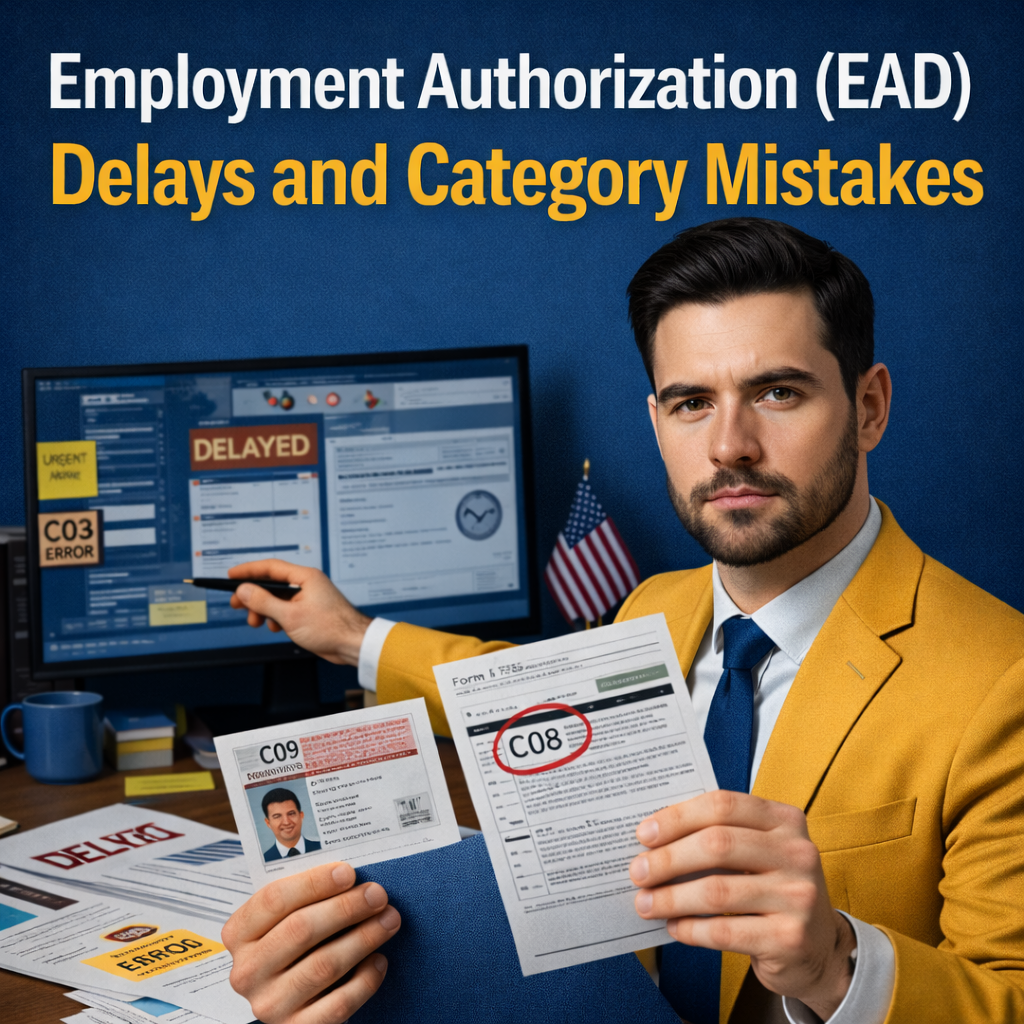
Employment authorization (EAD) delays and category mistakes
Delays and wrong category choices can block lawful work, so mapping EAD codes and timelines supports planning and compliance.
Employment Authorization Documents (EADs) sit at the intersection of immigration status and day-to-day work eligibility. Confusion often starts with one simple question: which EAD category applies, and how long does it take to receive the card after filing.
Processing time is not just an administrative detail. It affects onboarding dates, payroll timing, continuity of employment, and whether a person can keep working while a renewal is pending, depending on the category and filing posture.
- Wrong category code on Form I-765 can trigger rejection or long rework cycles
- Renewal timing gaps can interrupt work eligibility even with a strong underlying case
- Delays often come from missing evidence, status mismatches, or address delivery failures
- Some categories have continuity rules, while others require the physical card before work begins
Quick guide to Employment authorization (EAD) categories and timelines
- What it is: a USCIS-issued document showing temporary authorization to work in the U.S. under a specific category.
- When it comes up: initial permission to work, renewing an expiring EAD, or replacing a lost/damaged card.
- Main legal area: U.S. immigration compliance and work authorization verification (employment eligibility rules).
- What goes wrong if ignored: work start dates slip, renewals lapse, and employers may pause employment for I-9 compliance.
- Basic path: confirm the correct category code, file Form I-765 with supporting evidence, track receipt/biometrics, and monitor card production/delivery.
Understanding Employment authorization (EAD) in practice
An EAD is not a single benefit with one universal timeline. It is a framework that ties work eligibility to a specific legal basis, expressed through a category code on the card and on Form I-765.
USCIS processing can vary widely by category, service center workload, and whether the filing is an initial request, renewal, or replacement. Clear categorization and clean evidence packages usually reduce avoidable delays.
- Category-driven: the eligibility basis controls what evidence is required and what continuity rules may apply.
- Time-limited: EADs generally expire and must be renewed when renewal is permitted for that category.
- Document-dependent: some situations require the physical EAD card before work can start; other statuses may authorize work “incident to status” without an EAD.
- Workflow-based: receipt notice, biometrics (if required), adjudication, card production, and delivery all matter.
- Category code accuracy is often the biggest single factor in avoiding rejections and re-filing
- Evidence alignment should match the underlying petition/receipt and current lawful status posture
- Renewal lead time should be planned around employer onboarding rules and document expiration dates
- Address stability matters because card delivery issues can create hidden delays even after approval
- Receipt notices can be operationally important for some renewals, depending on eligibility rules
Legal and practical aspects of EAD categories
EAD categories generally appear as letter-number codes that correspond to regulatory eligibility groups. Many common categories are associated with a broader immigration filing that is already pending or approved.
Examples of widely encountered groupings include students in practical training, applicants in humanitarian protection processes, and applicants with pending adjustment-type filings where the EAD bridges the waiting period.
- Students and training: practical training-based EADs commonly tie to school documentation and program dates.
- Humanitarian-based filings: authorization may depend on filing posture, waiting periods, and renewal rules.
- Pending applications: some EADs derive from a separate, pending benefit request and require the correct receipt linkage.
- Dependents: some dependent spouses qualify for EADs in specific categories, while other classifications may allow work without an EAD.
Important differences and possible paths in EAD processing
Not all EAD filings behave the same operationally. Initial EADs often require tighter proof of eligibility, while renewals often hinge on consistent identity records, category continuity, and proof that the underlying basis remains valid.
- Initial EAD vs renewal: renewals typically focus on continuity of eligibility and identity matching across filings.
- Replacement vs renewal: replacements address loss/damage but do not extend validity; planning should account for the original expiration date.
- Standalone vs tied filings: some EADs stand alone; others depend on a separate pending petition or application.
- Paths when delayed: case inquiry through USCIS tools, escalation through service requests, and counsel-led strategies when delay becomes unreasonable.
Practical application of EAD in real cases
EAD problems most commonly show up during job starts, renewal windows, or after a move. Employers may pause onboarding when documents cannot be verified under standard employment eligibility rules, even if an immigration case is otherwise progressing.
Evidence usually revolves around identity, current status posture, and proof that the filing category is correct. Supporting items can include USCIS receipt notices, prior EAD copies, status documents, school records, and proof of name consistency.
Operational records also matter. Delivery confirmations, address change receipts, and complete copies of the filed packet help troubleshoot missing notices or card delivery issues.
- Confirm category and basis: match the I-765 category code to the underlying immigration posture and receipts.
- Assemble clean evidence: ensure identity, status documents, and receipts align and names are consistent.
- File and track: keep the receipt notice, monitor biometrics requirements, and save all status updates.
- Manage deadlines: track EAD expiration, employer onboarding windows, and any renewal eligibility rules.
- Escalate methodically: use inquiries and documented follow-ups if processing extends beyond published expectations.
Technical details and relevant updates
EAD adjudication is process-driven. Even when eligibility is clear, delays can arise from identity verification steps, background check timing, or internal workload shifts between centers.
Further reading:
Some renewal categories can have continuity mechanisms under specific conditions, often tied to timely filing and category eligibility. These rules can change over time, so the safest operational approach is to rely on the text of the current receipt notice, the category code, and USCIS guidance for the filing date.
- Biometrics: may be required, reused, or waived depending on category and current policy.
- Delivery: returned mail and address errors are common “silent” causes of post-approval delay.
- Expedite channels: some situations allow requests based on documented hardship criteria, but outcomes vary.
- Premium processing: availability is limited and category-specific; eligibility depends on current USCIS program rules.
Practical examples of EAD
Example 1 (more detailed): A student in an authorized training period files Form I-765 under a training-based category. The packet includes school-issued documentation covering program dates and eligibility, identity documents, prior immigration records, and the correct fee. After receiving the receipt, the case progresses through review and card production. A delay occurs because the mailing address was updated after filing; the file is stabilized by documenting the address change, tracking delivery, and keeping the approval notice and card production status aligned.
Example 2 (shorter): A humanitarian applicant renews an expiring EAD. The renewal packet includes the prior EAD copy, the relevant receipt showing the continuing underlying case posture, and identity documents. Processing extends beyond expectation, so the record is organized for a structured inquiry and, if needed, counsel-led escalation based on documented timelines and impacts on employment continuity.
Common mistakes in EAD
- Using the wrong I-765 category code for the underlying immigration posture
- Filing too close to expiration without a realistic buffer for processing variability
- Submitting incomplete supporting documents or mismatched receipts and status records
- Ignoring address changes, leading to returned notices or undelivered cards
- Assuming work can begin without confirming the correct work-authorization basis
- Overlooking name consistency issues across passports, prior filings, and identity documents
FAQ about EAD
What does an EAD category code mean?
The category code identifies the legal basis for work authorization under immigration regulations. It determines what evidence is required, whether renewals are allowed, and how the EAD relates to other pending or approved filings. Category accuracy is essential to avoid rejections and misrouting during adjudication.
Who is most affected by EAD timing issues?
Timing issues most often affect applicants whose employment depends on the EAD card itself, especially during onboarding, renewals near expiration, or transitions between eligibility bases. Delays can also affect employers’ compliance steps, such as verification records and payroll start dates.
Which documents usually matter most in an EAD filing?
Most filings rely on identity documents, proof of the specific eligibility basis, and receipts or approvals for related immigration filings when applicable. Prior EAD copies, status records, and proof of consistent biographic data also help prevent requests for additional evidence and reduce avoidable rework.
Legal basis and case law
EAD authority is grounded in U.S. immigration statutes and implementing regulations that define who may be authorized to work and under what conditions. A core regulatory framework lists eligibility categories for employment authorization and sets procedural rules for applications and renewals.
Employment verification rules also shape practical outcomes. Employers generally must document work authorization and may pause work when authorization cannot be verified through acceptable documentation, making EAD timing and document control operationally significant.
Courts sometimes review prolonged government delays under general administrative law principles, particularly when delay becomes unreasonable relative to the specific posture of the case. Outcomes depend on facts, documentation, and jurisdictional standards, and they do not guarantee faster approval in any individual situation.
Final considerations
EAD categories and timelines are best treated as a planning exercise rather than a simple form filing. The category code, the underlying legal basis, and clean evidence alignment typically control whether the process stays predictable.
Strong practical habits include renewing with a realistic buffer, preserving complete copies of filings and receipts, and keeping addresses and identity records consistent across the case history.
This content is for informational purposes only and does not replace individualized analysis of the specific case by an attorney or qualified professional.