
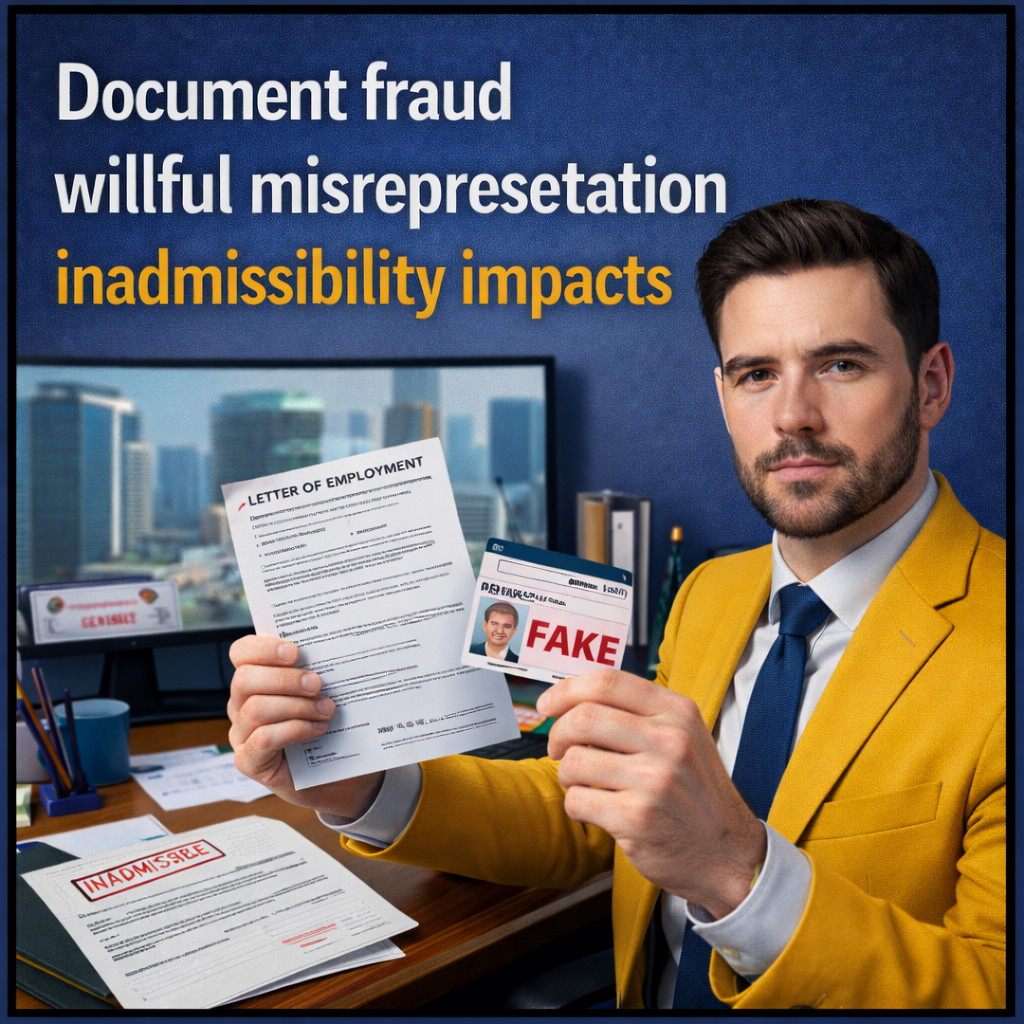
Document fraud willful misrepresentation inadmissibility impacts
Misstatements or altered records can trigger lifelong inadmissibility, so knowing the standards helps avoid preventable denials.
Document fraud and willful misrepresentation under INA 212(a)(6)(C)(i) is one of the most serious issues in U.S. immigration because it can lead to a permanent inadmissibility finding, even when the underlying benefit might otherwise be approvable.
The confusion usually comes from the line between a mistake and a “willful” misstatement, what counts as “material,” and how officers treat inconsistent records, third-party paperwork, or old filings that resurface years later.
- Permanent inadmissibility findings that affect future visas, entries, and green card cases
- Denials based on “material” facts, even without a criminal conviction
- Case delays from Requests for Evidence, fraud referrals, or enhanced review
- Waiver strategy becomes central and time-sensitive in many pathways
Quick guide to document fraud and willful misrepresentation
- What it is: Using false documents or knowingly providing false facts to obtain an immigration benefit.
- When it arises: Visa interviews, border entry, adjustment filings, asylum contexts, or prior applications reviewed later.
- Main legal area: Inadmissibility and eligibility determinations under INA 212(a)(6)(C)(i).
- Why it matters: A finding can block approval until addressed, often with a waiver strategy.
- Basic path: Clarify facts, gather proof of intent and context, respond to notices, and evaluate waiver options where available.
Understanding document fraud and willful misrepresentation in practice
INA 212(a)(6)(C)(i) generally covers two related concepts: fraud (deception used to obtain a benefit) and willful misrepresentation (a knowing false statement of a material fact). Officers often discuss them together because both can lead to the same inadmissibility consequence.
In practical case review, the focus is usually less on labels and more on whether the record shows a knowing falsehood, whether the falsehood was material, and whether it was used to seek a benefit or entry.
- Willful: The person knowingly provided incorrect information (not necessarily with malicious intent).
- Misrepresentation: A false statement or misleading omission, often tied to eligibility facts.
- Material: The fact could affect eligibility, admissibility, or the decision process.
- Benefit sought: The statement was used to obtain a visa, admission, status, or other immigration benefit.
- Evidence-based finding: The conclusion must rely on the record, not speculation.
- Materiality often turns on whether the fact could change eligibility or trigger further inquiry
- Intent evidence includes explanations, translations, third-party preparation, and pattern of inconsistencies
- Prior filings are frequently compared to new statements (dates, addresses, work, entries, marital history)
- Document authenticity issues can expand quickly if one record appears altered or unverifiable
- Admissions at interview or in writing can heavily shape the final finding
Legal and practical aspects of 212(a)(6)(C)(i)
Officers typically evaluate whether the statement or document was false, whether it was knowingly presented, and whether it concerned a material fact. Materiality commonly means the falsehood had a natural tendency to influence the decision, or it shut down an inquiry that could lead to ineligibility.
Document issues can involve altered civil records, counterfeit IDs, changed biographical data, or “support letters” that misstate employment, finances, or relationships. Misrepresentation issues can also arise from answers on forms, interview responses, or omissions that hide a relevant fact.
- Typical triggers: identity inconsistencies, travel/entry history mismatch, undisclosed arrests, prior removals, prior marriages, unauthorized work, or false addresses.
- Common evidence types: application copies, interview notes, prior immigration files, civil registry checks, employer records, and digital history where relevant.
- Process points: Requests for Evidence, Notices of Intent to Deny, consular refusals, or border findings can all raise the issue.
- Consequence scope: the finding can affect multiple future benefits unless overcome or waived where permitted.
Important differences and possible paths in 212(a)(6)(C)(i)
Not every error equals willful misrepresentation. Translation problems, misunderstanding a question, third-party form preparation, and confusing timelines can matter, but the record must support a non-willful explanation with consistent proof.
- Fraud vs. misrepresentation: fraud implies deceptive conduct; misrepresentation focuses on the knowing false statement.
- Statements vs. documents: oral answers and written filings can both trigger findings; altered records often increase scrutiny.
- Consular vs. USCIS context: consular decisions may be less transparent, while USCIS often issues written notices to respond.
- Waiver-dependent outcomes: many solutions depend on whether a waiver is legally available and factually supportable.
Common paths include responding with clarifying evidence, seeking reconsideration where available, pursuing a waiver strategy (when eligible), or re-planning the immigration route to avoid unsupported claims that invite a renewed finding.
Practical application of 212(a)(6)(C)(i) in real cases
This issue often appears when an application is compared against older filings: a prior visa application, a border record, a past petition, or an earlier benefit request prepared by someone else. Small inconsistencies can escalate if they relate to eligibility facts.
It also shows up in document-heavy cases involving civil records (birth, marriage, divorce, police certificates) or employment/financial proof. If one document is questioned, officers may reassess the reliability of the entire file.
Useful evidence tends to be objective and cross-checkable: certified records, official corrections, sworn explanations with supporting exhibits, proof of translation accuracy, and documentation showing who prepared prior forms and what information was provided.
Further reading:
- Identify the exact statement or document at issue by collecting copies of filings, interview notes, and notices.
- Map the timeline of entries, addresses, employment, and key life events to remove inconsistencies.
- Gather objective supporting records (certified civil documents, agency letters, corrected records, affidavits with exhibits).
- Prepare a structured explanation addressing willfulness and materiality, without adding new contradictions.
- Evaluate waiver or alternative pathways where a finding is likely or already made, and track all deadlines.
Technical details and relevant updates
In many cases, the key technical fight is materiality: whether the falsehood would have affected the decision or cut off an inquiry. Another common focus is willfulness, especially when forms were prepared by third parties or answers were based on misunderstanding.
Where a finding is made, the next technical layer is often waiver eligibility. For 212(a)(6)(C)(i), waivers may exist in limited contexts (commonly discussed under INA 212(i)), and they usually require strong equities and specific qualifying relationships, depending on the benefit type.
- File review consistency: prior applications and entries are frequently compared line-by-line.
- Corrections matter: amended civil records should be supported by official correction procedures and documentation.
- Admissions matter: statements at interviews can be treated as highly persuasive evidence.
- Waiver preparation: hardship evidence and credibility restoration typically require detailed, corroborated proof.
Practical examples of 212(a)(6)(C)(i)
Example 1 (more detailed): A person applies for adjustment of status and lists a prior entry date that differs from an older visa application. USCIS compares the records and finds that the earlier application omitted a prior overstay and used a different employment history. A Notice of Intent to Deny raises willful misrepresentation concerns. The response focuses on obtaining certified copies of prior filings, showing that an unlicensed preparer completed the older form, providing consistent travel documentation, and explaining why the incorrect employment information was not knowingly supplied, supported by contemporaneous payroll records and sworn statements with exhibits. Depending on the agency’s conclusion, the case may proceed, be denied, or shift to waiver analysis.
Example 2 (shorter): At a visa interview, an applicant presents a letter claiming a job position that cannot be verified. The consular officer requests additional proof and later refuses the case. A follow-up strategy may include obtaining verifiable employer records, correcting the submission, explaining who produced the letter, and assessing whether the facts could be treated as a willful misrepresentation that requires a waiver route.
Common mistakes in 212(a)(6)(C)(i)
- Submitting “support documents” from third parties without verifying authenticity and consistency
- Answering forms from memory without building a timeline of entries, addresses, and work history
- Trying to “fix” one inconsistency by creating new contradictions elsewhere in the record
- Ignoring a notice deadline or responding with a long narrative without objective proof
- Assuming an old misstatement will not be reviewed in a new application
- Filing a waiver or new case without confirming eligibility and required qualifying relationships
FAQ about 212(a)(6)(C)(i)
What makes a misrepresentation “willful” in immigration cases?
“Willful” generally means the incorrect statement was made knowingly, not necessarily with bad motives. Officers often look for awareness of the true fact, control over the information provided, and whether the explanation is consistent with objective records.
Can a simple mistake or translation issue trigger inadmissibility?
Mistakes can raise credibility concerns, but inadmissibility usually requires a knowing false statement about a material fact. Clear documentation of translation, form preparation, and consistent timelines can be important to show the error was not knowingly made.
What documents help respond to a suspected misrepresentation finding?
Helpful items often include certified civil records, copies of prior filings, agency correspondence, corrected documents with official proof of correction, travel and entry history evidence, and structured declarations supported by exhibits that address willfulness and materiality.
Legal basis and case law
The primary legal foundation is INA 212(a)(6)(C)(i), which addresses inadmissibility for fraud or willful misrepresentation of a material fact in seeking a visa, admission, or other immigration benefit. In practice, the provision centers on the relationship between the falsehood and the benefit sought.
Decision-makers commonly apply a “materiality” analysis focused on whether the false fact could influence the decision or stop an inquiry into eligibility. They also analyze whether the record supports a finding of knowing misstatement, as opposed to confusion, misunderstanding, or third-party error supported by consistent proof.
Courts and agency guidance often emphasize that credibility and consistency across filings matter, and that outcomes frequently depend on the specific record. Where a finding is made, the availability of relief is typically shaped by waiver law and the applicant’s eligibility category.
Final considerations
Document fraud and willful misrepresentation claims can reshape an immigration case because they affect admissibility at a foundational level. The practical priority is building a clean factual timeline, identifying the exact alleged falsehood, and responding with objective, verifiable proof.
When the record indicates a serious issue, careful planning is essential: avoid adding new inconsistencies, preserve copies of every filing and notice, and evaluate whether a waiver pathway exists and can be supported with strong evidence.
This content is for informational purposes only and does not replace individualized analysis of the specific case by an attorney or qualified professional.