
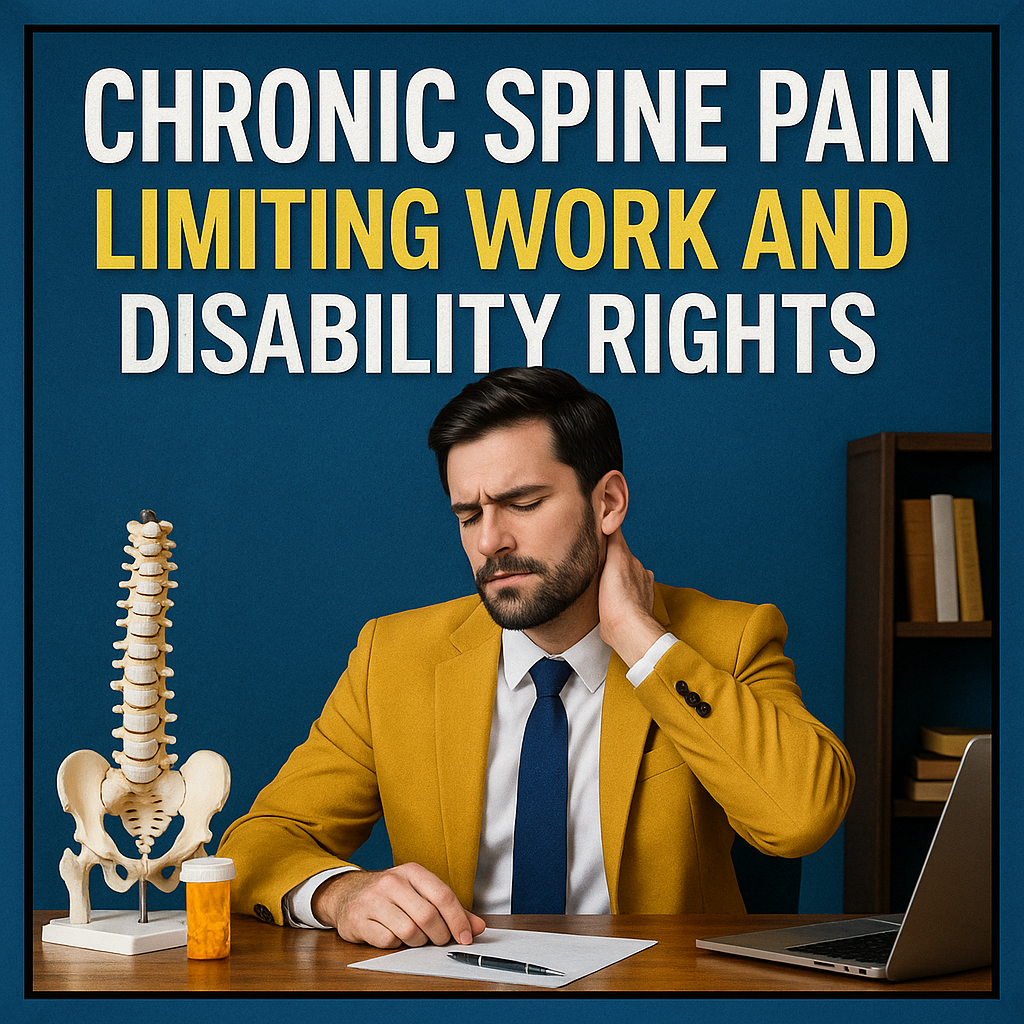
Chronic Spine Pain Limiting Work and Disability Rights
Degenerative disc disease with chronic intractable pain often blurs the line between medical treatment and disability law, and understanding how symptoms, exams and documentation fit together can protect health, work capacity and benefit rights.
Degenerative disc disease with chronic intractable pain is more than “ordinary back pain”.
For many patients, it means progressive disc damage, constant or frequently recurring pain that resists standard treatment, and real limits on standing, sitting, lifting or concentrating at work.
Because of this dual impact on health and function, the condition sits at the crossroads of medicine and social security / disability law, especially when long-term work ability is questioned.
Degenerative disc disease and chronic intractable pain: medical overview
Degenerative disc disease (DDD) describes a spectrum of changes in the intervertebral discs, usually related to aging, genetics, biomechanical stress and sometimes previous injuries.
Discs may lose height, become dehydrated, develop annular tears or herniations, and irritate nearby nerve roots or the spinal cord itself.
When pain persists despite conservative care and significantly interferes with function, it is often described as chronic intractable pain.
Typical clinical picture and diagnostic tools
From a clinical standpoint, DDD with intractable pain is usually confirmed by a combination of:
- Detailed history: onset of symptoms, aggravating activities, prior injuries, failed treatments, sleep disruption.
- Physical examination: range of motion, muscle strength, reflexes, sensory changes, straight-leg raise or other provocative tests.
- Imaging: MRI or CT scans showing disc height loss, herniation, spinal stenosis or nerve root compression.
- Response to treatment: documentation of limited or temporary relief from physical therapy, injections, medications or surgery.
- Axial pain in the neck or low back, often worse with sitting or bending.
- Radicular symptoms such as shooting pain, numbness or tingling down the arm or leg.
- Functional limits like difficulty standing more than short periods or lifting moderate weights.
- Secondary effects including sleep disturbance, fatigue, mood changes and reduced concentration.
The expression “chronic intractable pain” typically implies that symptoms have persisted for months or years and have not responded adequately to an appropriate sequence of medical treatments, even when the patient is cooperative and adherent.
Legal and disability framework: when pain becomes a benefit question
In many jurisdictions, especially within social security and private disability systems, DDD with intractable pain becomes relevant when it limits the person’s ability to perform substantial work on a consistent basis.
The legal analysis does not hinge solely on the diagnosis; it focuses on how the condition affects functional capacity.
How disability systems tend to evaluate degenerative disc disease
Although specific rules vary, a few recurring legal-medical questions appear in disability evaluations:
- Objective findings: Do imaging and clinical exams corroborate the reported pain and neurological deficits?
- Duration: Has the impairment lasted, or is it expected to last, at least the minimum duration required by the system (often 12 months)?
- Residual functional capacity: How long can the person sit, stand, walk, lift, carry, reach or bend during a normal workday?
- Consistency: Are medical notes, diagnostic tests and daily-activity reports coherent over time?
Mini “pie chart” in text – focus of many disability files
In a typical spine-related disability file, attention often clusters around three areas:
- 40% – imaging and physical exam findings (disc levels, nerve compression, range of motion);
- 35% – longitudinal treatment records and response to therapy or surgery;
- 25% – functional statements from the patient, relatives and treating doctors.
These proportions are only illustrative, but they show that decisions rarely rest on a single MRI or one office visit; they reflect the overall pattern across time.
Because of this, a person with severe pain but minimal documentation can face difficulty proving disability, while another with similar symptoms but detailed records may meet the legal thresholds for long-term benefits.
Building a medical and legal record for chronic intractable pain
For those whose degenerative disc disease has reached a point of chronic intractable pain, organizing information is as important as receiving treatment.
From a legal-medical perspective, documentation should show both the nature of the disorder and the functional limitations that follow from it.
Further reading:
Practical steps to structure the record
Several practical measures tend to strengthen medical and disability files:
- Consistent specialist follow-up with orthopedic surgeons, neurosurgeons or pain specialists when indicated.
- Complete medication history, noting dosages, side effects (such as drowsiness or cognitive changes) and partial relief.
- Therapy records from physical therapy, occupational therapy, injections or other procedures.
- Functional descriptions in medical notes, such as tolerance for sitting, standing, walking or lifting.
- Objective measurements like grip strength, gait observations and range-of-motion data where relevant.
- Keep a simple pain diary noting good and bad days, triggers and medication effects.
- Bring a list of current medications and prior therapies to each appointment.
- Ask that work-related limitations (lifting, bending, sitting) be recorded in the chart when discussed.
When disability or social-security benefits are involved, this same documentation forms the basis for legal opinions, administrative decisions and any later appeals.
Application and claim process: step-by-step orientation
Although procedures differ between countries and programs, many spine-related disability claims follow a similar path.
The goal is to translate a medical story of degenerative disc disease and chronic intractable pain into structured legal evidence.
Core stages commonly seen in disability or social-security claims
- Initial application: personal data, work history, list of medical providers, medications and description of limitations.
- Requesting records: the agency or insurer gathers hospital reports, imaging results and clinic notes.
- Medical review: internal doctors or independent experts assess whether medical criteria are met.
- Functional evaluation: analysis of what types of work, if any, remain realistically possible.
- Decision and appeal: acceptance, denial or partial approval, followed by potential reconsideration or hearing.
Throughout this process, coherence between what is written in forms, what is said in interviews and what appears in medical records strongly influences credibility.
Examples and models related to degenerative disc disease claims
A few simplified scenarios help to illustrate how medical and legal elements interact when DDD with chronic intractable pain leads to a benefit request.
- Example 1 – heavy-labor worker: a warehouse employee with lumbar DDD, repeated herniations and failed surgery has constant low-back pain and leg numbness. Specialist notes restrict lifting to light weights and limit standing to short durations. These details support the argument that returning to previous heavy work is unrealistic.
- Example 2 – office worker: an administrative assistant with cervical and lumbar DDD reports severe pain when sitting more than 20–30 minutes and needs to alternate positions frequently. Treatment records mention concentration problems due to pain and medication side effects, which can affect the ability to perform sedentary work.
- Example 3 – mixed medical and psychiatric impact: long-standing intractable pain contributes to depression and anxiety. Psychiatric records note reduced energy, poor sleep and difficulty with pace and persistence, adding another layer to the functional assessment.
In each scenario, a combination of spine findings, pain descriptions, therapy responses and functional observations guides both the medical management and any legal discussion about disability or long-term benefits.
Common mistakes in managing medical and legal aspects
Some recurring errors can weaken the position of a person living with degenerative disc disease and chronic intractable pain when benefits are under review.
- Stopping medical follow-up entirely, leaving long gaps in records that make symptoms appear intermittent.
- Relying only on imaging, without documenting functional limits such as sitting, standing or lifting tolerance.
- Submitting disability forms that contradict what is written in clinic notes about daily activities.
- Discarding imaging reports, therapy notes or work restrictions that could support the claim later.
- Ignoring deadlines for appeals or additional documentation set by social-security agencies or insurers.
- Underreporting medication side effects that affect concentration, reaction time or safety in certain jobs.
Conclusion: integrating medical care and rights in degenerative disc disease
Degenerative disc disease with chronic intractable pain is a complex condition that demands coordinated attention to clinical care, documentation and, when necessary, benefit or disability procedures.
The medical side focuses on diagnosis, treatment and symptom relief, while the legal-administrative side evaluates how those symptoms translate into functional limitations over time.
- Consistent, well-documented treatment is often as important as imaging when disability is considered.
- Clear descriptions of everyday limitations help bridge the gap between clinical language and legal criteria.
- Respecting procedural timelines and seeking guidance when uncertain can prevent avoidable loss of rights.
This text is intended for general informational purposes only and does not replace the individualized assessment of a licensed physician, attorney or other qualified professional.
Any decision about diagnosis, treatment, work activity, or pursuit of disability or social-security benefits should be made with personalized advice based on the specific medical records, legal rules and deadlines applicable to each case.
Quick guide
When degenerative disc disease leads to chronic intractable pain, the key is to align medical care, documentation and disability rules so the clinical reality is accurately reflected in any benefits analysis.
- Document symptoms over time: note frequency, intensity, flare-ups and how long pain lasts despite treatment.
- Keep regular specialist follow-up with orthopedics, neurosurgery or pain management, avoiding long gaps in care.
- Organize imaging and reports (MRI, CT, EMG) together with written explanations from treating physicians.
- Ask doctors to record functional limits such as sitting, standing, walking and lifting tolerance in minutes or kilos.
- Track treatment response: medications tried, side effects, injections, physical therapy and any surgeries, with dates.
- Check disability or social-security rules for duration requirements, medical criteria and deadlines for appeals.
- Store all letters from agencies or insurers in one place, noting due dates for forms, reviews and hearings.
FAQ
Does degenerative disc disease alone automatically qualify for disability benefits?
No. Most systems require proof that the condition causes significant and persistent functional limitations, not just a diagnostic label or imaging report showing wear and tear in the spine.
How important is MRI or CT imaging in spine-related disability cases?
Imaging is often central because it can confirm disc degeneration, herniation or stenosis; however, decision-makers also look for consistency between images, physical examination findings and reported daily limitations.
Can chronic pain be considered disabling even when neurological exams are relatively normal?
Yes, in some cases chronic intractable pain with credible documentation and long-term treatment may support disability, especially when it results in reduced endurance, concentration problems and the need to change positions frequently.
Do I need to try surgery before applying for disability benefits?
Not necessarily. The question is usually whether reasonable treatment options have been explored and documented. Some patients are not surgical candidates, and that medical judgment should be clearly recorded in the file.
How do medication side effects influence the legal analysis?
Sedation, cognitive slowing or gastrointestinal issues from pain medications can affect reliability, safety and productivity. When documented in medical notes, these side effects are often relevant to functional capacity assessments.
Is a pain diary useful in legal or administrative proceedings?
A simple, consistent pain diary can support testimony about good and bad days, but it is most persuasive when its description of limitations matches the treating physicians’ notes and the broader medical record.
What happens if I miss a deadline for appeal or review?
Missing a procedural deadline may lead to dismissal of the claim or require a new application, depending on the system. It is important to read decision letters carefully and seek clarification or advice as soon as possible.
Normative and evidentiary framework
From a medico-legal perspective, degenerative disc disease with chronic intractable pain is evaluated under a combination of statutory provisions, administrative guidelines and case law that govern when an impairment is considered severe enough to justify disability or long-term benefits.
- General disability definitions that focus on the inability to perform substantial or gainful work.
- Specific musculoskeletal or spine listings that describe objective criteria and functional benchmarks.
- Rules on duration, requiring that limitations last or are expected to last a minimum period (often 12 months).
- Evidentiary standards concerning medical records, expert opinions and claimant testimony.
Administrative bodies and courts tend to read these rules together, asking whether the medical evidence shows a long-standing disorder, whether treatment has been reasonably pursued and whether functional capacity has been reduced in a measurable way.
- Priority is often given to longitudinal treatment notes from specialists over isolated one-time examinations.
- Objective findings such as nerve root compression or positive straight-leg-raise tests can strengthen a claim when aligned with reported pain.
- Functional descriptions—how long the person can sit, stand, walk, lift and focus—are crucial for translating medical data into legal conclusions.
When these elements are presented coherently, they allow adjudicators to connect radiological evidence, clinical observations and daily-life impact into a single structured narrative about work capacity and entitlement to benefits.
Final considerations
Degenerative disc disease with chronic intractable pain demands parallel attention to health and rights. Effective management involves not only seeking appropriate medical treatment but also ensuring that examinations, imaging and functional limits are properly recorded and preserved.
In disability and social-security settings, the strength of a case often reflects the quality and consistency of the underlying documentation. Clear communication with treating physicians, awareness of procedural rules and timely responses to agency requests can significantly influence the outcome.
- Maintain continuous, well-documented treatment with specialists familiar with spine disorders.
- Ensure that medical notes describe functional limits in practical terms relevant to work activities.
- Monitor deadlines for applications, reviews and appeals in any disability or benefit process.
This material is provided for general information only and does not replace the individualized assessment of a licensed physician, attorney or other qualified professional, who should review the specific medical records, legal rules and time limits applicable to each individual situation before any clinical or legal decisions are made.