
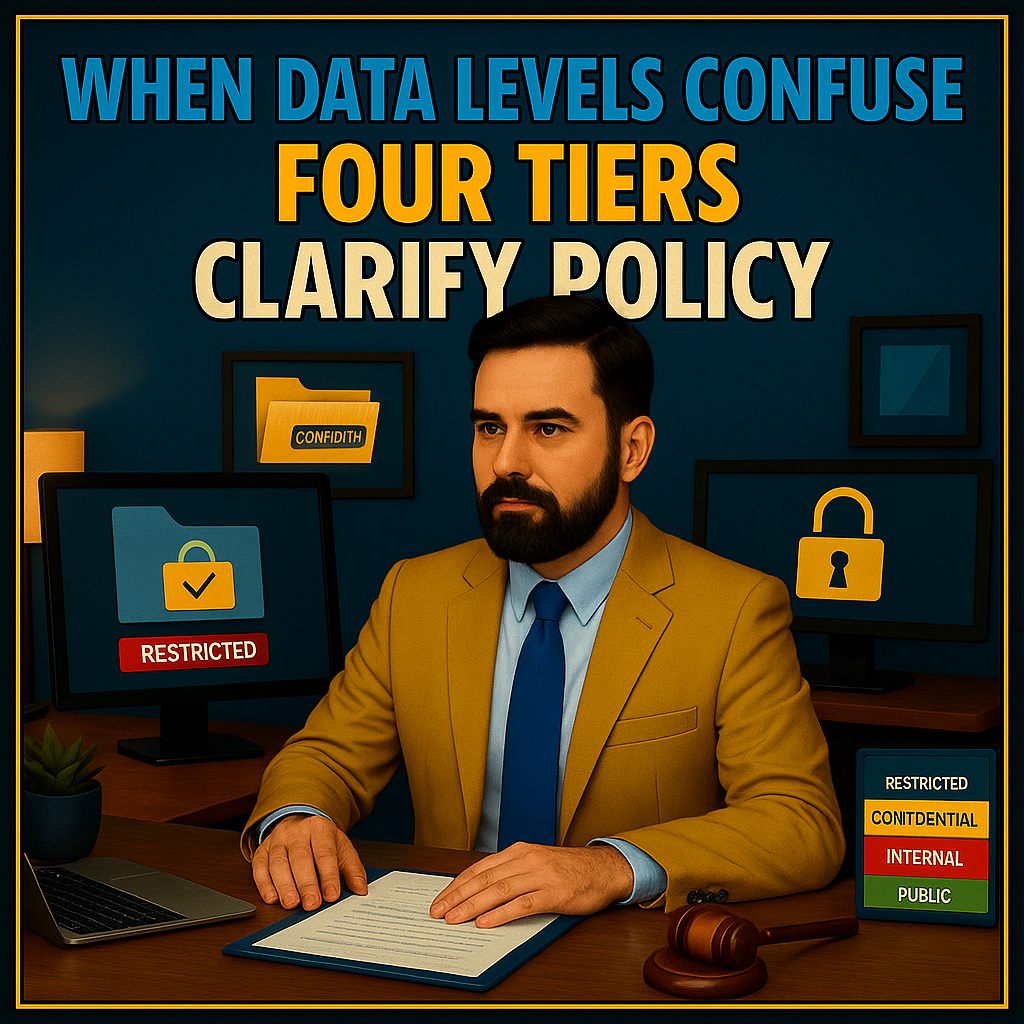
When Data Levels Confuse Four Tiers Clarify Policy
A four-level data model turns abstract security rules into concrete handling steps for every system and employee.
Many organisations say they “care about data protection”, but day-to-day decisions still feel blurry: can this spreadsheet be emailed? Is this customer file allowed in a shared drive? A clear 4-tier data classification policy turns those doubts into simple rules. When everyone knows what each level means and how to treat it, security, compliance and productivity start pulling in the same direction.
Why a 4-tier data classification model matters
Linking risk, regulation and daily behaviour
The purpose of data classification is not to create extra bureaucracy. It is to connect three elements that usually live apart:
- Risk: what happens if the information is lost, leaked, altered or unavailable?
- Regulation: which privacy, financial, health or sector rules apply?
- Behaviour: how employees, systems and vendors may use, share and store that information.
Good 4-tier models share three traits:
- Simple wording that non-technical staff can remember.
- Clear mapping from each level to concrete controls (encryption, access limits, retention, sharing rules).
- Enough flexibility to add industry-specific examples without rewriting the whole policy.
Typical four levels at a glance
Level 1 – Public
Information safe to share widely, even outside the organisation.
Level 2 – Internal
Routine business data for employees and trusted partners only.
Level 3 – Confidential
Customer, employee or business-sensitive data with legal or financial impact.
Level 4 – Restricted
Highest-impact data: regulated, mission-critical or security-sensitive.
This four-step scale is enough for most organisations. More levels often create confusion; fewer levels tend to mix highly sensitive data with low-risk information.
The 4-tier classification model explained with examples
Level 1 – Public information
Definition. Information that, if disclosed, changed or lost, would have little or no adverse impact. It is intended for open distribution.
Examples.
- Published marketing materials, blog posts and press releases.
- Public financial statements already filed with regulators.
- Job adverts and information on the corporate website.
Typical rules. No special access controls beyond standard IT hygiene; may be shared externally without NDA; still protected against tampering and obvious misuse (defacement, fake versions, etc.).
Level 2 – Internal information
Definition. Information for internal use that should not be exposed to the general public, but where impact is mostly reputational or operational, not catastrophic.
Examples.
- Internal policies, procedures and non-public process documentation.
- Team-level performance metrics and non-public financial projections.
- Supplier lists, internal project plans, internal meeting notes.
Typical rules. Accessible to staff and authorised contractors; stored in managed systems; sharing with third parties requires a business need and contractual protection, but encryption and strict access are not always mandatory.
Practical controls for Level 1–2 data:
- Use corporate accounts (not personal email or consumer cloud drives).
- Apply basic retention rules to avoid keeping obsolete drafts forever.
- Ensure change tracking and backups to protect integrity and availability.
Level 3 – Confidential information
Definition. Information that could cause legal, financial or privacy harm if disclosed or misused. This usually includes personal data, non-public financials and commercially sensitive information.
Examples.
- Customer and employee records, including identifiers and contact details.
- Non-public contracts, pricing structures and negotiation documents.
- Incident reports, internal audit findings, non-public risk assessments.
Typical rules. Access is limited on a need-to-know basis; encryption in transit and at rest is recommended or required; sharing outside the organisation needs NDAs or data-processing agreements; stricter retention and deletion rules apply.
Level 4 – Restricted or highly confidential information
Definition. Data where unauthorised access could cause serious regulatory penalties, major financial loss, safety issues or large-scale privacy impact. This category usually maps to regulated or mission-critical information.
Examples.
- Authentication secrets: passwords vault exports, encryption keys, admin tokens.
- Special-category personal data (health, biometrics, financial account details) in regulated sectors.
- Merger and acquisition plans, litigation strategy, detailed incident forensics.
Typical protection stack for Level 4 data:
- Strong encryption, key management and hardened storage.
- Strict access approval, with multi-factor authentication and detailed logging.
- Storage only in vetted systems; sending by regular email or consumer tools is prohibited.
- Short retention windows with documented destruction procedures.
Legal and compliance angles of data classification
Connecting tiers to privacy and sector-specific laws
Most privacy and data-protection laws do not dictate a specific 4-tier model. Instead, they require “appropriate technical and organisational measures”, proportionate to the risk. A tiered classification policy is one of the most effective ways to demonstrate that proportionality in practice.
Typical alignments include:
- Personal data (especially sensitive data) mapped to Level 3 or 4, with documented safeguards.
- Financial, health or children’s data treated as Level 4 whenever regulations impose strict breach-notification duties or heavy fines.
- Less sensitive operational records kept at Level 2, showing that resources are focused on higher-risk data.
During audits, regulators and customers often ask for evidence that high-risk data is identified, labelled and protected consistently. A written classification policy, linked to access control standards and retention schedules, is a strong answer to that question.
Retention and cross-border transfer considerations
Classification also guides how long data may be kept and where it is allowed to travel:
- Level 1–2 information can often follow business needs, subject to generic corporate rules.
- Level 3–4 information usually requires specific retention periods (for example, tax, employment or medical laws) and documented deletion.
- For international transfers, the policy can say that Level 4 data is only stored in approved jurisdictions or providers with adequate safeguards.
Applying the 4-tier model in practice
Step-by-step approach for implementation
- 1. Inventory key data sets. Start with customer systems, HR, finance, product databases and shared drives. Identify what kind of information each one contains.
- 2. Map each set to a level. Use risk and legal impact as the main drivers. It is better to slightly over-protect than to under-classify critical data.
- 3. Define controls per level. For each tier, document required controls: access, encryption, sharing channels, retention, backup, monitoring.
- 4. Label and automate where possible. Use system tags, metadata, DLP rules and templates to apply the policy consistently, not only in PowerPoint.
- 5. Train people using real examples. Short, scenario-based training (“Is this Level 2 or Level 3?”) will work better than theory alone.
- 6. Review annually. New systems, regulations and acquisitions can change where data sits and how risky it is.
Concrete examples of the model in action
- Example – healthcare provider. Website articles and public brochures are Level 1; internal procedures and generic statistics Level 2; patient records Level 4; aggregated, anonymised research data Level 3.
- Example – fintech company. Marketing content is Level 1; internal dashboards on product performance Level 2; named customer transactions Level 4; internal fraud-risk models Level 3 or 4 depending on detail.
- Example – municipal government. Public meeting minutes Level 1; draft policy papers Level 2; tax and social-benefit records Level 4; internal risk registers Level 3.
Common mistakes when building data classification policies
- Creating too many levels, making it impossible for users to choose correctly.
- Writing definitions in legal or technical jargon that non-experts cannot apply.
- Classifying documents once on paper but never updating or enforcing the model in systems.
- Marking everything as “highly confidential”, which dilutes focus and increases friction.
- Ignoring vendor systems and cloud tools, leaving large data sets unclassified.
- Skipping user training and expecting labels alone to change behaviour.
Conclusion – turning classification into a living practice
A 4-tier data classification policy works when it is simple enough to remember, precise enough to guide decisions and directly tied to technical controls and legal requirements. Public and internal data stay easy to work with; confidential and restricted data receive the extra protection they truly need.
Instead of being a one-off compliance document, the classification model should live inside everyday tools: file labels, email warnings, DLP prompts, onboarding training and vendor questionnaires. When employees can instantly answer “which level is this?” and “what am I allowed to do with it?”, classification stops being a theoretical framework and becomes a practical shield for the organisation’s most important information.
Quick guide – 4-tier data classification in daily work
- Identify what you handle. Before storing or sharing, ask whether the information is public, internal, confidential or restricted.
- Check the highest element. If a document mixes levels, classify it according to the most sensitive piece of data inside.
- Use approved systems only. Store Level 3–4 data only in corporate tools with access control, logging and encryption.
- Limit who can see what. Apply strict “need-to-know” for Level 3 and Level 4, and review access lists regularly.
- Share securely. For confidential and restricted data, use encrypted channels and contracts (NDA or DPA) before sharing externally.
- Respect retention rules. Keep data only as long as law and business require, then delete it securely.
- Ask when in doubt. If you are unsure of a level or a control, stop and consult security, privacy or legal before proceeding.
FAQ
Is a 4-tier model mandatory under data protection laws?
No specific law forces a 4-tier model, but many frameworks (such as privacy laws and security standards) require risk-based protection. A clear four-level structure is a practical way to show that higher-risk data receives stronger safeguards.
How do I decide between “Internal” and “Confidential” data?
Ask what would happen if the information appeared on the internet. If impact is mostly inconvenience or mild reputation effects, it is often internal. If disclosure could harm customers, staff, finances or create legal issues, it should be treated as confidential.
Does all personal data automatically fall into the highest level?
Not always. Basic business-contact details may be confidential, while highly sensitive categories—such as health, biometrics or full payment information—are typically restricted. The key is to consider both privacy impact and regulatory obligations.
Can we downgrade classification later if a project changes?
Yes, but only after confirming that sensitive data has been removed or anonymised. Downgrades should follow a documented review and, ideally, approval from the data owner or risk/security function.
How does classification interact with encryption?
Encryption is strongly recommended for confidential data and normally mandatory for restricted data, especially on mobile devices, backups and cloud services. For internal and public data, encryption may be optional but still useful in many scenarios.
What about data held by vendors and cloud providers?
Third-party systems must follow the same levels and controls as internal ones. Contracts should explicitly state classification expectations, security measures, breach-notification duties and audit or assessment rights.
Is labelling documents enough to be compliant?
No. Labels without enforced controls have limited value. Effective classification requires technical measures (access, logging, DLP), training, governance and periodic reviews to confirm that rules are working in practice.
Regulatory and standards framework (formerly “technical basis”)
Data classification policies sit at the intersection of privacy law, information security standards and sector-specific regulations. While the exact references depend on the jurisdiction and industry, several recurring principles support a 4-tier model.
Privacy and data-protection laws generally require organisations to adopt appropriate technical and organisational measures to protect personal data, taking into account the nature of the information and the risk to individuals. A tiered classification approach demonstrates that the organisation has assessed relative risk and linked it to specific controls such as access limits, encryption, retention rules and breach-response procedures.
Information security standards and frameworks reinforce this view. Many of them call for a formal information classification scheme, labelling procedures and handling rules. They also require that critical assets be identified, that access be restricted on a need-to-know basis and that highly sensitive information receive stronger protection than routine internal material. A four-level model is an effective way to align day-to-day operations with these expectations.
Sector regulations—for example in finance, healthcare, telecommunications or public administration—often introduce additional obligations for particular data types: transaction records, health information, minors’ data, security logs and so on. In practice, these categories usually map to the Confidential or Restricted levels, triggering stronger requirements for encryption, monitoring, incident reporting and cross-border transfers.
By documenting which kinds of data fall into each level, and by linking levels to concrete safeguards, the policy helps show that the organisation has a structured, evidence-based approach to compliance rather than a purely ad-hoc setup.
Final considerations
A 4-tier data classification policy is most effective when it is both simple enough for everyday use and detailed enough to satisfy legal, regulatory and contractual obligations. It should guide concrete decisions: which system to use, how to share, how long to retain and when to delete.
For that to happen, classification must live beyond the policy document. Labels should appear in productivity tools, automated rules should protect sensitive levels, and teams should receive short, practical training with real scenarios from their work. Regular reviews, audits and incident post-mortems can then test whether the model still matches reality and where adjustments are needed.
Disclaimer – this information does not replace a professional: The guidance in this article is for general educational purposes only and is not legal advice, regulatory advice or a substitute for consultation with qualified specialists. Data-protection and security requirements vary by country, industry, contract and technical context. Organisations should seek advice from their own legal counsel, privacy officers and information-security professionals before designing, approving or relying on any data classification policy or related controls.