
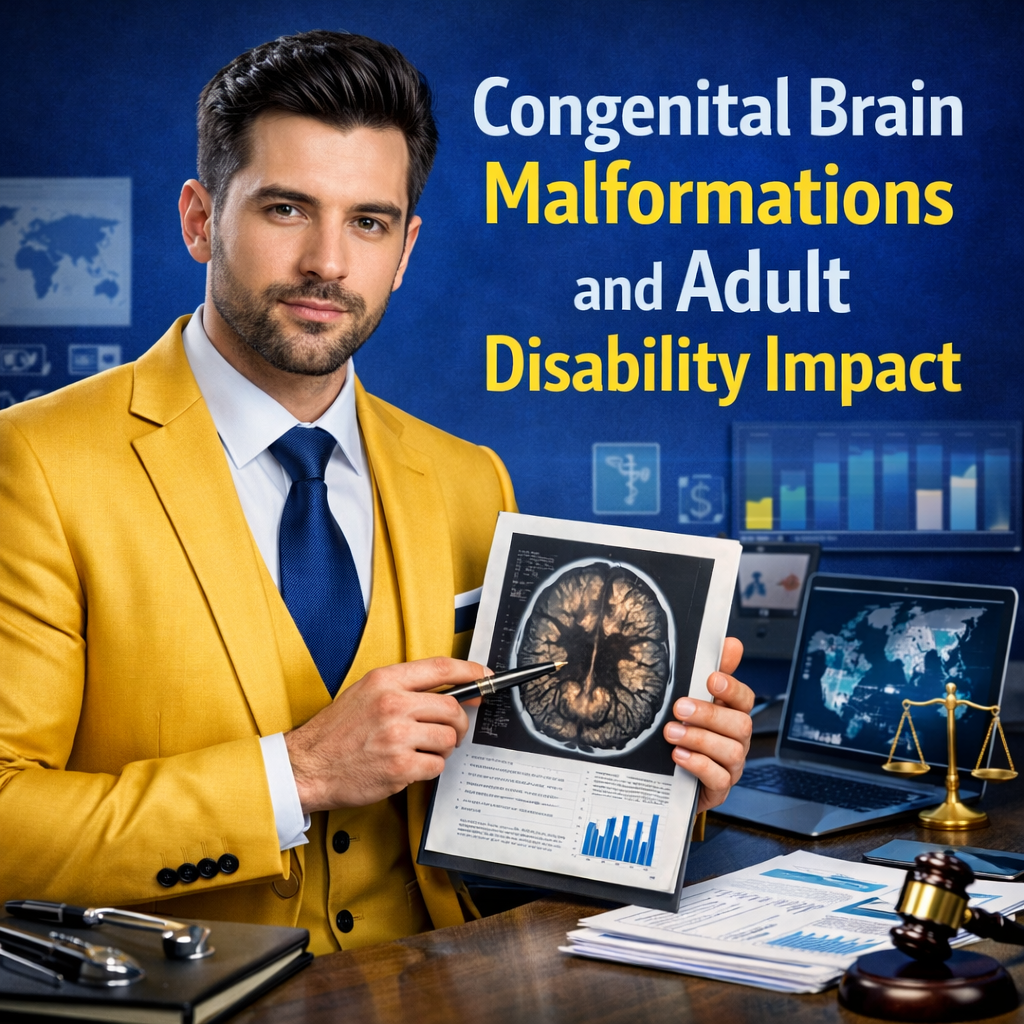
Congenital brain malformations and adult disability impact
Adult life with congenital brain malformations often involves subtle but persistent neurological limitations that affect work capacity, autonomy and access to medical and disability protection.
Congenital brain malformations diagnosed in childhood are sometimes considered “resolved” or “stable” once growth is complete. In adult life, however, these anomalies may still cause seizures, coordination problems, cognitive difficulties or behavioral changes that interfere with employment and social participation.
In medical and social security disputes, the central question is whether lifelong structural abnormalities translate into current functional limitations. Many claims fail because reports focus on the anatomical diagnosis instead of explaining how the condition actually affects daily activities, safety and sustainable work performance.
- Structural brain differences may cause seizures, fatigue and cognitive fluctuation.
- Adult work demands often exceed the coping strategies learned in childhood.
- Benefits are denied when reports ignore functional impact and environmental barriers.
- Clear documentation connects imaging findings with specific limitations and support needs.
Essential overview of congenital brain malformations
- Congenital brain malformations are structural abnormalities present from birth that can persist into adult life.
- Problems usually arise when adult responsibilities highlight residual deficits in attention, planning, mobility or seizure control.
- The main legal areas involved are health coverage, workplace accommodation and social security disability.
- Ignoring the condition can lead to unsafe tasks, employment loss and inadequate income protection.
- Solutions often require coordinated medical assessment, administrative claims and, when needed, judicial review.
Understanding congenital brain malformations with adult functional impact in practice
These malformations include a wide spectrum, from cortical development disorders to corpus callosum agenesis or posterior fossa abnormalities. Some individuals have near-normal functioning, while others present significant motor, sensory or cognitive impairment despite apparently “stable” imaging.
Function in adult life depends not only on anatomy, but also on seizure control, fatigue, learning history, comorbid psychiatric conditions and demands of the work environment. The same malformation can have very different implications for a desk job, manual labor or high-risk occupations.
- Describe the specific malformation and affected brain regions in simple terms.
- Explain how motor, sensory, cognitive and behavioral functions are impacted.
- Detail seizure frequency, residual symptoms and treatment side effects.
- Relate limitations to concrete job tasks, commuting and self-care activities.
- Clarify whether the condition is stable, fluctuating or progressively decompensating under stress.
Legal and practical aspects of congenital brain malformation cases
Medical and social security systems generally focus on current functional capacity rather than the mere presence of a congenital anomaly. The key is showing how structural findings, clinical manifestations and environmental demands interact to reduce work ability or require ongoing support.
Decision-makers look for consistent evidence across medical records, neuropsychological tests and occupational history. Vague statements such as “mild cognitive deficit” or “old malformation” without concrete descriptions of impact tend to carry limited weight in disability determinations.
- Identify the applicable definition of disability or incapacity in the relevant system.
- Align clinical descriptions with standardized functional domains (mobility, cognition, behavior, self-care, social interaction).
- Document attempts at treatment, rehabilitation and workplace adaptation.
- Respect filing and appeal deadlines established in statutes and regulations.
Key distinctions and available avenues in these claims
There is an important difference between congenital malformations that cause stable, compensated limitations and those that result in frequent decompensations, crises or hospitalizations. Another distinction is between claims for full disability and requests for partial benefits or targeted accommodations.
Depending on the jurisdiction, paths may include administrative disability benefits, employer-based accommodations, private insurance claims and judicial actions. Each route calls for specific documentation strategies and attention to procedural steps.
- Full disability benefits for severe, persistent limitations incompatible with any gainful activity.
- Partial benefits or restricted duties when reduced capacity still allows some work.
- Workplace adjustments and protected leave to manage symptoms and treatment.
- Formal appeals or litigation when decisions disregard solid medical and functional evidence.
Practical application of congenital brain malformation issues in real cases
Real-life disputes often arise when an adult with a known malformation begins to experience worsening seizures, fatigue or cognitive overload under increasing job pressure. Employers may perceive poor performance or behavioral changes without understanding the underlying neurological background.
These situations typically involve repeated sick leave, inconsistent productivity, safety concerns and, sometimes, disciplinary actions. Well-structured evidence can help distinguish intentional misconduct from limitations directly linked to the congenital condition and its treatment.
Key documents include longitudinal medical records, neuroimaging, neuropsychological evaluations, occupational health reports and descriptions of daily routine from relatives or caregivers, all converging to show real-world impact.
Further reading:
- Gather imaging reports, specialist evaluations and neuropsychological testing results.
- Compile employment records, performance reviews and any formal workplace restrictions.
- Request detailed medical reports connecting the malformation to current symptoms and limitations.
- File the appropriate benefit claim or accommodation request within statutory deadlines.
- In case of denial, organize an appeal with updated evidence and a structured legal argument.
Technical details and relevant updates
Advances in neuroimaging and genetics have refined diagnostic categories for congenital brain malformations. For legal purposes, updated terminology and precise anatomical descriptions can improve the clarity of reports and the credibility of expert opinions.
Some disability guidelines now encourage evaluation of combined impairments rather than isolating motor, cognitive and behavioral aspects. This integrative approach is particularly relevant when malformations produce subtle deficits across several domains that, together, significantly reduce work capacity.
Procedurally, there is growing emphasis on standardized functional assessment tools and structured reasoning in administrative decisions. References to these tools in medical and legal documents can make it easier to compare cases and challenge inconsistent decisions.
- Use current diagnostic terminology aligned with recognized classification systems.
- Explain how combined impairments affect complex tasks, multitasking and stress tolerance.
- Monitor new guidelines or case law that specifically address congenital brain anomalies in adults.
Practical examples of congenital brain malformation disputes
Example 1: An office worker with corpus callosum agenesis and a history of childhood learning difficulties develops increasing fatigue, headaches and difficulty managing multiple tasks. Neuropsychological testing in adulthood reveals deficits in processing speed and executive function. The initial disability claim is denied because imaging is “unchanged” and education level is considered adequate. On appeal, counsel submits detailed functional testing, employer reports about missed deadlines and a structured medical opinion demonstrating that current job requirements exceed the person’s adaptive capacity. The reviewing body grants partial benefits and recommends a change to simplified duties.
Example 2: A warehouse employee with a congenital cerebellar malformation experiences chronic imbalance and frequent falls despite physiotherapy. Occupational health advises against tasks involving heights or operating forklifts. After dismissal, the individual submits a social security claim supported by imaging, gait assessments and documentation of workplace incidents, seeking long-term income protection.
Common mistakes in congenital brain malformation claims
- Focusing solely on anatomical findings without describing day-to-day limitations.
- Assuming that a “stable” malformation automatically means preserved work capacity.
- Omitting neuropsychological or functional testing in complex cognitive cases.
- Providing generic medical certificates that do not address legal criteria.
- Neglecting to document workplace incidents, adaptations and performance changes.
- Missing deadlines for filing claims, submitting reports or lodging appeals.
FAQ about congenital brain malformations with adult impact
Can congenital brain malformations justify disability benefits in adulthood?
They can, when objective evidence shows that structural abnormalities and resulting symptoms significantly limit functional capacity. Benefits depend on how the condition affects essential tasks, not only on the label or imaging appearance.
Which adults are most affected in legal disputes involving these malformations?
Disputes often involve adults in jobs with high cognitive load, strict productivity targets or physical hazards, where seizures, coordination problems or executive dysfunction lead to performance concerns, accidents or repeated absences.
What documents are essential when a claim related to congenital brain malformations is denied?
Important documents include updated imaging, specialist reports, neuropsychological assessments, records of hospitalizations or seizures, occupational health opinions, employer statements on performance and a clear legal memorandum connecting these elements to the applicable criteria.
Legal basis and case law
Most legal systems define disability in terms of reduced capacity to work or perform daily activities due to medically determinable impairments. Congenital brain malformations fall within this framework when symptoms and objective findings align with statutory definitions and regulatory guidelines.
Regulations and technical manuals frequently require an assessment of cognitive, behavioral and motor functioning, as well as the stability of symptoms under treatment. They also emphasize the importance of consistent documentation over time and consideration of environmental demands.
Case law in several jurisdictions tends to recognize claims where structured evidence demonstrates persistent limitations, unsuccessful adaptation attempts and clear links between the malformation, symptoms and occupational consequences. Conversely, courts are less receptive when documentation is sparse, outdated or inconsistent.
Final considerations
Congenital brain malformations with adult functional impact demand careful coordination between medical evaluation and legal strategy. Structural anomalies that seemed manageable in childhood may generate substantial limitations when adult work and social responsibilities increase.
Organizing evidence around functional domains, respecting deadlines and seeking specialized guidance improves the quality of claims and decisions. Clear communication of how symptoms interfere with real-world tasks is crucial for fair access to treatment, accommodations and income protection.
This content is for informational purposes only and does not replace individualized analysis of the specific case by an attorney or qualified professional.