
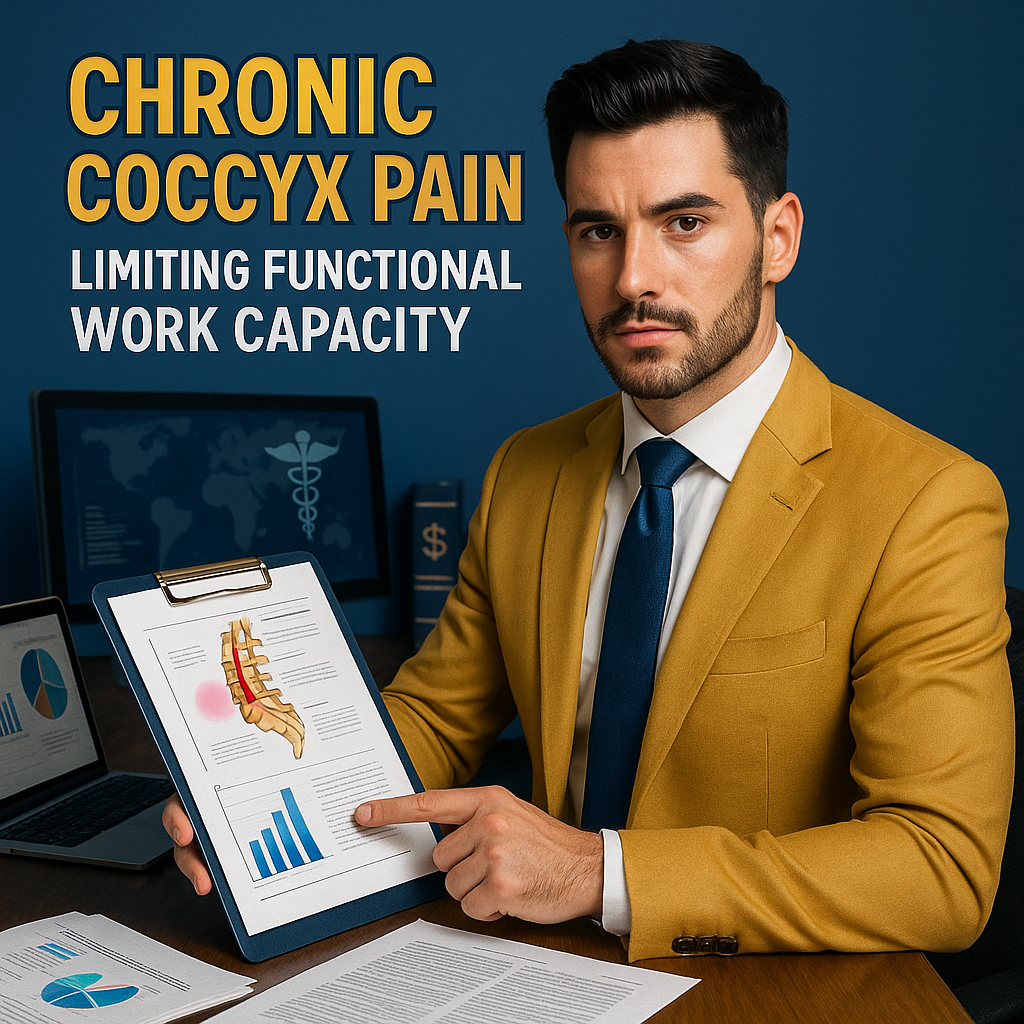
Chronic coccyx pain limiting functional work capacity
Chronic coccyx pain with sitting intolerance often raises questions about work capacity, disability benefits and how to prove functional impact.
Chronic coccyx pain, or coccydynia, may look like a small problem at first glance, but persistent pain when sitting can seriously limit work and daily activities. For workers who spend most of the day seated, intolerance to sitting becomes more than a medical issue: it can affect income, employment stability and long-term earning capacity.
When symptoms persist despite conservative treatment, questions quickly arise about work restrictions, accommodations and the possibility of disability or social security benefits. Understanding how the condition is evaluated medically and legally is essential to avoid underestimating limitations or losing important deadlines and rights.
- Risk of job loss or demotion due to inability to sit for prolonged periods.
- Difficulty proving pain intensity and functional impact without clear documentation.
- Denial of benefits when medical evidence is incomplete or inconsistent.
- Stress and mental health strain caused by chronic pain and financial insecurity.
Quick guide to chronic coccyx pain with sitting intolerance
- Coccydynia is chronic pain in the tailbone region, often worsened by sitting or leaning back.
- The problem usually appears or worsens after trauma, childbirth, repetitive sitting or unknown causes.
- The main legal areas involved are occupational health, social security law and disability discrimination law.
- Ignoring the issue may lead to progressive loss of function, performance problems and disputes about capacity.
- The basic path includes medical evaluation, workplace adjustments, thorough records and, if needed, administrative or judicial claims.
Understanding chronic coccyx pain with sitting intolerance in practice
In practice, coccydynia typically presents as sharp or burning pain in the lower spine that intensifies with sitting, especially on hard surfaces. Many patients report needing to change position every few minutes, use cushions or avoid sitting altogether, which directly affects office work, driving and study.
From a medico-legal perspective, what often matters most is not only the diagnosis, but the functional limitation: how long the person can sit, stand or alternate positions, and whether reasonable accommodations are enough to keep a safe and productive work routine.
- Detailed pain history is often more relevant than imaging alone.
- Descriptions of sitting tolerance in minutes or hours are key for disability analysis.
- Use of cushions, standing desks and frequent breaks should be documented.
- Consistency between medical notes, tests and daily activities strengthens credibility.
- Occupational impact must be related to actual job demands, not only diagnosis labels.
Legal and practical aspects of coccydynia with sitting intolerance
Many systems for workers’ compensation and long-term disability focus on functional capacity rather than on the medical name of the condition. For coccydynia, the central issue is whether the person can remain seated for the time normally required by the job, even with ergonomic adaptations.
Agencies and courts typically look for objective elements that support subjective complaints of pain. Consistent clinical examinations, repeated reports of sitting intolerance and referrals to pain management or physical therapy lend weight to the claim, especially when combined with a clear description of job tasks.
- Clear diagnosis or at least a documented pain syndrome affecting the coccyx region.
- Clinical records describing range of motion, tenderness and aggravating factors.
- Information on past treatments: medication, injections, physiotherapy, cushions, surgery.
- Work descriptions showing time spent seated, driving or performing static tasks.
Important differences and possible paths in coccydynia claims
Not every person with coccydynia will qualify for disability or social security benefits. Some maintain work with reasonable accommodation, such as sit-stand desks, more frequent breaks or partial remote work. Others may need temporary leave while treatment is adjusted, or a job change to a less sedentary position.
When limitations remain severe despite treatment, options range from administrative claims with insurers or social security agencies to formal lawsuits. Each path involves different standards of proof, deadlines and possibilities of appeal, so early legal guidance is often advisable.
- Negotiated accommodation with the employer to maintain work with modified duties.
- Administrative disability claim with medical reports and functional capacity evaluations.
- Judicial review or lawsuit if benefits are denied or accommodations are refused without reasonable justification.
Practical application of coccydynia with sitting intolerance in real cases
Typical cases involve office workers, drivers, call center employees and students who must remain seated for long periods. Over time, pain may start within minutes of sitting, forcing constant position changes and making concentration difficult. Some people describe being able to sit for less than 15 or 20 minutes without significant discomfort.
The most affected group tends to be adults in working age who depend on seated positions to perform their job. For them, documentation showing failed attempts at accommodation, such as special cushions or adjusted schedules, becomes crucial to demonstrate why work is no longer sustainable under regular conditions.
- Gather medical records, imaging, pain clinic reports and prescriptions covering at least the last months.
- Ask the treating physician to document sitting tolerance, need for position changes and recommended work restrictions.
- Request ergonomic or schedule adjustments from the employer and keep written proof of the response.
- File a disability, workers’ compensation or social security claim if limitations persist despite accommodations.
- Monitor deadlines and, if needed, seek legal assistance to appeal denials or challenge unfair dismissals.
Technical details and relevant updates
Evaluation of chronic pain conditions has gradually shifted toward a more functional and multidimensional approach. Reports that combine physical findings, pain intensity, psychological aspects and occupational demands tend to be more persuasive than isolated test results.
Further reading:
In many disability frameworks, evidence such as functional capacity evaluations, specialist opinions in pain medicine and occupational therapy assessments carry increasing weight. These documents help translate medical jargon into practical limitations, such as how long a person can sit, stand, walk or concentrate.
It is also important to track changes in internal guidelines of social security agencies and insurers, as they may introduce specific criteria for chronic pain and musculoskeletal conditions. Updated guidance often clarifies how persistent sitting intolerance should be measured and documented.
- Preference for longitudinal records over one-time consultations.
- Greater attention to mental health consequences of chronic pain.
- Use of standardized questionnaires and functional scales in many assessments.
- Growing expectation of consistent data between medical reports and daily activities.
Practical examples of coccydynia with sitting intolerance
An administrative assistant develops severe coccyx pain after a fall. Despite medication, cushions and physiotherapy, she can sit for only 20 minutes before needing to stand or walk. Her physician documents strict sitting limits, recommends a sit-stand station and reduced continuous sitting periods. The employer initially agrees but soon requires her to return to full-time desk work. With persistent symptoms and clear documentation, she files a disability claim and, after appeal supported by an occupational medicine report, obtains partial benefits and a reassigned role with mixed standing and sitting tasks.
In another case, a delivery driver experiences chronic pain after repeated impacts on rough roads. He can no longer tolerate long hours behind the wheel, even with cushions. Medical notes, driving logs and failed attempts to switch to shorter routes support a claim for temporary disability while he retrains for a less sedentary role in the company.
Common mistakes in coccydynia disability and benefits claims
- Relying on the diagnosis label without describing concrete sitting limitations.
- Submitting disability claims with sparse or outdated medical records.
- Failing to document attempts at workplace accommodation and the employer’s response.
- Providing inconsistent information about daily activities in medical and legal forms.
- Missing filing or appeal deadlines set by social security agencies or insurers.
- Ignoring psychological impact and secondary conditions such as anxiety or depression.
FAQ about chronic coccyx pain with sitting intolerance
Is a diagnosis of coccydynia enough to qualify for disability benefits?
Usually not. Most systems focus on functional capacity, so documentation must describe how long the person can sit, stand or walk, what accommodations were tried and why regular work duties are no longer feasible, even with treatment and ergonomic adjustments.
Who is most affected by sitting intolerance linked to coccyx pain?
People whose jobs require prolonged sitting, such as office workers, drivers and call center staff, are commonly affected. For these groups, reduced sitting tolerance directly interferes with core job tasks and may lead to repeated absences, performance problems and disputes about capacity.
Which documents are most important when filing a legal or benefits claim?
Key documents include specialist reports, imaging results, pain clinic notes, functional capacity evaluations, detailed work descriptions and written records of requested accommodations. Together, they provide a coherent picture of how chronic coccyx pain limits work and daily life.
Legal basis and case law
The legal framework for coccydynia cases usually combines social security rules, occupational safety standards and disability discrimination laws. These norms protect workers who become partially or totally unable to perform their duties due to chronic health conditions, including persistent pain syndromes.
Courts and administrative bodies often emphasize the duty of employers to offer reasonable accommodations when feasible, such as modified workstations or schedule adjustments. At the same time, they evaluate whether the employee can still perform essential job functions, even with such measures in place.
Case law tends to favor claims supported by strong medical evidence, consistent testimonies and a clear connection between sitting intolerance and job demands. Decisions may grant temporary or permanent benefits, order reinstatement with accommodations or confirm the legitimacy of dismissal when no reasonable adjustment is possible.
Final considerations
Chronic coccyx pain with sitting intolerance is more than simple discomfort; it can seriously threaten job stability and financial security. Addressing the condition requires careful coordination between medical care, workplace adaptations and the legal instruments available to protect income and dignity when work capacity is reduced.
Organizing documentation, respecting deadlines and seeking qualified advice are essential steps to avoid losing rights in complex disability and benefits procedures. Early attention to both medical treatment and legal strategy often makes the difference between a denied claim and a structured long-term solution.
This content is for informational purposes only and does not replace individualized analysis of the specific case by an attorney or qualified professional.