
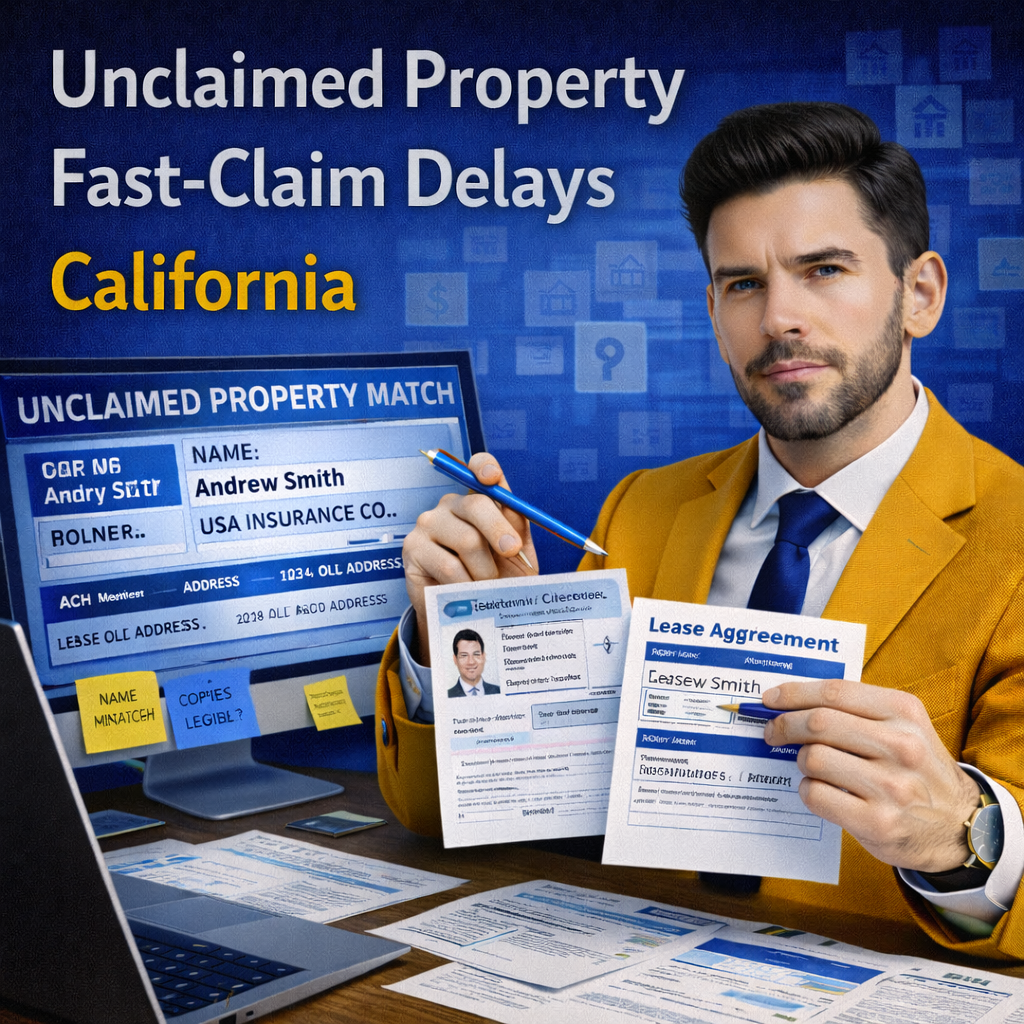
Unclaimed property fast-claim delays in California
Unclaimed property searches can miss matches or stall, and a clean claim file helps speed review and payment.
Money and assets can end up in California’s unclaimed property system after years of inactivity, address changes, or a business closing an account. Many people only discover this when a letter arrives, a tax refund is offset, or a routine online search shows a “possible match” with unfamiliar details.
The confusion usually starts with identity matching: similar names, old addresses, missing middle initials, and outdated records. A fast claim is less about luck and more about submitting the right proof the first time, in the format the administrator expects.
- Missed matches due to name or address variations
- Delays from incomplete identity and ownership proof
- Holds caused by estate, trust, or business authority issues
- Scam “recovery” solicitations and unnecessary fees
Quick guide to unclaimed property (escheat) in California
- What it is: assets turned over to the state after inactivity, held until the owner or heirs claim them.
- When it appears: after moves, forgotten accounts, payroll checks, insurance proceeds, or closed utilities.
- Main legal area: state unclaimed property administration, consumer finance, and probate/estate procedures.
- What happens if ignored: ongoing holding, potential documentation hurdles later, and a higher chance of lost paperwork.
- Basic path: search, identify likely matches, submit a complete claim packet, respond to follow-ups, and escalate if stalled.
Understanding unclaimed property (escheat) in practice
“Escheat” is the administrative transfer of abandoned or unclaimed assets from a holder (like a bank or employer) to the state. In California, the state holds the property for the rightful owner rather than keeping it tied to the original holder’s records.
Most speed issues happen at the matching stage. Systems commonly rely on partial identifiers, and a “possible match” does not guarantee ownership. A clean claim focuses on proving two things: identity and the link to the reported property.
- Owner identity: legal name, date of birth (if applicable), and a consistent ID record.
- Address connection: current address plus proof of the old address shown in the listing.
- Ownership link: account statements, pay stubs, policy letters, invoices, or holder correspondence.
- Authority to claim: executor/administrator papers, trust authority, or business authorization.
- Clear formatting: legible scans, full pages, and consistent names across documents.
- Match quality matters: exact name variants and address history can determine the review path.
- Proof of old address: a single strong document can replace multiple weak ones.
- Heir or estate claims: authority documents often drive the longest timelines.
- Business claims: signatory authority and entity status checks are common.
- Legibility wins: clear scans reduce back-and-forth requests.
Legal and practical aspects of unclaimed property claims
California’s unclaimed property program is administered by a state agency (commonly through the State Controller’s Office). The process is administrative, but it is still evidence-based: the agency must be satisfied that the claimant is the owner (or has legal authority) before releasing funds.
Proof standards vary by property type and claimant status. A direct owner claim for a simple payroll check is usually straightforward, while a claim involving a deceased owner, a trust, or a dissolved business can require formal documentation.
- Identify the property type: banking, securities, wages, insurance, refunds, escrow, utility deposits, or safe deposit contents.
- Confirm the listing details: name formatting, last reported address, and any partial identifiers.
- Prepare a complete packet: identity proof plus a strong link to the reported address or holder record.
- Track requests: agencies may ask for clarification, notarization, or certified copies in special cases.
- Maintain consistency: explain name changes and provide supporting documents when needed.
Important differences and possible paths in claims
Not all claims follow the same lane. Some may be processed through a streamlined review if the match is strong and documentation is minimal, while others are routed to manual review due to estates, business authority questions, or unclear address history.
- Owner vs. heir: heirs may need probate or small-estate documentation depending on the situation.
- Individual vs. business: businesses often need proof of current authority to act for the entity.
- Single-item vs. multiple properties: bundling claims can help organization but may increase review complexity.
- Online vs. paper workflow: some items support electronic submission; others require mailed originals or certified copies.
Possible paths include (1) administrative follow-up with complete documents, (2) supervisor-level review requests when a file stalls, and (3) legal guidance for disputed authority, estate complications, or unusual ownership evidence.
Practical application of unclaimed property claims in real cases
Common situations include old bank accounts after a move, uncashed paychecks from past employers, insurance proceeds after a policy lapse, or utility deposits after a service cancellation. People most affected include frequent movers, seniors, heirs handling estates, and small business owners who changed entity status.
Strong supporting evidence is usually simple: a government ID, proof of current address, and proof linking the claimant to the address or holder record shown in the listing. When identity has changed, the “bridge” document (marriage certificate, court order, or legal name change) becomes essential.
Useful documents often include account statements, W-2s/pay stubs, old lease agreements, DMV records, insurance letters, utility bills, and holder notices. For estates, certified death certificates and court authority documents are common.
Further reading:
- Run a targeted search: try name variants, initials, prior addresses, and business DBA names.
- Screen matches: prioritize listings with recognizable addresses, employers, or holders.
- Build the proof set: ID + current address proof + old address link + ownership link document.
- Submit and track: keep a dated copy of everything and note confirmation or reference numbers.
- Respond quickly: answer follow-up requests with clean, legible documents and short explanations.
Technical details and relevant updates
California unclaimed property rules are built around dormancy (inactivity) periods and “holder” reporting duties. After the dormancy period ends, holders generally report and remit the property to the state, and the state lists it for owners to claim.
Timelines for review vary based on claim type, the clarity of the match, and whether special documents are required. Claims involving estates, trusts, or entity authority typically require more verification steps than direct owner claims for simple property types.
- Name mismatch handling: include a short explanation and the document that connects the names.
- Old address proof: prefer official records over informal statements when possible.
- Certified copies: use when a process specifically requests certified documents.
- Submission hygiene: avoid blurry photos, cropped pages, and missing signatures.
Practical examples of unclaimed property claims
Example 1 (more detailed): A claimant finds a California listing tied to an old apartment address and a former employer. The claimant submits a government ID, a current utility bill, a prior lease showing the old address, and a W-2 from that employer for the relevant time period. The packet includes a short note explaining that the claimant moved and the employer issued a final wage check that was never cashed. The agency requests one clarification about a middle initial, and the claimant responds with a DMV record showing the full legal name. The file proceeds to payment after verification.
Example 2 (shorter): An heir finds a listing under a deceased parent’s name. The heir submits identity proof, a certified death certificate, and documents showing authority to act for the estate. If probate is not opened, the heir may need alternative estate documentation depending on the facts and the agency’s requirements.
Common mistakes in unclaimed property claims
- Submitting ID without any proof linking the claimant to the listed address or holder
- Uploading blurry images, cropped pages, or documents with missing corners and seals
- Ignoring name variations and failing to include a document that explains the difference
- Using informal letters instead of stronger records for old address verification
- Filing estate or business claims without clear authority documentation
- Paying third-party “recovery” fees without checking whether self-filing is available
FAQ about unclaimed property in California
What does “unclaimed property” mean in California?
It refers to assets that a holder (such as a bank or employer) could not deliver to the owner after a period of inactivity. The holder reports and transfers the property to the state, which holds it for the rightful owner. A claim is the process of proving identity and ownership so the state can release the property.
Who usually has the hardest time getting a fast approval?
Claims tend to take longer when the listed address is very old, the owner’s name has changed, or the claimant is an heir, trustee, or business representative. These situations often require extra authority documents and clearer links to the listed owner record.
What documents help most if a claim is questioned or delayed?
A strong proof set usually includes a government ID, proof of current address, a reliable record tying the claimant to the listed prior address, and an ownership link document such as a statement, W-2, policy letter, or holder correspondence. For estates or trusts, authority documents are often decisive.
Legal basis and case law
California’s unclaimed property framework is set out in the state’s Unclaimed Property Law, which is commonly codified in the California Code of Civil Procedure. The statutes address dormancy periods, holder reporting, notice duties, and the owner’s right to file a claim for return of property.
In practice, the legal standard applied in claims is proof of entitlement. The state’s role is to safeguard property and release it to the correct person based on reliable documentation. This is why identity, address linkage, and authority records are treated as core evidence rather than optional attachments.
Courts addressing unclaimed property disputes often focus on due process and statutory compliance: whether required notices and procedures were followed, and whether the claimant has established entitlement under the governing rules. When documentation is unclear, decisions tend to favor additional verification rather than immediate release.
Final considerations
California unclaimed property claims move faster when the match is clean and the packet is organized: identity proof, a solid link to the listed address or holder, and clear authority documents when claiming for an estate, trust, or business. Most delays come from missing “bridge” documents or low-quality scans that trigger repeated requests.
A practical approach is to search with name and address variations, prioritize the most recognizable matches, and submit the strongest documents first. Keeping copies, tracking follow-ups, and responding quickly usually improves outcomes and reduces administrative friction.
This content is for informational purposes only and does not replace individualized analysis of the specific case by an attorney or qualified professional.