
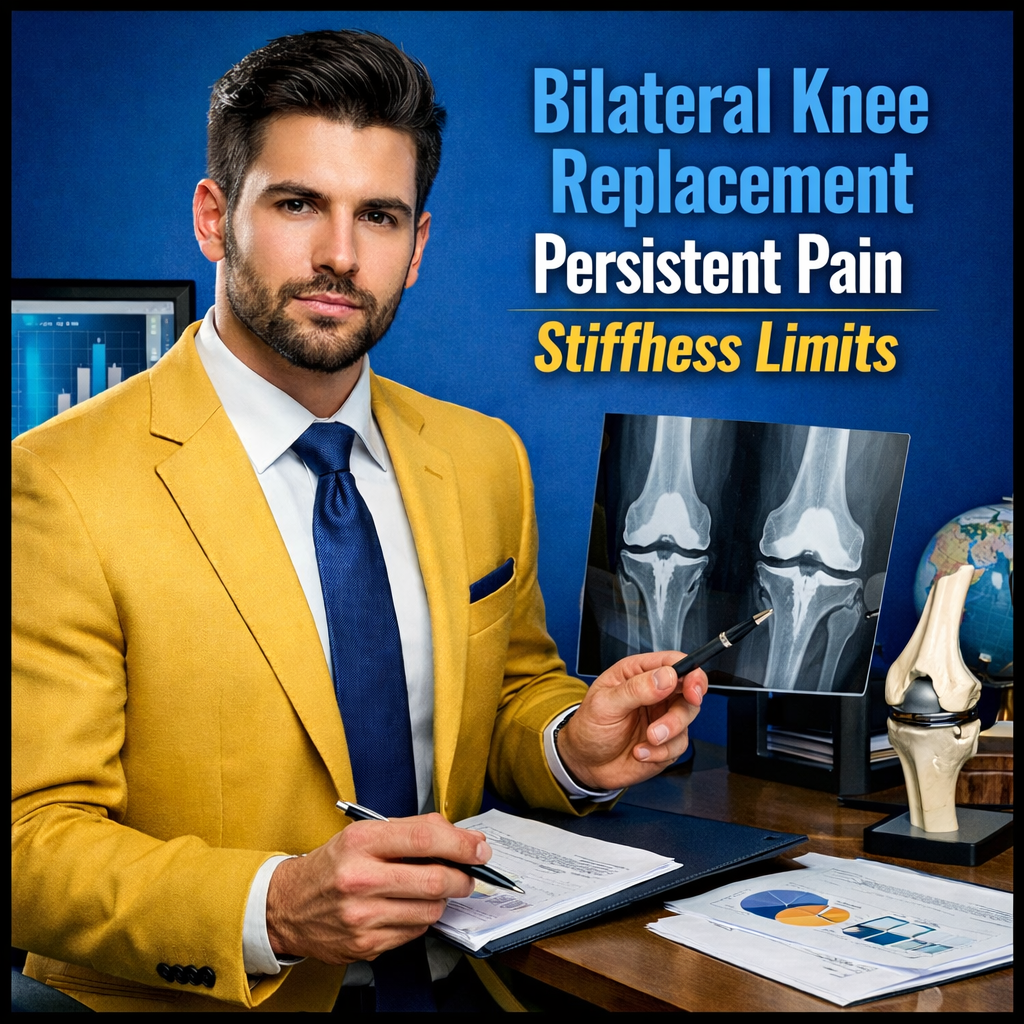
Bilateral knee replacement persistent pain stiffness limits
Bilateral knee replacement can restore stability and reduce severe arthritis pain, but some people continue to face persistent pain and stiffness long after surgery.
When symptoms limit walking, standing, kneeling, or climbing stairs, the key legal question becomes whether the documented functional limits match the standards used in disability and insurance decisions.
- Ongoing post-surgical pain without clear objective documentation
- Stiffness and reduced range of motion affecting work tasks
- Denials based on “expected recovery” timelines
- Gaps between medical records and day-to-day functional limits
Persistent pain and stiffness after bilateral knee replacement must be documented to support work-limiting impairment claims.
Practical guide to bilateral knee replacement with persistent pain and stiffness
- What it is: Total knee arthroplasty on both knees, followed by rehabilitation and functional recovery expectations.
- When issues arise: Continued pain, stiffness, swelling, instability, or limited motion after the typical recovery window.
- Main legal area: Disability benefits, long-term disability insurance, workers’ compensation, and functional capacity disputes.
- Why it matters: Decisions often turn on objective findings and consistent functional limitations over time.
- Basic path: Build a medical-legal file, submit an administrative claim, then appeal or litigate if denied.
Understanding bilateral knee replacement outcomes in practice
Two replaced knees do not guarantee full functional recovery. Persistent pain and stiffness can come from scar tissue, inflammation, weakness, alignment issues, nerve sensitivity, or secondary conditions.
In disability and insurance settings, the focus is usually not the diagnosis alone, but whether the limitations are consistent, measurable, and supported by longitudinal documentation.
- Range of motion limits affecting sitting, standing, and stair use
- Endurance limits (time-on-feet, walking distance, pacing needs)
- Strength and stability issues (buckling, falls, assistive device use)
- Pain patterns documented with triggers, frequency, and treatment response
- Rehabilitation course showing plateau or limited gains despite compliance
- Consistent notes of function: gait, stairs, transfers, and need for breaks
- Objective measures: ROM, strength testing, imaging when indicated
- Therapy records showing persistence despite structured rehab
- Clear work restrictions tied to specific tasks and durations
- Third-party evidence aligned with medical records (employer, family, logs)
Legal and practical aspects of persistent post-arthroplasty impairment
Benefit administrators and agencies commonly review whether treatment has been appropriate, whether the record shows ongoing impairment, and whether restrictions are supported by clinical findings.
They may compare reported limitations against “typical recovery” expectations, making it important to document why recovery is incomplete and how symptoms translate into functional limits.
- Medical support: orthopedic follow-ups, physical therapy, pain management, primary care coordination
- Functional evidence: observed gait deficits, limited stair tolerance, inability to kneel/squat, slowed transfers
- Consistency: similar limitations across providers and visits over time
- Work nexus: restrictions matched to essential job duties and schedule demands
- Timeline clarity: symptom persistence beyond the expected post-op course with documented plateau
Key differences and possible procedural paths
Claims vary depending on the forum. A public disability claim typically applies standardized functional criteria, while an insurance claim may apply contract-based definitions such as “own occupation” or “any occupation.”
Common paths include an initial administrative filing, a structured appeal with additional functional evidence, and litigation when the record supports ongoing work-limiting impairment.
- Administrative disability: focus on sustained functional limits and objective support over time.
- Private LTD insurance: focus on policy definitions, medical necessity, and documented restrictions.
- Workers’ compensation: focus on causation, impairment ratings, and work capacity restrictions.
Where appropriate, resolution may involve settlement discussions, but the strength of a case usually depends on cohesive documentation rather than volume alone.
Practical application in real cases
These cases often involve people whose jobs require prolonged standing, frequent stairs, kneeling, lifting, or fast-paced movement. Persistent stiffness can make even basic transfers and commuting difficult.
Key documents typically include operative reports, post-op follow-ups, physical therapy notes, imaging when clinically indicated, medication history, and objective functional testing such as a functional capacity evaluation.
Further reading:
Daily-living documentation can also matter, as long as it matches the medical record and is written in concrete terms (minutes walking, stair counts, breaks needed, flare patterns).
- Collect core medical records: surgery records, imaging, orthopedic notes, PT notes, medication lists.
- Document function: gait, stairs, standing tolerance, sitting tolerance, transfers, assistive device use.
- Obtain clear restrictions: written work limits tied to tasks and time (not vague statements).
- File the claim carefully: align symptoms, findings, and job demands in a consistent narrative.
- Appeal if denied: add targeted evidence (FCE, updated imaging, specialist opinions, job analyses).
Technical details and relevant updates
Persistent pain after knee replacement may be evaluated for mechanical issues, arthrofibrosis, infection markers when clinically suspected, component loosening, malalignment, or neuropathic pain features.
From a legal perspective, updated medical evaluations can help explain why the condition remains limiting and can clarify whether further intervention is planned or whether the condition has stabilized with permanent restrictions.
When applicable, functional testing can bridge the gap between subjective pain reports and work capacity conclusions by measuring endurance, gait tolerance, lifting limits, and positional tolerance.
- Arthrofibrosis/stiffness: documentation of ROM plateau and rehab attempts
- Instability/buckling: falls, brace use, and clinical exams
- Chronic pain patterns: consistent symptom tracking and treatment response
- Work capacity limits: objective measurements tied to job tasks
Practical examples of bilateral knee replacement impairment
Example 1 (more detailed): A warehouse supervisor undergoes bilateral knee replacement. After completing formal therapy, the record shows a persistent ROM deficit, swelling after short periods on the floor, and a slow, guarded gait. The orthopedic provider documents standing tolerance under 30–45 minutes without breaks, stair limits, and no kneeling or squatting. The claim includes PT plateau notes, a functional capacity evaluation confirming limited endurance, and a job description showing frequent stairs and on-floor troubleshooting. The administrative decision may turn on the consistency between medical findings, measured limits, and essential job demands.
Example 2 (shorter): An office worker with long commutes reports persistent stiffness and pain with prolonged sitting and stair use. Supporting evidence may include recurring follow-up notes, documented limitations on stairs and transfers, medication side effects, and a consistent work restriction plan addressing schedule flexibility and reduced standing requirements.
Common mistakes in bilateral knee replacement impairment claims
- Relying on pain complaints without objective functional documentation over time
- Missing physical therapy and rehab records that show plateau or persistent deficits
- Submitting vague provider letters without specific task-based restrictions
- Ignoring job duty details that explain why limitations matter
- Gaps in care or inconsistent reports across providers without explanation
- Failing to update the record after denials with targeted functional testing
FAQ about bilateral knee replacement with persistent pain and stiffness
What evidence matters most when pain and stiffness continue after surgery?
Decision-makers usually look for consistent medical notes over time, objective findings such as range-of-motion measurements, therapy progress/plateau documentation, and clear restrictions tied to specific work tasks. Functional testing can be especially helpful when symptoms are significant but imaging is limited.
Who is most affected by these work capacity disputes?
People in jobs that require prolonged standing, frequent stairs, kneeling, squatting, lifting, or fast-paced movement are commonly affected. Even sedentary roles can be impacted when commuting, transfers, and prolonged sitting worsen stiffness and pain.
What should be done after a denial based on “expected recovery”?
It is often useful to submit updated objective documentation showing ongoing functional limits, rehabilitation plateau, and specific restrictions, along with a job duty analysis. If appropriate, add a functional capacity evaluation or specialist opinion that explains why recovery remains incomplete.
Legal basis and case law
In public disability systems, the legal framework typically requires showing a medically determinable impairment and sustained functional limitations that prevent substantial work activity over a required duration. The analysis is functional: what activities can be performed reliably and consistently.
In private insurance claims, the governing documents are often the policy terms and claim procedures. The decision may focus on whether restrictions prevent performing the material duties of the relevant occupation, supported by objective evidence and consistent treatment records.
Courts and reviewers commonly emphasize longitudinal consistency and objective support. They may give more weight to detailed treating provider records, therapy documentation, and functional testing than to short, conclusory statements.
Final considerations
Persistent pain and stiffness after bilateral knee replacement can limit work capacity even when surgery was technically successful. The strongest cases usually connect medical findings to real-world functional limits in a consistent, measurable way.
Clear records, task-based restrictions, and objective functional evidence can reduce disputes and improve the quality of administrative review, appeals, and litigation posture.
This content is for informational purposes only and does not replace individualized analysis of the specific case by an attorney or qualified professional.