
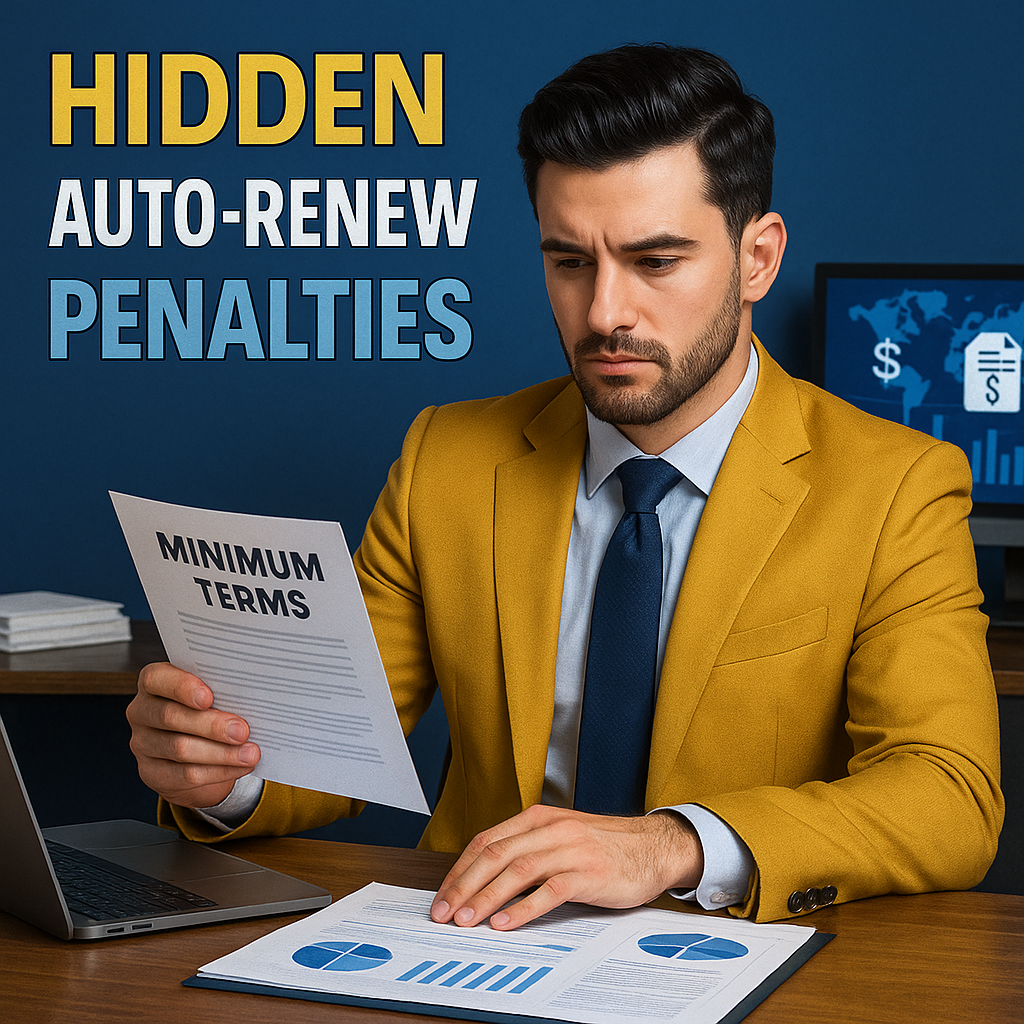
Auto-renew hidden minimum terms unfairness and penalties
Automatic renewals tied to hidden minimum terms generate disputes over unexpected lock-in, cancellation penalties and the fairness of contract design.
Auto-renew contracts are often marketed as a convenient way to keep services running without interruption. The problem becomes serious when a hidden minimum term is tied to the auto-renew, preventing cancellation or triggering heavy penalties long after the initial decision.
These arrangements raise questions about what was clearly disclosed, how freedom to cancel was restricted and which unfairness theories can be used to challenge the clause. Understanding how law approaches auto-renew with hidden minimum terms is crucial for both providers and customers.
- Risk of long lock-in periods that were not clearly presented at sign-up.
- Unexpected cancellation fees based on a minimum term nobody realised existed.
- Regulatory scrutiny over unfair terms and misleading auto-renew disclosures.
- Difficulty proving what exactly the customer understood and accepted.
Key elements of auto-renew with hidden minimum terms
- The topic covers contracts that renew automatically while binding the customer to an undisclosed or poorly explained minimum term.
- Problems usually arise when customers try to cancel and are told they must pay remaining months or a large early termination fee.
- The main legal areas involved are consumer protection, unfair contract terms, contract law and, in some sectors, telecom or financial regulation.
- Ignoring these issues can lead to widespread complaints, chargebacks and enforcement actions focused on unfair lock-in practices.
- Solutions typically combine clearer disclosures, fairer minimum-term structures and robust procedures for resolving disputes.
Understanding hidden minimum-term auto-renewals in practice
In practice, auto-renew clauses are often buried in long terms, while marketing focuses on flexible monthly pricing. A minimum term may apply from the start or be silently reset each time a contract renews, with little or no notice in the main subscription flow.
For fairness, customers need to know not only that the contract renews, but also how long they are locked in and what happens if they cancel early. When these elements are unclear, tribunals frequently treat the clause as surprising, onerous or potentially unfair.
- Is the minimum duration clearly stated next to the price and renewal details?
- Does the contract explain whether the minimum term restarts on each renewal?
- Are early termination fees easily understandable and proportionate?
- Is cancellation allowed online without hidden obstacles or extra charges?
- Clauses that surprise customers are more vulnerable to unfairness challenges.
- High penalties compared with remaining value of the service raise concerns.
- Lack of prominent information about minimum terms weakens consent arguments.
- Clear renewal notices and easy cancellation options mitigate perceived unfairness.
Legal and practical aspects of unfairness theories
Unfairness theories often rely on the idea that the term causes a significant imbalance in rights and obligations, contrary to good faith. Authorities also examine whether the clause would reasonably be expected by the average consumer in the context of the deal.
Practically, businesses must be prepared to show that minimum terms and auto-renew mechanics were presented in a transparent, legible and timely way. Evidence includes contracts, marketing materials, sign-up flows and renewal notices, all read together as a single narrative.
- Transparency requirements for key terms like duration, price and renewal.
- Deadlines for giving renewal reminders or minimum-term expiry notices.
- Criteria used by courts to classify terms as unfair or non-binding.
Important differences and possible paths in hidden minimum-term disputes
Disputes vary depending on whether the customer is a consumer or a business, whether the contract involves essential services and whether the minimum term was part of a promotional campaign. Some sectors are subject to strict rules on contract duration and cancellation.
Possible paths include internal complaint procedures, mediation, regulatory intervention and litigation or arbitration. Each path involves different costs, timelines and standards for assessing unfairness, as well as potential outcomes such as refunds, contract adjustment or term invalidation.
- Negotiated release from the minimum term with partial or full fee waivers.
- Regulator-led enforcement requiring contract changes and customer redress.
- Court decisions declaring specific clauses non-binding or void.
Practical application of unfairness theories in real cases
Typical cases involve mobile, gym, software or media contracts marketed as flexible monthly subscriptions. When customers try to cancel, they discover a one-year minimum term or a requirement to pay all remaining monthly fees, even if they no longer use the service.
Young consumers, small businesses and people in financial difficulty are commonly affected, because they may rely on the impression of easy cancellation. Relevant evidence includes the contract, promotional materials, screenshots of the sign-up process and any renewal communications.
Organising this material chronologically helps show whether the hidden minimum term could reasonably have been noticed, and whether the provider acted fairly when enforcing it.
Further reading:
- Collect contracts, invoices and marketing materials that refer to duration and renewal.
- Obtain screenshots or reconstructions of the sign-up and cancellation flows.
- Identify when and how the minimum term and penalties were first mentioned.
- Submit a written complaint asking for release or adjustment based on unfairness.
- Escalate to regulators or courts if the response is inadequate or repeated issues arise.
Technical details and relevant updates
Many jurisdictions have introduced specific rules for automatic renewals, including requirements for clear, conspicuous disclosure of duration, minimum terms and cancellation methods. Some also require renewal reminders shortly before a contract rolls over into a new period.
Sectoral regulations for telecoms, gyms or online services may set maximum contract durations or limit penalties for early termination. Businesses operating across borders must track these differences carefully to avoid practices considered unfair in certain markets.
Continuous monitoring of guidance and enforcement trends is needed to ensure that existing auto-renew models do not conflict with evolving unfairness standards.
- Check whether new rules demand explicit consent for extended minimum terms.
- Review templates regularly to align with updated guidance on unfair terms.
- Monitor enforcement actions targeting subscription and auto-renew schemes.
Practical examples of hidden minimum-term auto-renewals
A gym advertises a “cancel anytime monthly plan” but includes a twelve-month minimum term in small print. When a member moves city and tries to cancel after three months, the gym demands payment of the remaining nine months. An unfairness claim argues that the minimum term contradicts the main message and imposes a disproportionate burden.
In another case, a software provider offers an “annual plan billed monthly” with automatic renewal. The minimum term silently resets each year, and customers only discover this when attempting to leave. Complaints and regulatory pressure lead the company to stop resetting the term, improve disclosures and waive penalties for affected users.
Common mistakes in auto-renew contracts with minimum terms
- Highlighting flexibility in marketing while hiding long minimum terms in dense clauses.
- Resetting the minimum term at each renewal without clear, prominent explanation.
- Imposing high early termination fees that exceed any reasonable estimate of loss.
- Failing to send renewal reminders before a new minimum period begins.
- Making cancellation difficult or confusing, especially in digital interfaces.
- Not keeping records that show how terms were presented and agreed.
FAQ about hidden minimum terms and unfairness theories
Why are hidden minimum terms in auto-renew contracts controversial?
They are controversial because they can lock customers into paying for services longer than expected, especially when contract duration and penalties are not clearly presented at the time of agreement or renewal.
Who is most affected by these clauses?
Consumers and small businesses that rely on headline messages about flexibility are most affected, as they may not have the time or expertise to detect buried minimum-term language in complex contracts or interfaces.
Which documents help challenge an unfair minimum-term clause?
Important documents include the contract, marketing materials, screenshots of the sign-up and cancellation flows, renewal notices, correspondence with the provider and any internal or public guidance on contract duration and termination.
Legal basis and case law
The legal basis for challenging hidden minimum terms in auto-renew contracts often lies in unfair contract term regimes, consumer-protection statutes and general principles of good faith and transparency. These frameworks aim to prevent significant imbalances that customers could not reasonably anticipate.
Case law typically examines whether duration and penalties were sufficiently clear, whether the term contradicts the main impression given by advertising and whether the customer had a realistic opportunity to avoid or exit the minimum term. Courts may declare unfair clauses non-binding or interpret them narrowly.
Regulatory decisions also play an important role, providing examples of enforcement actions against aggressive auto-renew schemes and establishing practical benchmarks for what counts as fair, proportional and transparent in this context.
Final considerations
Auto-renew contracts with hidden minimum terms concentrate risk on customers who believed they could leave with limited cost. When duration and penalties are obscured, unfairness theories give regulators and courts tools to rebalance those relationships.
Designing contracts and interfaces that present duration, renewal and cancellation terms openly helps prevent disputes, protect trust and reduce exposure to legal challenges. Proper documentation and internal review processes are essential in any strategy for managing auto-renew risk.
This content is for informational purposes only and does not replace individualized analysis of the specific case by an attorney or qualified professional.