
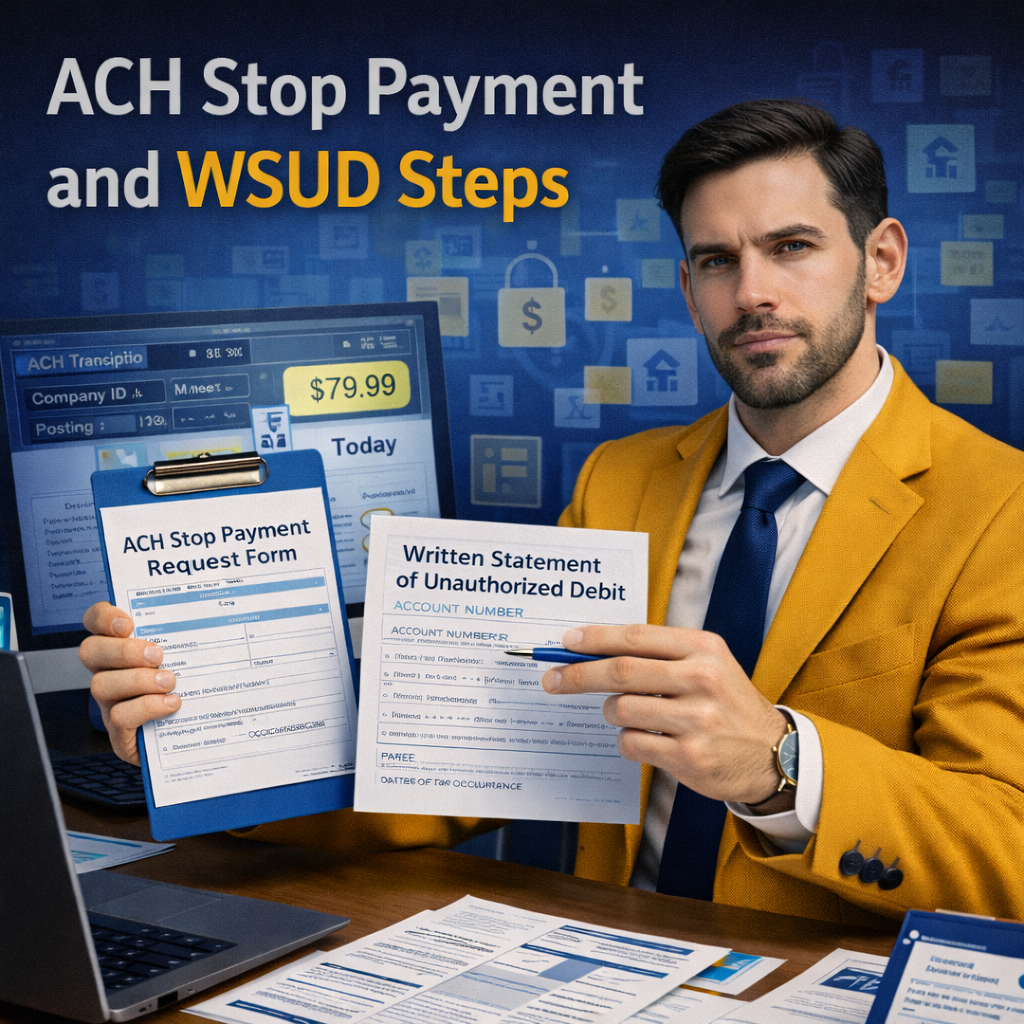
ACH stop payment and WSUD steps
Stopping ACH debits and using WSUD correctly reduces chargeback delays and improves unauthorized debit outcomes.
When an ACH debit hits an Arkansas account unexpectedly, the confusion usually comes from mixing three different concepts: stopping a future payment, disputing a posted debit, and proving that an authorization never existed (or was revoked). Banks and credit unions often use different forms and channels for each step, and small mistakes can slow everything down.
A clean approach links the stop payment request (to prevent the next pull) with a WSUD submission (to document an unauthorized debit under network rules), while also using Reg E error resolution for consumer accounts. The practical goal is consistent documentation: dates, amounts, merchant identifiers, and a clear statement of what was or was not authorized.
- Recurring debits continue when stop payment is not set for the correct entry details.
- Disputes stall when WSUD facts do not match the transaction record.
- Deadlines tighten quickly after statements and settlement dates.
- Outcomes improve with clear revocation proof and consistent identifiers.
Fast orientation to ACH stop payments and WSUD
- What it is: an ACH stop payment blocks future debits; WSUD supports an unauthorized debit dispute.
- When it arises: subscriptions, trials, gym/telehealth billing, payday-style debits, or merchant token updates.
- Main legal area: consumer accounts typically rely on Regulation E plus bank procedures and ACH network rules.
- Ignoring it leads to: repeat withdrawals, slower investigations, and fragmented evidence.
- Basic path: contact the financial institution promptly, file stop payment for future pulls, submit WSUD for unauthorized debits, track responses and escalate if needed.
Understanding ACH stop payment and WSUD in practice
An ACH stop payment is designed to prevent a debit that has not posted yet. It is most effective for recurring or scheduled debits, where the next withdrawal date is known or predictable. It does not automatically reverse what already posted, so it usually runs alongside a dispute process.
A WSUD (Written Statement of Unauthorized Debit) is a short signed statement used by many institutions for consumer ACH unauthorized debit claims. It supports an ACH return and helps the institution document why the debit should be treated as unauthorized versus a billing disagreement.
- Stop payment focus: future entries (next debit or series) and correct transaction identifiers.
- WSUD focus: whether authorization existed, whether it was revoked, and what exactly was unauthorized.
- Reg E focus: error investigation duties, provisional credit practices, and statement-based notice timelines for consumer accounts.
- Merchant-side focus: revoking authorization directly with the merchant and keeping proof.
- Match the entry: use the same company name, amount pattern, and dates shown on the posted ACH record.
- Separate issues: “unauthorized” is different from “authorized but unhappy with service.”
- Document revocation: keep emails, screenshots, chat logs, and cancellation confirmations.
- Act quickly: early reporting improves routing options and reduces processing delays.
- Request confirmation: obtain a stop payment reference number and submission receipt for WSUD.
Legal and practical aspects of ACH stop payments and WSUD
For consumer accounts, Regulation E is the main framework for electronic fund transfer disputes and error resolution. It generally supports a consumer’s ability to challenge unauthorized transfers and requires the institution to investigate when a valid notice of error is received.
Separately, ACH processing follows network operating rules that govern return reasons and required documentation. Many institutions collect WSUD details to meet internal controls and network expectations, especially when deciding whether an entry is “unauthorized” or a merchant dispute.
- Common requirements: customer identity confirmation, transaction details, and a clear unauthorized statement.
- Typical timing pressure: institutions often rely on strict internal windows; earlier notice is consistently better.
- Decision criteria: whether authorization existed, whether it was revoked, and whether the dispute is actually about service quality.
- Evidence weight: cancellation proof, communication logs, and a consistent transaction narrative.
Important differences and possible paths in stop payments and disputes
Not every ACH problem is the same. A dispute can involve no authorization, authorization revoked, wrong amount/date, or a merchant performance issue. Each category tends to trigger different forms, return reasons, and responses.
- Stop payment only: best when the debit has not posted and the goal is preventing the next pull.
- WSUD plus dispute: best when a debit posted and the consumer claims it was unauthorized or authorization was revoked.
- Merchant resolution first: useful for billing disagreements where authorization existed and the dispute is about refunds.
- Escalation path: supervisor review, written complaint to the institution, then regulator or CFPB complaint when responses remain inconsistent.
In practice, the safest approach is parallel: set a stop payment to prevent repeat entries, submit WSUD/dispute for posted debits, and send a written revocation to the merchant to avoid “authorization still active” arguments later.
Practical application of stop payments and WSUD in real cases
These issues commonly appear with subscriptions that change names on statements, merchants using multiple company IDs, and recurring services that keep billing after cancellation. They also appear after account credentials are compromised and a fraudster initiates transfers that look “valid” at first glance.
The people most affected are consumers using checking accounts for recurring bills, gig workers with debit-linked accounts, and families sharing devices where authorizations are created without clear consent. The most relevant documents are statement screenshots, ACH transaction details, merchant cancellation proof, and any bank case numbers.
Useful documentation usually includes posted ACH details (company name, amount, posting date), revocation proof (email/chat), and identity indicators (device alerts, password reset timestamps, police report number when appropriate).
Further reading:
- Collect the transaction record: screenshot the ACH entry details and note dates, amounts, and merchant identifiers.
- Contact the institution quickly: request an ACH stop payment for future entries and ask what identifiers they need.
- Submit WSUD or the institution’s affidavit: keep a copy and request a submission receipt or reference number.
- Send revocation to the merchant: use email or portal cancellation and keep proof; request written confirmation.
- Track deadlines and responses: keep a timeline and escalate in writing if the outcome is unclear or inconsistent.
Technical details and relevant updates
ACH disputes sit at the intersection of consumer banking rules and network procedures. This is why two customers can report the same debit and receive different checklists: one case is treated as a Reg E “error,” another as a merchant refund request, and another as an ACH unauthorized return supported by WSUD.
For consumer accounts, an institution’s investigation steps often include confirming whether the debit was preauthorized, whether the consumer provided timely notice, and whether any cancellation proof exists. For recurring entries, institutions may ask for the “next scheduled date” to ensure the stop payment targets the correct cycle.
- Multiple merchant descriptors: one subscription can appear under different names and company IDs.
- Wallet and token billing: cancellations in-app may not revoke bank authorization automatically.
- Same-day processing: acting early matters when entries are already in processing queues.
- Written follow-up: a short written summary sent after phone calls reduces later contradictions.
Practical examples of ACH stop payment and WSUD
Example 1 (more detailed): A consumer in Arkansas cancels a monthly telehealth subscription, but an ACH debit posts again the next month under a slightly different company name. The consumer gathers screenshots of the cancellation confirmation, the prior statement line items, and the new ACH entry details. The consumer calls the bank the same day, requests an ACH stop payment for the upcoming recurring debit series, and asks for the exact descriptor and company ID used on the entry. The consumer submits the bank’s WSUD/affidavit stating authorization was revoked before the debit date and attaches the cancellation proof. The bank provides a case number and the consumer saves the confirmation email. The likely outcome is a cleaner review because the narrative aligns: revocation proof, matched identifiers, and prompt reporting.
Example 2 (shorter): A consumer sees an ACH debit with no merchant relationship and no prior authorization. The consumer reports it immediately, completes WSUD, changes online banking credentials, and requests a stop payment if similar debits appear. The consumer keeps the fraud alert emails and a written timeline of events.
Common mistakes in stop payment and WSUD workflows
- Requesting a stop payment without matching the actual ACH descriptor shown on the entry.
- Calling it “unauthorized” when it is really a refund disagreement after a valid subscription.
- Submitting WSUD without a clear statement of whether authorization never existed or was revoked.
- Failing to keep proof of cancellation, chat logs, or merchant portal screenshots.
- Waiting too long after statements post, which can narrow available processing options.
- Not obtaining a case number or written confirmation after phone conversations.
FAQ about ACH stop payment and WSUD
Is a stop payment the same as disputing an ACH debit?
No. A stop payment is mainly to prevent a future debit from posting. A dispute (often supported by WSUD for unauthorized claims) focuses on a debit that already posted and requires an investigation process and documentation.
Who is most affected by ACH unauthorized debits and repeat withdrawals?
Consumers with recurring subscriptions, shared devices, and accounts used for frequent online purchases are commonly affected. Cases also arise after credential compromise, where entries appear as routine debits but were not authorized by the account holder.
What documents usually help most if the institution denies the claim?
Transaction detail screenshots, cancellation or revocation proof, a clear timeline, and the institution’s case references are typically the most helpful. If the explanation is inconsistent, a written request for clarification and escalation can help align the record for review.
Legal basis and case law
For consumer accounts, the central legal foundation is the Electronic Fund Transfer Act and its implementing regulation, Regulation E, which governs electronic fund transfers and sets investigation and notice concepts for errors and unauthorized transfers. In practice, it frames how consumers report issues and how institutions document and respond.
ACH processing also follows network operating rules that standardize return handling and documentation practices. WSUD is commonly used as a documentation tool in unauthorized consumer ACH scenarios. For Arkansas accounts, state law may matter when disputes expand into broader consumer protection, contract cancellation, or unfair practices arguments, but the day-to-day workflow typically starts with federal consumer EFT rules and the institution’s procedures.
Courts generally look at whether notice was provided, whether the transfer was actually authorized, and whether the institution followed its investigation duties and maintained consistent records. Outcomes often turn on documentation quality rather than long legal argument, especially at the administrative complaint stage.
Final considerations
ACH stop payment and WSUD work best when treated as a coordinated process: prevent the next debit, document why the posted debit was unauthorized (or why authorization was revoked), and keep the narrative consistent across bank contacts and merchant communications.
Clean records matter most: accurate identifiers, a clear timeline, and proof of revocation or lack of authorization. When responses are unclear, written follow-ups and a structured escalation path help keep the case moving.
- Organize documents before the first call and keep copies of submissions.
- Act quickly and track case numbers, dates, and promised timelines.
- Seek qualified guidance when amounts are high or patterns repeat.
This content is for informational purposes only and does not replace individualized analysis of the specific case by an attorney or qualified professional.