
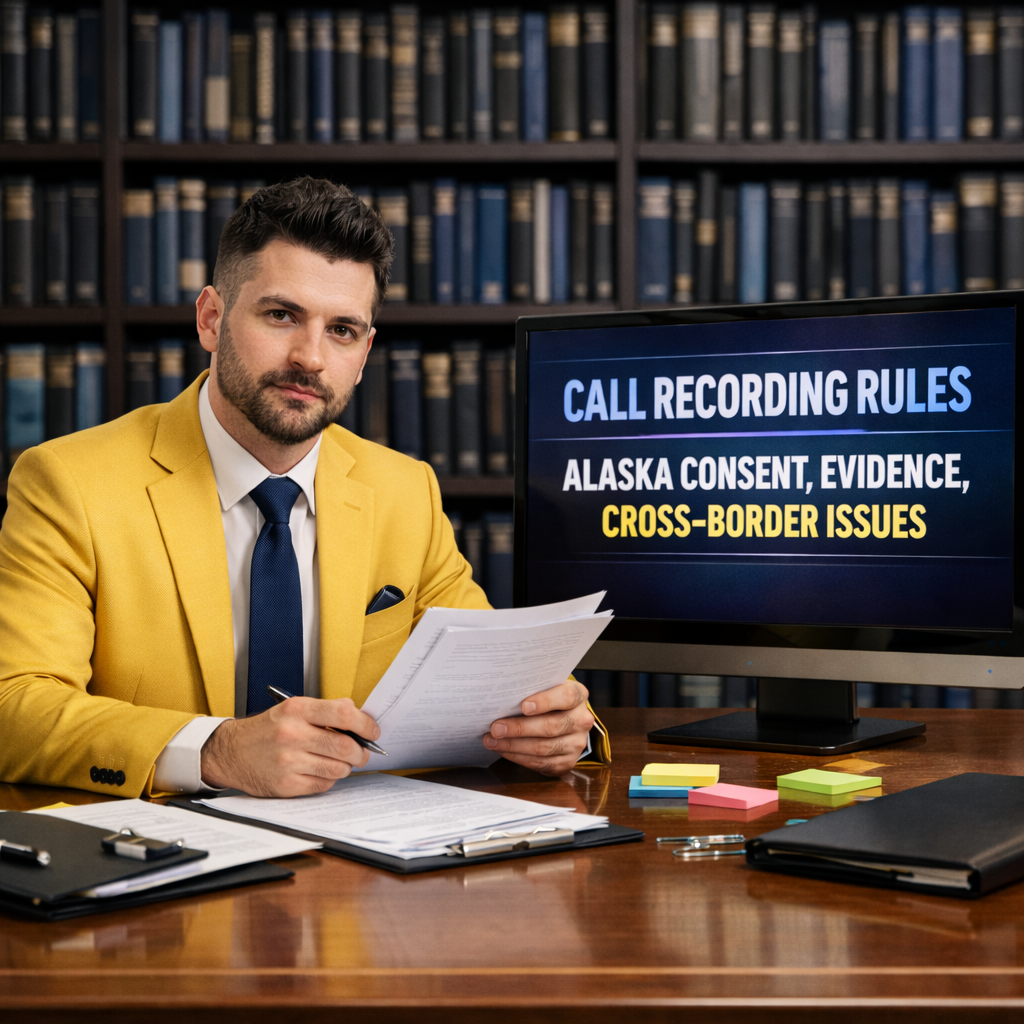
Call recording rules Alaska consent, evidence, cross-border issues
Alaska’s one-party call recording rules hinge on consent, context, and expectations of privacy, making proof, notices, and storage decisions central.
In Alaska, phone and video calls can seem simple to record until a dispute appears and someone claims a conversation was captured unlawfully. Arguments then shift from “who said what” to whether consent, location, and privacy expectations were handled correctly.
Confusion usually arises because Alaska is widely known as a one-party consent state, but that headline hides important nuances. The type of communication, who is participating, how the recording is used, and whether any interception devices are involved can all change the legal analysis.
This article walks through the basic one-party rule, the key exceptions, and a practical workflow for deciding when recording is allowed, when notice is advisable, and how to document consent so the recording can be used later without becoming its own legal problem.
- Confirm whether at least one party on the call is aware and affirmatively consenting to the recording.
- Check if any party is in a different state with stricter all-party consent requirements that could also apply.
- Identify whether the call involves sensitive contexts such as workplace monitoring, government functions, or minors.
- Document how consent was obtained (verbal at the start of the call, written policy, or separate agreement).
- Decide in advance how long the recording will be kept, who may access it, and how it will be secured.
See more in this category: Digital & Privacy Law
In this article:
Last updated: January 10, 2026.
Quick definition: Call recording rules in Alaska set the conditions under which telephone and similar communications may be recorded when at least one party to the call consents.
Who it applies to: Individuals, businesses, and organizations that place or receive calls touching Alaska, including in-state calls and calls where participants are located in different states but Alaska law may be invoked.
Time, cost, and documents:
- Policies or internal guidelines for recording customer service, HR, or compliance calls.
- Retention schedules and logs showing when recordings are created and deleted.
- Scripts or templates used by staff to announce recording and capture verbal consent.
- IT documentation describing systems used to capture, store, and restrict access to recordings.
- Incident files where recordings are used as evidence in complaints, investigations, or litigation.
Key takeaways that usually decide disputes:
- Whether at least one participant on the call clearly consented to recording at or before the time of capture.
- Whether any participant had a reasonable expectation that the call would remain unrecorded or entirely private.
- Whether the recording was made directly by a party to the call or through separate interception equipment.
- Whether participants were located only in Alaska or in mixed jurisdictions with stricter consent standards.
- How the recording was used afterward, especially if it was disclosed, posted, or reused beyond the original purpose.
Quick guide to call recording rules in Alaska
- Confirm that at least one party to the call knowingly consents to the recording before it begins or as it starts.
- Map where each participant is located and check if any other state’s all-party consent rule may also apply.
- Use clear, repeatable scripts when recording routine business calls so consent and notice are easy to prove.
- Limit access to recordings and align retention periods with business needs and any legal hold obligations.
- Document decisions when using recordings in investigations, HR actions, or formal disputes.
- When in doubt, obtain express consent from all participants and store that proof with the recording details.
Understanding call recording rules in Alaska in practice
The basic rule in Alaska is that a conversation may generally be recorded when at least one party to the communication consents. In practice, this means a participant can record their own call, or an organization can record calls handled by its staff, if the person doing the recording is part of the conversation and has decided to capture it.
Further reading:
However, the simplicity of the headline rule fades in real situations. Questions arise about whether consent was truly informed, whether the other party reasonably expected privacy, and whether the recording involved any separate interception technology that could trigger additional obligations or prohibitions.
Organizations that routinely record customer service, sales, or support calls often adopt written scripts and automated announcements. This reduces ambiguity about whether consent was communicated and shows regulators or courts that the organization treated recording as a controlled compliance process, rather than an ad hoc surveillance practice.
- Confirm whether the recorder is a party to the call or an external listener using interception technology.
- Log when and how consent or notice was provided, including language used in the call script.
- Flag calls where parties are in multiple states and escalate for legal review before relying on recordings.
- Restrict recording in particularly sensitive contexts, such as counseling, internal complaints, or medical details.
- Ensure that any sharing of recordings outside the organization is tied to a defined legal or business purpose.
Legal and practical angles that change the outcome
Outcomes can shift quickly when calls involve participants in different states. Even if Alaska allows one-party consent, another jurisdiction might require all parties to agree, and a court could decide that the stricter standard should govern the recording in a multi-state dispute.
Another key angle is whether recording is done openly or in a way that feels covert. Even where the law permits one-party consent, secretly capturing sensitive discussions can erode trust and lead to claims under other legal theories, such as intrusion on seclusion or misuse of personal data.
Finally, outcomes often depend on how narrow and disciplined the recording program is. Clear scope, limited retention, and consistent notice practices typically fare better than broad, indefinite recording with little oversight or documentation.
Workable paths parties actually use to resolve this
When disputes arise over call recordings, the first step is often to clarify the purpose for which the recording was made and identify who knew about it at the time. Many issues can be de-escalated by agreeing to limit how the recording will be used or to rely on a written summary instead.
In a business setting, internal compliance teams may adjust scripts, training, or IT settings, using the dispute as a trigger to tighten policies. Where relationships are ongoing, parties sometimes negotiate stipulations about future recording, such as requiring advance written notice for certain call types.
More serious disagreements, especially those wrapped into litigation or regulatory complaints, are often addressed through formal discovery processes, protective orders, or negotiated confidentiality agreements that control who may listen to recordings and in what context.
Practical application of call recording rules in Alaska in real cases
In day-to-day operations, call recording policies are implemented through scripts, system settings, and training. What often breaks is the link between policy and execution: staff forget to give notice, notifications are buried in long automated messages, or remote workers use personal devices without clarity on consent rules.
From a practical standpoint, organizations need a workflow that traces each recorded call back to clear authorization. That means knowing which lines are recorded, when announcements are triggered, and how consent is preserved alongside the recording’s metadata.
When a complaint or investigation emerges, this workflow allows compliance teams to reconstruct the call history and show when each participant was informed. Without that trail, even lawful recordings can become contentious, weakening their value as evidence.
- Define which call types are eligible for recording and document the governing policy and legal assumptions.
- Configure systems so that recording is tied to specific lines or queues, with clear logs for each recording event.
- Embed short, unmistakable consent language into call flows and staff scripts for recorded lines.
- Store recordings in a structured system that tags date, time, participants (where known), and consent method.
- Establish review and escalation steps when a recording is requested for HR actions, disputes, or regulatory responses.
- Align deletion and retention practices with legal holds, ongoing matters, and documented business needs.
Technical details and relevant updates
Technical implementation directly shapes whether call recording stays within legal and policy boundaries. Systems that silently enable recording on ad hoc devices are more likely to generate disputes than centrally managed, logged solutions with uniform settings.
Notice and consent often depend on small, technical details: whether the initial automated message actually plays before a person speaks, whether mobile apps display visible indicators, and whether remote workers use approved platforms instead of personal tools.
Retention and access controls are equally critical. Even a lawfully recorded call can create exposure if copied to unsecured media, shared through unsecured channels, or retained far beyond documented policy without a clear legal hold.
- Define which networks, apps, and devices are authorized to record calls touching Alaska participants.
- Centralize logs so each recording can be traced back to the device, user, and consent method used.
- Apply role-based access so only trained personnel may retrieve or export call recordings.
- Implement retention rules that automatically delete recordings when no legal or operational need remains.
- Review system updates and new communication tools regularly to confirm recording settings and disclosures remain aligned.
Statistics and scenario reads
The following scenario patterns reflect how organizations often experience call recording issues in Alaska-related operations. They are not legal conclusions, but they show where monitoring and documentation usually make the biggest difference.
Reading these distributions as “risk heat maps” helps teams focus on the calls and workflows where gaps in consent, notice, or retention practices are most likely to cause friction or trigger review.
Typical distribution of recording-related issues
- Customer service calls with inconsistent notice – 35%: Problems usually surface when only some agents use the consent script.
- Remote worker calls on personal devices – 25%: Recording apps and messaging tools fall outside central IT control.
- Internal HR or complaint calls – 15%: Participants later dispute whether recording was appropriate or necessary.
- Multi-state or cross-border calls – 15%: Different consent standards create uncertainty over which rule applies.
- Ad hoc “self-help” recordings by individuals – 10%: People record contentious calls without any documented policy.
Before and after tightening recording practices
- Unlogged recordings in disputes – 40% → 12%: Drops when all recording goes through centralized, auditable systems.
- Complaints about “secret recording” – 30% → 10%: Falls as clear, concise notice is added to all recorded lines.
- Recordings lacking clear consent evidence – 45% → 18%: Improves once scripts and metadata fields are standardized.
- Disputes over multi-state consent conflicts – 20% → 8%: Decreases when high-risk call types are flagged for review.
Monitorable points for ongoing oversight
- Percentage of recorded calls with logged consent language (target: >95%).
- Average days until recordings are deleted when no legal hold applies (tracked against policy limits).
- Number of employees using approved apps for recorded calls versus personal tools each month.
- Incidents per quarter involving disputed or unclear recording consent.
- Time from complaint to retrieval of relevant recordings in days, indicating system responsiveness.
Practical examples of call recording rules in Alaska
Routine customer service line with clear notice
An Alaska-based utility runs all inbound calls through a system that announces, “This call is recorded and may be monitored,” before an agent answers. Scripts instruct agents to repeat a short notice if recording restarts or the call is transferred.
When a billing dispute later arises, the utility can show the recorded call, the timestamped system log confirming recording was active, and the initial announcement. The customer may dislike the outcome, but arguments about “secret recording” have little traction because notice and consent are well documented.
Ad hoc recording of a sensitive HR conversation
A supervisor in Alaska records a performance meeting on a personal smartphone without informing the employee. The employee later learns of the recording and raises privacy and trust concerns while also questioning whether the file may be shared or used selectively.
Even if the recording might be lawful under a one-party rule, the lack of policy, unclear consent, and use of unsecured personal equipment all weigh against relying on the recording. The employer ends up excluding it from the investigation and revising its HR and IT guidance.
Common mistakes in call recording rules in Alaska
Assuming “one-party” means “no notice needed”: Overlooks expectations of privacy and multi-state participants that can complicate disputes.
Letting staff choose their own recording tools: Produces unlogged, unsecured recordings that cannot be easily tracked or controlled.
Recording sensitive calls by default: Fails to weigh additional privacy and employee-relations impacts in HR or complaint contexts.
Ignoring where the other participant is located: Misses that another state’s stricter consent requirement might also be relevant.
Keeping recordings indefinitely “just in case”: Expands exposure in security incidents and complicates discovery and deletion requests.
FAQ about call recording rules in Alaska
Is Alaska generally considered a one-party consent state for call recording?
Alaska is typically treated as a one-party consent jurisdiction for many telephone and similar communications. This means a conversation may usually be recorded if at least one participant knows about and agrees to the recording at the time it is made. The analysis can still change with different technologies, locations, and expectations of privacy.
Does a business in Alaska have to tell callers that customer service lines are recorded?
Many organizations use automated announcements or scripts to tell callers that lines are recorded. Doing so helps show that at least one party gave informed consent and reduces disputes about “secret” recording. Policies, call flow diagrams, and sample scripts are often kept on file to demonstrate consistent notice practices if a complaint arises.
What happens if participants on an Alaska call are located in different states?
When callers are in multiple states, more than one consent rule can be relevant. Some states require all parties to agree to recording, so the stricter standard may be considered in a dispute. Legal teams usually review call routing, participant locations, and any applicable terms or disclosures before relying heavily on such recordings in formal proceedings.
Can an employee in Alaska record work calls without telling a manager or HR?
Employees sometimes record conversations as personal documentation, but internal policies may restrict this to protect confidential business and personnel information. Handbooks and IT policies often define whether recording is permitted, which devices may be used, and how any recording must be stored. Breaches of policy can trigger HR or disciplinary responses even when a recording might be legally permissible.
Are there special considerations for recording internal HR or complaint calls in Alaska?
Recording internal HR, disciplinary, or complaint calls is particularly sensitive because the content often involves personal information and workplace dynamics. Organizations that record such calls usually apply stricter access controls, narrower retention periods, and clearer documentation of why recording was necessary. Written protocols and case files help show that recordings were handled proportionally and as part of an established process.
How long should call recordings involving Alaska participants typically be kept?
Retention periods are usually set by internal policy, industry expectations, and any specific legal requirements. Many organizations assign shorter default retention for routine customer calls and longer retention for calls tied to contracts, complaints, or investigations. Legal holds, discovery requests, or regulatory inquiries can extend retention beyond the default schedule when necessary.
Can call recordings from Alaska be used as evidence in court or arbitration?
Recordings may be considered in court or arbitration when lawfully made and properly authenticated. Courts often look at who made the recording, how consent was obtained, whether the file was tampered with, and how it was stored. Logs, metadata, policies, and witness testimony are commonly used to lay a foundation before the recording itself is reviewed by a decision-maker.
What documentation helps show that call recording in Alaska followed policy?
Useful documentation includes written call recording policies, scripts, and training materials; technical diagrams showing which lines are recorded; system logs linking recordings to dates and users; and retention schedules. These materials allow auditors or tribunals to assess whether recording was targeted, consistent, and aligned with declared practices rather than improvised.
How should organizations handle access requests for call recordings involving Alaska participants?
Access requests are typically processed through established intake channels, such as privacy offices, legal teams, or customer service units. Workflows often require verifying the requester’s identity, confirming the scope of calls involved, and assessing whether any privileges or third-party interests are implicated. Logs of search efforts and responses are kept for audit purposes.
What role do training and periodic audits play in Alaska call recording programs?
Training ensures that staff understand when lines are recorded, how to give notice, and how to respond when callers object. Periodic audits then test whether scripts are being used, recordings are logged correctly, and retention rules are enforced. Findings from audits often drive updates to scripts, technical settings, or policy language.
References and next steps
- Map current call flows, identify which lines are recorded, and document the consent assumptions for each type.
- Update scripts and employee training so notice language is short, consistent, and aligned with technical settings.
- Review retention schedules and access controls for recordings, confirming that deletion and legal hold processes are working.
- Schedule periodic audits of a sample of recorded calls, checking that logs, consent, and system behavior match written policy.
Related reading:
- Alaska Personal Information Protection basics — Alaska
- Email and message monitoring in the workplace — Alaska
- Location tracking, GPS data, and employee monitoring — Alaska
- Biometric data collection and notice duties — Alaska
- Social media monitoring and account access in employment — Alaska
Normative and case-law basis
Call recording disputes tied to Alaska often draw on state statutes governing interception and privacy, as well as more general provisions related to misuse of personal information or intrusion upon seclusion. Industry-specific rules, such as financial or healthcare regulations, may add additional expectations on notice and retention.
Fact patterns and proof typically drive outcomes. Decision-makers look closely at who initiated the recording, whether any statute or policy expressly allowed it, and how clearly consent and notice can be reconstructed from logs, scripts, and correspondence.
Because wording varies between statutes and policies, and because multi-state calls can bring in other jurisdictions’ laws, organizations often seek tailored legal analysis for high-stakes recording programs or contentious disputes involving mixed locations or sensitive subject matter.
Final considerations
Call recording in Alaska can support accountability and clarity when conflicts arise, but only when programs are built on clear rules, documented consent, and disciplined technical execution. Treating recording as an intentional compliance tool rather than an improvised convenience usually leads to more reliable outcomes.
Aligning policies, scripts, and systems allows organizations and individuals to understand when calls are recorded, how recordings are protected, and why they are retained. That clarity helps limit disputes over secrecy and keeps attention on the underlying facts of the conversation.
Build on a clear consent model: Define when one-party recording is appropriate and when broader notice is warranted.
Connect policies to actual call flows: Ensure scripts, system settings, and training all reflect the same assumptions.
Use recordings selectively and proportionally: Focus on defined legal or business purposes with documented boundaries.
- Review at least one sample recorded line end-to-end, from notice to deletion.
- Refresh documentation so policies, scripts, and technical diagrams stay synchronized.
- Flag multi-state or particularly sensitive calls for tailored legal analysis before relying on recordings in disputes.
This content is for informational purposes only and does not replace individualized legal analysis by a licensed attorney or qualified professional.