
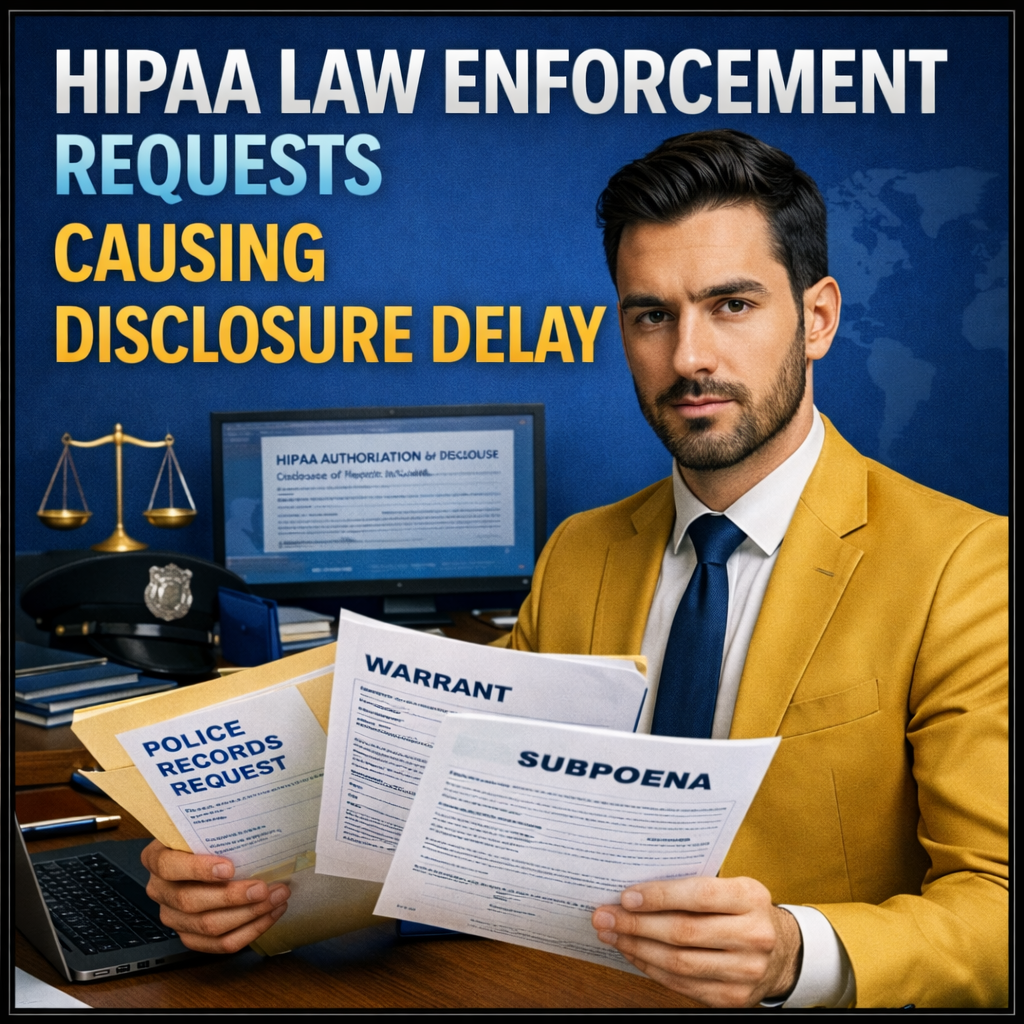
HIPAA Law Enforcement Requests Causing Disclosure Delays
When police request health information, knowing HIPAA limits helps prevent improper disclosures and delays.
Law enforcement requests for medical information often arrive urgently, with little context, and can pressure staff to share more than required.
HIPAA allows certain disclosures, but many requests still need patient authorization, a court order, or narrowly tailored documentation before releasing records.
- Over-disclosure beyond what a request legally permits
- Delays caused by missing documentation or unclear legal process
- Improper reliance on informal police requests or phone calls
- Confusion between HIPAA permissions and other privacy rules
Quick guide to HIPAA and law enforcement requests
- HIPAA sets rules for when protected health information may be shared without patient authorization.
- Problems usually arise when requests are urgent, informal, or lack the right legal paperwork.
- Main legal area: U.S. health privacy (HIPAA Privacy Rule), plus state privacy laws.
- Ignoring the framework can lead to improper disclosure, refusals, or operational delays.
- Basic path: verify identity and scope, confirm legal basis, document, then disclose the minimum necessary or deny.
Understanding HIPAA and law enforcement requests in practice
HIPAA does not automatically block all disclosures to law enforcement, but it does require a valid pathway for releasing protected health information.
The practical question is rarely “can anything be shared?” and more often “what can be shared, to whom, and on what documentation?”
- Identity verification of the requesting official and agency
- Purpose clarity for the request and what information is needed
- Documentation type (warrant, subpoena, order, administrative demand, or authorization)
- Scope limits tied to the request and applicable exceptions
- Minimum necessary evaluation when the rule applies
- Informal requests often slow processing because they lack required paperwork.
- Scope must be narrowed to what the legal basis supports, not what is requested.
- Emergency disclosures are possible but require documented justification.
- Separate rules may apply to psychotherapy notes, minors, and substance use records.
- Routing through a privacy officer or counsel reduces inconsistent responses.
Legal and practical aspects of HIPAA law enforcement disclosures
HIPAA permits disclosures to law enforcement in specific circumstances, such as when a court order or warrant compels disclosure, or when certain limited information is requested for identification and location purposes.
In many settings, the safest operational approach is to treat each request as a workflow: validate the authority, confirm the legal basis, and respond with the smallest set of information needed.
Common documentation pathways include:
- Judicial process: court order, warrant, or similar court-issued directive
- Legal process: subpoena or summons, subject to HIPAA conditions and state rules
- Administrative request: certain agency demands, when HIPAA criteria are met
- Patient authorization: a HIPAA-compliant authorization signed by the individual
- Emergency circumstances: limited disclosures to prevent serious harm, with documentation
Important differences and possible paths in responding
Not all law enforcement requests are the same. A request backed by a court order is operationally different from an officer asking for records at the front desk or by phone.
- Immediate safety: may allow limited disclosure, but requires clear justification and documentation.
- Investigation support: typically requires formal legal process or authorization, depending on the request.
- Identification/location: may allow limited directory-type information, with strict limits.
- Victim or suspect scenarios: additional rules may apply depending on capacity, consent, and the context.
Possible paths include a compliant disclosure, a partial disclosure limited to scope, or a documented refusal pending proper paperwork. When the request is unclear, escalation to the privacy officer or counsel often avoids inconsistent decisions.
Practical application of HIPAA law enforcement requests in real cases
Typical situations include police requesting records for an investigation, officers asking whether a patient is present, or agencies seeking injury-related information after an incident.
Delays most commonly affect hospitals, urgent care centers, clinics, and behavioral health settings where multiple departments may receive requests without a single intake process.
Further reading:
Relevant documents and evidence often include the request itself (with dates and signatures), patient identifiers, any court documents, a HIPAA authorization if applicable, and internal logs showing what was disclosed and why.
- Log and route the request to the designated privacy or records team immediately.
- Verify identity and authority of the requester, including agency contact details.
- Confirm the legal basis (order, warrant, subpoena, authorization, or limited exception).
- Limit the scope to what is supported and apply minimum-necessary rules when applicable.
- Document and respond with a clear record of what was disclosed, withheld, and the reason.
Technical details and relevant updates
HIPAA’s law enforcement permissions live primarily in the Privacy Rule, but actual disclosure decisions may also be shaped by state privacy laws, facility policies, and special record categories.
Some categories can trigger additional protections, such as psychotherapy notes, certain mental health records, and substance use treatment information under separate federal frameworks.
- Check state law for stricter limits on disclosures to law enforcement.
- Separate record categories may need different paperwork than general medical records.
- Policy alignment across departments reduces inconsistent disclosures.
- Audit readiness improves when disclosure logs are standardized.
Practical examples of HIPAA law enforcement requests
Example 1 (more detailed): An officer asks a hospital to provide an injured patient’s full chart for an ongoing investigation. The request arrives by email without a court document. The records team logs the request, verifies the officer’s identity, and asks for the appropriate legal process or a HIPAA authorization. While waiting, the hospital confirms whether limited information can be shared for identification purposes under policy. Once the hospital receives a valid court order specifying categories of information, the team releases only the requested sections and documents the disclosure in the patient’s disclosure log.
Example 2 (shorter): Police ask by phone whether a person is currently being treated at a clinic. The clinic routes the call to the privacy contact, confirms identity, and applies the facility’s rules for directory and presence information. If policy requires, the clinic refuses to confirm presence without proper documentation and records the interaction for compliance tracking.
Common mistakes in HIPAA law enforcement requests
- Releasing records based on informal requests without confirming a valid legal basis
- Failing to verify the requester’s identity and authority
- Disclosing more information than the request supports
- Not documenting the justification and scope of the disclosure
- Ignoring special categories of records with stricter protections
- Letting multiple departments respond independently without a single workflow
FAQ about HIPAA law enforcement requests
Can medical records be released to police without a patient’s authorization?
Sometimes, but only through specific HIPAA pathways such as court orders, warrants, certain subpoenas, or limited exceptions. Informal requests often do not qualify. The scope must match the documentation and applicable policy.
Who is most affected by delays in responding to law enforcement requests?
Hospitals, emergency departments, and clinics with high request volume are most affected, especially when requests arrive through multiple channels. Delays increase when documentation is incomplete or the request is broader than permitted.
What documents usually matter most when responding?
The request itself, proof of identity and authority, and any court-issued documents are central. If relying on an exception, contemporaneous notes explaining the justification are important. A disclosure log entry helps maintain consistency.
Legal basis and case law
The primary framework is the HIPAA Privacy Rule, which permits certain disclosures to law enforcement under defined conditions. In practice, this means the provider must match the request to the proper legal pathway and limit disclosure to the supported scope.
State privacy laws and facility policies can impose stricter limits than HIPAA, and special record categories can be protected by additional federal or state rules. Providers often use a centralized process to ensure consistent compliance.
Courts and enforcement authorities generally evaluate whether disclosures followed the required process, whether the scope was limited, and whether documentation supports the decision. Consistent policies and disclosure logs are commonly viewed as strong compliance indicators.
Final considerations
HIPAA and law enforcement requests often feel urgent, but a structured response prevents improper disclosures and reduces avoidable delays.
Clear intake procedures, identity verification, and documentation checks help ensure records are released only when the legal basis supports it and only within the necessary scope.
This content is for informational purposes only and does not replace individualized analysis of the specific case by an attorney or qualified professional.