
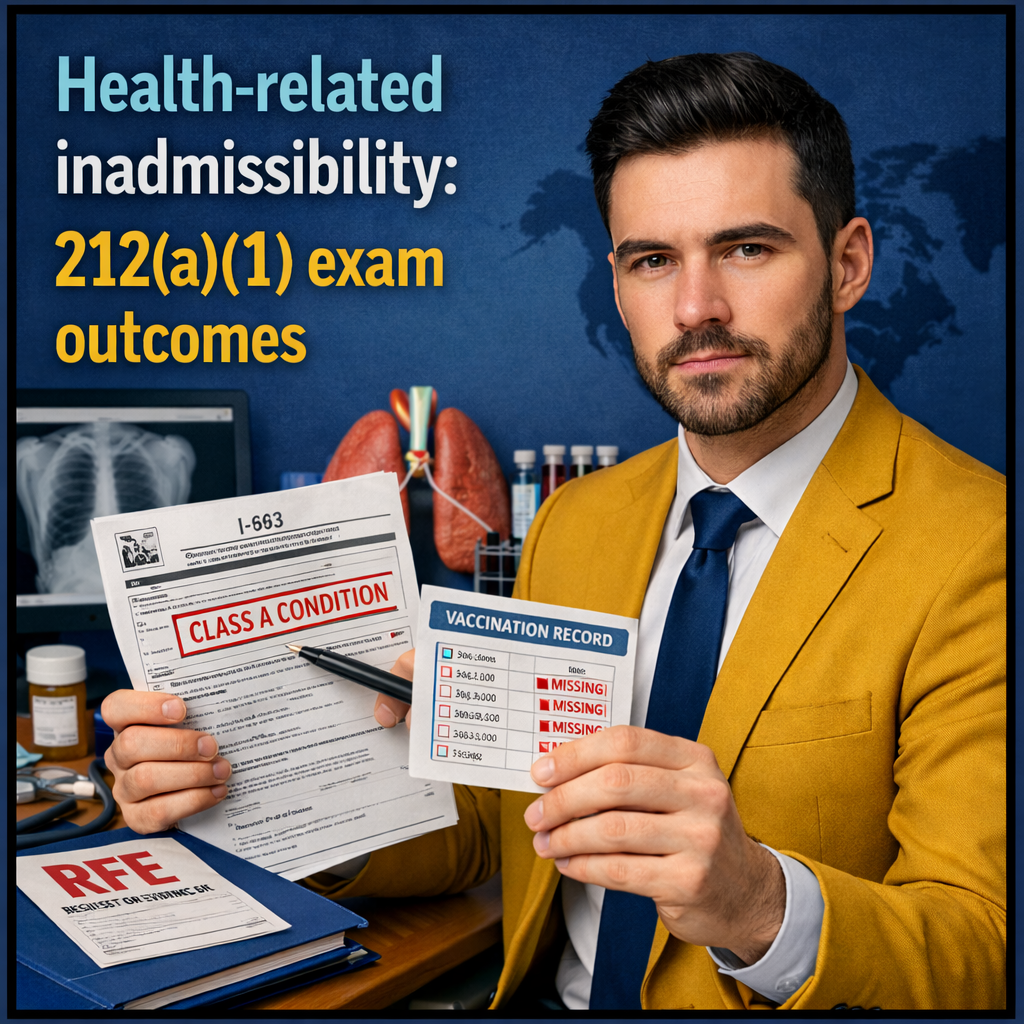
Health-related inadmissibility: 212(a)(1) exam outcomes
Health-related inadmissibility under INA 212(a)(1) often surprises applicants because it is not only about “having an illness.” It can turn on how a medical condition is classified in the immigration exam, whether required vaccines are documented, and how records are presented to the examining physician.
Delays and denials frequently stem from missing vaccination proof, unclear treatment history, or a misunderstanding of what triggers a Class A finding. Knowing how the medical exam is structured and what can be addressed through documentation or waivers helps prevent avoidable stalls in a case.
- Medical exam outcomes can create a direct inadmissibility finding.
- Missing vaccine records commonly triggers requests for evidence and delays.
- Mental health history may raise questions when linked to harmful behavior.
- Waiver eligibility depends on the exact category and facts.
Quick guide to health-related grounds of inadmissibility (212(a)(1))
- What it is: Immigration rules that can bar admission or adjustment based on specific medical findings and documentation.
- When it arises: Most often during the required medical exam for immigrant visas or adjustment of status.
- Main legal area: U.S. immigration law, medical screening rules, and agency technical instructions.
- What gets overlooked: Vaccine documentation, treatment records, and how conditions are classified in the exam.
- Basic path: Organize medical evidence, complete the exam properly, respond to requests, and evaluate waiver options when applicable.
Understanding health-related grounds of inadmissibility in practice
INA 212(a)(1) groups health-based inadmissibility into defined categories. The analysis is usually driven by the official immigration medical examination, not by a general doctor’s note, and the outcome depends on how the examining physician documents findings and requirements.
In practice, the most common problems involve documentation gaps rather than a newly discovered medical issue. The goal is to ensure the exam file clearly shows what the rules require and how the applicant satisfies (or can address) those requirements.
- Communicable diseases of public health significance as defined by current public health guidance.
- Vaccination compliance for the required immunizations or properly documented exceptions.
- Physical or mental disorders associated with harmful behavior or a history likely to recur.
- Drug abuse or addiction as assessed under the medical exam standards.
- Classification outcomes that determine whether a finding is disqualifying or simply noted.
- Most delays come from incomplete vaccine history or unclear lab documentation.
- Exam classification (Class A vs. Class B) can change the legal impact.
- “Condition present” is not the same as “inadmissible” under 212(a)(1).
- Consistency across forms, records, and disclosures reduces follow-up requests.
- Waiver analysis requires matching the facts to the exact subcategory.
Legal and practical aspects of health inadmissibility
The medical exam is performed by a designated physician (panel physician abroad or civil surgeon in the United States) using standardized instructions. The examining physician documents the findings and the vaccine assessment, and the agency relies heavily on that official record.
For vaccination issues, the key question is whether the required vaccines are documented as received, medically contraindicated, not age appropriate, or otherwise properly recorded as an allowable exception. For mental health and substance-related findings, the focus is on defined medical criteria and any link to harmful conduct, including timing, severity, and recurrence.
- Required exam record: Complete forms and supporting documentation in the format the agency accepts.
- Record clarity: Dates, diagnoses, treatment completion, and objective lab results when relevant.
- Consistency: Disclosures in immigration filings should not contradict medical documentation.
- Follow-up readiness: Ability to provide supplemental evidence promptly if requested.
Important differences and possible paths in health inadmissibility cases
Not all health-related findings have the same legal effect. Some outcomes trigger inadmissibility directly (for example, certain communicable disease classifications or drug abuse findings), while others may be recorded without creating a bar, depending on classification and documentation.
- Documentation-driven issues: Often resolved by clarifying vaccine history, updating records, or redoing parts of the exam properly.
- Exam classification disputes: May require additional medical evaluation and careful coordination with the designated physician.
- Waiver-eligible situations: Certain grounds may allow a waiver, but eligibility depends on category, family relationships, and evidence.
Common paths include addressing missing records through an updated exam submission, responding to agency requests with targeted evidence, or pursuing a waiver where permitted. Each path requires attention to deadlines and to ensuring the official medical record aligns with the supporting documentation.
Practical application of health inadmissibility in real cases
These issues frequently appear in adjustment of status filings when a medical exam is incomplete, vaccines are missing, or prior medical history raises questions about classification. They also arise in consular processing when the panel physician documents a finding that the applicant did not anticipate.
Applicants commonly affected include those without childhood immunization records, individuals with prior diagnoses requiring clarification, and people with past treatment histories that need documentation. Useful evidence may include vaccination records, lab results, discharge summaries, treatment completion letters, and certified translations when applicable.
- Collect core records: Immunization history, prior diagnoses, treatment timelines, and any relevant lab reports.
- Prepare the exam file: Organize documents by category and ensure dates and identities match across records.
- Complete the designated exam: Attend the official exam and provide records in a clear, legible format.
- Monitor follow-up: Track requests for additional evidence and respond with focused, specific documents.
- Evaluate next steps: If a disqualifying finding is issued, consider whether re-documentation or waiver options apply.
Technical details and relevant updates
Health-related inadmissibility standards are closely tied to public health guidance and technical instructions used by designated physicians. This means requirements can shift over time, especially around what is considered a communicable disease of public health significance and how vaccination compliance is evaluated.
Further reading:
Another recurring technical point is the difference between a general medical letter and the official immigration medical record. Agencies typically require the standardized exam documentation, and supplemental letters are most effective when they directly address a classification question or document treatment completion in a way that the examining physician can incorporate.
- Keep vaccine evidence current: Outdated or incomplete records often trigger repeated follow-up.
- Use objective documentation: Lab results and treatment records can be more persuasive than summaries.
- Align disclosures: Inconsistencies across forms and records often lead to additional scrutiny.
- Plan for timing: Scheduling exams and follow-ups can affect filing and interview timelines.
Practical examples of health inadmissibility issues
Example 1 (more detailed): An applicant files adjustment of status with an incomplete vaccination record. The civil surgeon notes several vaccines as “not documented,” and the case receives a request for evidence. The applicant then gathers childhood immunization records from abroad, obtains certified translations, and completes any missing vaccines that are medically appropriate. A corrected exam record is issued and submitted, allowing the case to move forward without a disqualifying finding.
Example 2 (shorter): A consular applicant reports a past mental health diagnosis. The panel physician asks for treatment history and whether any harmful incidents occurred. The applicant provides treatment notes and a clinician letter addressing stability and history, and the physician documents the information clearly so the record reflects the correct classification and reduces follow-up questions.
Common mistakes in health inadmissibility cases
- Arriving at the exam without vaccination records or relying only on informal recollections.
- Submitting general doctor letters that do not address the official exam criteria.
- Leaving inconsistencies between immigration forms and medical history documentation.
- Ignoring follow-up instructions from the designated physician or the agency.
- Assuming every medical condition creates inadmissibility without checking the exact category.
- Missing deadlines for responding to evidence requests or exam validity requirements.
FAQ about health inadmissibility (212(a)(1))
Does having a medical condition automatically make someone inadmissible?
No. The legal outcome depends on whether the condition falls within a defined 212(a)(1) category and how it is classified in the official immigration medical exam. Many conditions are noted without creating a bar, especially when documentation is complete and classification is appropriate.
Who most often faces delays related to 212(a)(1)?
Delays commonly affect applicants with incomplete immunization records, unclear prior treatment histories, or medical files that require translations and verification. Timing issues also arise when follow-up testing is needed or when exam scheduling conflicts with filing deadlines.
What documents usually help when the agency requests more information?
Helpful documents often include vaccination records, lab results, treatment completion documentation, and clear medical summaries that the designated physician can incorporate into the official record. Responses work best when they directly address what the request asks for and remain consistent with prior filings.
Legal basis and case law
The primary legal authority is INA 212(a)(1), which sets the health-related grounds of inadmissibility and organizes them by category, including certain communicable diseases, vaccination requirements, physical or mental disorders associated with harmful behavior, and drug abuse or addiction. In practice, the statutory categories are applied through the standardized immigration medical exam process.
Implementation relies on agency procedures and public health technical instructions that guide designated physicians in testing, documentation, and classification. Courts generally defer to the statutory framework and the agency’s reliance on official medical exam records, and disputes often turn on whether the correct standards were applied and whether the record supports the classification used in the adjudication.
Final considerations
Health-related inadmissibility cases are often decided by documentation quality and exam classification rather than by the mere existence of a diagnosis. Clear records, consistent disclosures, and organized evidence can prevent common delays and reduce the chance of repeated follow-up requests.
When a disqualifying finding is possible, careful preparation matters: aligning medical documentation with the official exam requirements, tracking deadlines, and evaluating whether any waiver pathway exists under the correct category are practical steps that can shape the outcome.
This content is for informational purposes only and does not replace individualized analysis of the specific case by an attorney or qualified professional.